
Thermodynamic Properties — Understanding Extensive and Intensive Quantities
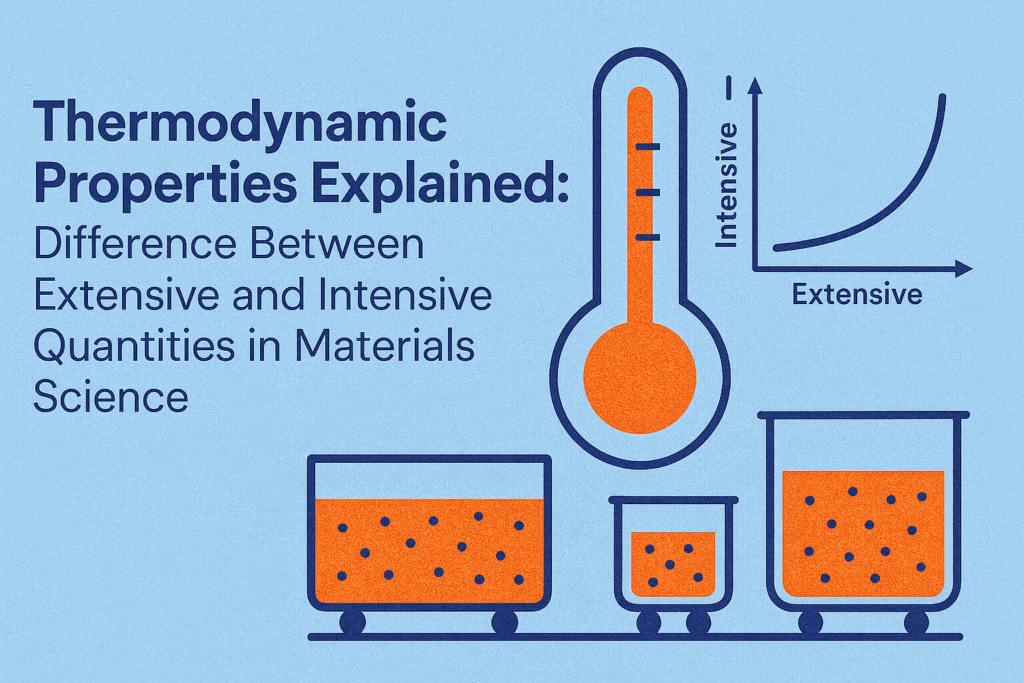
Thermodynamics is the branch of physical science that deals with the energy of the system. It governs how energy is stored, transformed, and transferred within any system — from atomic lattices in materials to large-scale industrial furnaces. It is not limited to equations or abstract concepts; rather, it is the language of energy and matter.
For students of materials science and engineering, thermodynamics is more than just a subject. It helps us understand why materials behave the way they do, why certain phases form, and why some reactions occur spontaneously while others require external energy. It allows us to predict how a material will respond when conditions such as temperature, pressure, or composition change.
In materials science, thermodynamics is the predictive tool. It allows us to anticipate material behavior even before conducting experiments.
For example:
- In metallurgy, thermodynamics tells us whether an alloy will form a single solid solution or separate into two phases.
- In nanotechnology, it predicts whether nanoparticles will remain stable or agglomerate.
- In energy materials such as electrode materials, fuel cell catalysts, photovoltaic etc., it helps us determine whether a reaction will efficiently generate energy or lose it as heat.
In all these cases, thermodynamic principles guide experimental design, simulation, and material processing decisions.
Table of Contents
Building the Foundation — System and Its Properties
Before examining the laws of thermodynamics, it is essential to understand how to describe a physical system. Each system—whether it is a gas sample, a metallic crystal, or a thin film—possesses measurable properties such as mass, volume, energy, temperature, and pressure. These properties, however, do not all respond uniformly to changes in the size or extent of the system.
Some properties change when the amount of matter changes, while others remain constant regardless of system size. This leads us to classify thermodynamic properties into two categories:
- Extensive properties — depend on the quantity of matter (e.g., volume, mass, energy).
- Intensive properties — independent of system size (e.g., temperature, pressure, density).
Recognizing whether a property is extensive or intensive is crucial for accurate thermodynamic analysis and modelling. Each term in thermodynamic equations—such as:
U = H – PV, or
dG = VdP – SdT
—must be applied with precision, as interchanging these concepts can lead to erroneous interpretations of material behavior.
For instance, the Gibbs free energy (G) is an extensive property, whereas the molar Gibbs free energy (Gm) is intensive. It is the intensive form that governs phase stability in materials. Likewise, in most experimental conditions, intensive variables such as temperature and pressure are controlled, while extensive variables like total energy are typically derived or measured indirectly.
Understanding Extensive and Intensive Properties
A thorough understanding of these two categories of properties enables accurate classification of thermodynamic quantities and enhances the precision with which physical phenomena are interpreted. Extensive properties, such as mass, volume, and total energy, depend directly on the size or amount of matter within a system. In contrast, intensive properties, including temperature, pressure, and density, remain independent of the system’s size. Recognizing and applying this distinction correctly ensures that thermodynamic equations and models remain consistent, providing a reliable framework for analyzing both macroscopic and microscopic systems.
1. What Is a Property in Thermodynamics?
A property in thermodynamics refers to any measurable quantity that characterizes the condition or state of a system. Common examples include temperature, pressure, and volume. These quantities offer a snapshot of the system’s state at a given moment. However, when the amount of matter in the system changes, some properties vary proportionally, while others remain constant. This distinction leads to the classification of properties as either extensive or intensive.
2. Extensive Properties — The “How Much” Type
An extensive property depends on the size or quantity of matter in the system. When the system is doubled in size, the value of the property also doubles.
For example, if two 1-liter samples of water are combined, the total volume becomes 2 liters. Volume, therefore, is an extensive property because it depends on the amount of matter present.
Examples:
Mass, Volume, Internal Energy, Enthalpy, Entropy, Gibbs Free Energy.
Rule of Thumb:
If doubling the system doubles the value of the property, it is extensive.
3. Intensive Properties — The “What Kind” Type
An intensive property does not depend on the size or quantity of the system. Instead, it describes the inherent characteristics or conditions of the material itself.
For instance, two identical metal blocks each at 25 °C, when combined, will still have a temperature of 25 °C — not 50 °C. Thus, temperature, pressure, and density are intensive properties because they represent the state of the material, not the amount.
Examples:
Temperature, Pressure, Density, Specific Heat, Molar Volume, Molar Gibbs Free Energy.
4. Simple Analogy — Think Like a Cook
Imagine preparing rice: the quantity of rice you cook is an extensive property—it depends on how much you decide to make. However, the taste or flavor of the rice remains the same, provided you cook it under identical conditions. The flavor, therefore, represents an intensive property.
Key Takeaways
Extensive properties vary with the size or amount of the system — for example, mass, volume, and energy.
Intensive properties describe the condition or nature of the system, such as temperature, pressure, and density.
Specific and molar properties are forms of intensive properties, as they are defined per unit mass or per mole.
The product of an intensive and an extensive property results in an extensive property (for instance, P×V=Energy).
In materials science, intensive variables such as temperature, pressure, and composition play a central role in determining phase behavior, diffusion processes, and thermodynamic stability.
Thermodynamics — FAQ (Exam-focused)
What is thermodynamics in the context of materials science?
Why is thermodynamics important for materials engineers and researchers?
What are the three main types of thermodynamic systems?
What’s the difference between extensive and intensive properties?
How do you convert an extensive property into an intensive one?
Which variables are controlled during thermodynamic experiments?
Why are intensive properties crucial for phase equilibrium?
Which thermodynamic properties are additive?
What does Gibbs Free Energy represent in materials thermodynamics?
Why is specific heat capacity considered an intensive property?
Why are CALPHAD models based on molar Gibbs energy and not total Gibbs energy?
What happens to properties when identical systems are combined?
Which of the following are extensive properties: Volume, Enthalpy, Temperature, Entropy?
How does nanoscale size affect thermodynamic properties?
Why is heat (q) not a thermodynamic property?
What’s the difference between specific and molar properties?
Why must we classify properties before applying thermodynamic equations?
What kind of thermodynamics questions are frequently asked in GATE & NET?

Dr. Rolly Verma
Explore More from Advance Materials Lab
Continue expanding your understanding of material behavior through our specialized resources on ferroelectrics and phase transitions. Each guide is designed for research scholars and advanced learners seeking clarity, precision, and depth in the field of materials science and nanotechnology.
🔗 Recommended Reads and Resources:
Ferroelectrics Tutorials and Research Guides — Comprehensive tutorials covering polarization, hysteresis, and ferroelectric device characterization.
Workshops on Ferroelectrics (2025–2027) — Upcoming training sessions and research-oriented workshops for hands-on learning.
Glossary — Ferroelectrics and Phase Transitions — Concise explanations of key terminologies to support your study and research work.
If you notice any inaccuracies or have constructive suggestions to improve the content, I warmly welcome your feedback. It helps maintain the quality and clarity of this educational resource. You can reach me at: advancematerialslab27@gmail.com