
Taming Light at the Atomic Scale: The Rise of Dirac Plasmon Polaritons in 2D Metamaterials
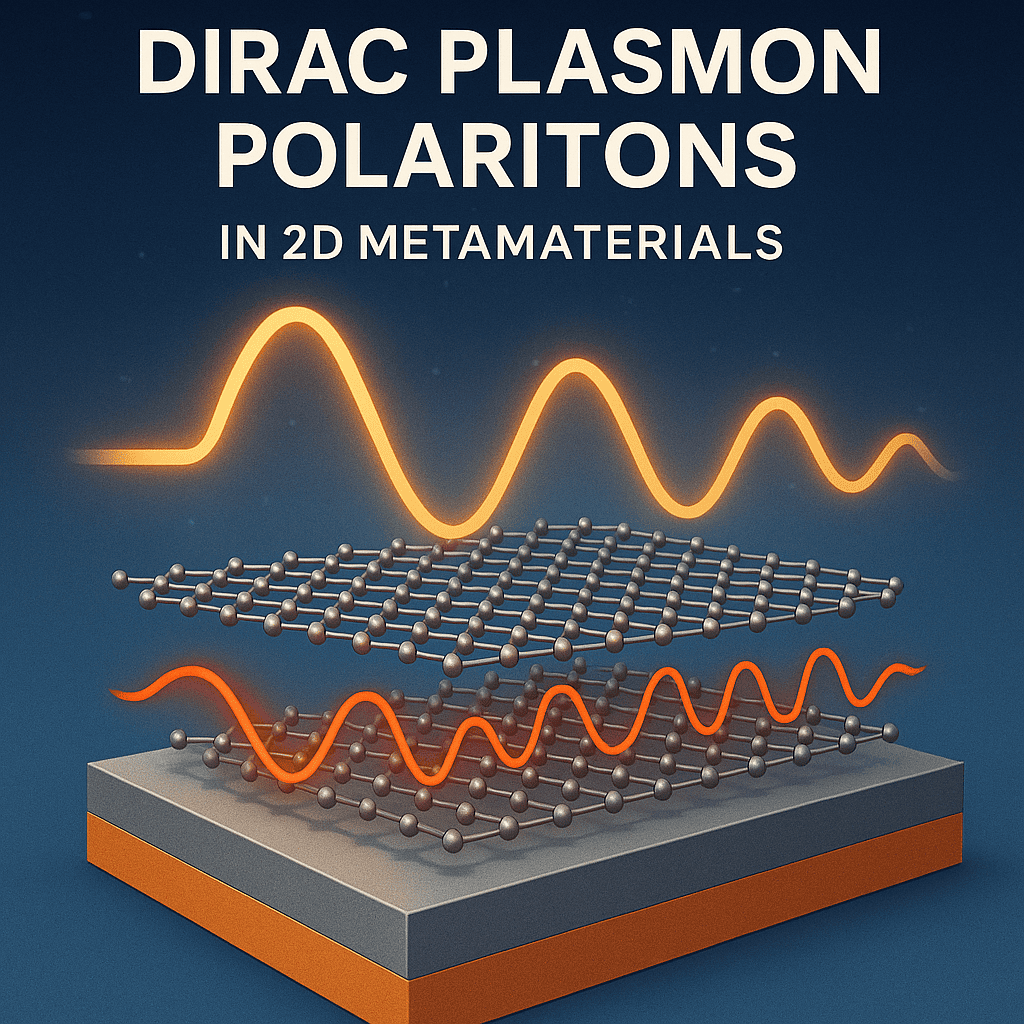
In the ever-evolving world of nanotechnology and advanced materials, one of the hottest breakthroughs this year comes from the field of nanophotonics. Scientists have recently discovered a way to precisely control Dirac plasmon polaritons (DPPs) in two-dimensional metamaterials — a milestone that could revolutionize the way we process information, build sensors, and even communicate in the future.
So, what does all of this actually mean? Imagine if scientists could control light the way we control water through pipes — bending it, guiding it, or even holding it still. Now, shrink that idea down to the world of atoms. At this tiny scale, light can interact with the sea of electrons on a material’s surface, forming something special called a plasmon polariton. Think of it like a “fusion” of light waves and electron ripples, working together as one.
When this happens in special materials such as graphene or topological insulators — called Dirac materials — the effect becomes even more unusual. In these materials, electrons act in strange ways, almost as if they are super-fast, weightless particles. This gives rise to optical and electronic behaviors that ordinary materials just don’t have.
The challenge has been that while we’ve known about these exotic light–electron couplings for years, controlling them precisely has been very difficult — especially in the terahertz frequency range (a part of the spectrum between microwaves and infrared light that’s really important for futuristic communications and imaging). Now, with new breakthroughs in nanotechnology and metamaterials, scientists are finally learning how to steer and tune these light–matter interactions at will.
A group of scientists has recently created special materials—called metamaterials—that can precisely control something known as Dirac plasmon polaritons (exotic waves that link light and electronic motion).
Why does this matter? Because it helps open up the terahertz spectrum, a frequency range of light that sits between microwaves and infrared. For decades, this “missing gap” has been very hard to use, but if unlocked, it could power super-fast wireless communication, advanced medical imaging, and next-gen airport security scanners.
This breakthrough is especially exciting because traditional electronics are reaching their limits. Silicon chips can’t shrink forever without running into overheating and performance problems. Light, however, can carry enormous amounts of data without those issues.
By using plasmon polaritons, researchers have found a way to trap and guide light at nanoscale dimensions, much smaller than its natural wavelength. This means we’re getting closer to photonic chips, where light and electrons work hand-in-hand—combining the speed of light with the logic of electronics.
The excitement doesn’t stop there. The broader field of nanotechnology is witnessing multiple breakthroughs that reinforce this trend. For example, researchers have developed ultra-thin, high-sensitivity membranes that could lead to compact night vision and thermal imaging systems. Others are using inkjet printing to mass-produce nanoparticles for wearable biosensors, while teams in India are combining quantum nanotechnology with AI to detect genetic mutations earlier than ever before. From AI-driven material discovery tools that accelerate innovation to DNA-origami nanostructures capable of drug delivery, the landscape of advanced materials has never been more vibrant.
Of course, challenges remain. Scaling up nanofabrication techniques, reducing material losses, and ensuring long-term stability are hurdles that scientists and engineers will need to overcome before these discoveries transition into everyday technologies. Yet the direction is clear: nanotechnology is rapidly moving from the laboratory into real-world applications that will shape the future of communication, medicine, and computing.
The journey of Dirac plasmon polaritons is more than a scientific breakthrough — it’s a reminder of how far human ingenuity can go in mastering nature. For centuries, electricity has powered our progress. Now, we are on the brink of an era where light itself could become the engine of discovery and innovation. As researchers continue to push these boundaries, the technologies of tomorrow — from lightning-fast communication to revolutionary medical tools — may no longer be powered by electrons alone, but by the very photons that make up light.
The journey of Dirac plasmon polaritons (DPPs) is more than just a story about exotic particles — it is about humanity’s growing mastery of light itself at the smallest scales. For centuries, electricity has powered our progress, but now we stand on the brink of a new era where light could become the primary engine of discovery and innovation.
By harnessing these quantum waves of light and electrons, researchers are beginning to unlock the long-missing terahertz spectrum, often referred to as the “THz gap” in technology. This breakthrough opens the door to ultra-fast wireless communications, highly sensitive medical imaging, and next-generation security scanners. More importantly, it comes at a time when traditional silicon electronics are approaching their physical limits.
Unlike electrons, photons can carry vast amounts of information without overheating or facing miniaturization barriers. By confining and controlling light through DPPs at dimensions smaller than its wavelength, scientists are bringing us closer to a future of integrated photonic chips, where light and electrons work together seamlessly.
In this sense, Dirac plasmon polaritons are not just a scientific curiosity — they represent a shift in the foundations of technology itself. The innovations of tomorrow may no longer be driven only by electrons, but by the very photons that make up light.
References
- Viti, L., et al. Tracing terahertz plasmon polaritons with a tunable-by-design dispersion in topological insulator metaelements. Light: Science & Applications (2025). Nature Link
- Chen, S., et al. Real-space nanoimaging of terahertz polaritons in topological insulators. Nature Communications 13, 1162 (2022). Nature Link
- Li, Y., et al. Two-dimensional Dirac plasmon-polaritons in graphene, 3D topological insulator and hybrid systems. Frontiers in Physics (2022). PMC Link
- Tan, Y., et al. Terahertz metamaterials for spectrum modulation. Optics & Laser Technology, 179, 110050 (2024). ScienceDirect Link
- Zhang, Y., et al. Terahertz surface plasmonic waves: a review. Advanced Photonics, 2(1), 014001 (2020). SPIE Link
If you enjoyed this article, explore more science and technology insights at AdvanceMaterialsLab.com and continue your journey of discovery.

Dr. Rolly Verma
Explore More from Advance Materials Lab
Deepen your insight into material behavior with expert resources on advanced materials crafted to support research scholars and advanced learners. Each guide is designed for research scholars and advanced learners seeking clarity, precision, and depth in the field of materials science and nanotechnology.
🔗 Recommended Reads and Resources:
Ferroelectrics Tutorials and Research Guides — Comprehensive tutorials covering polarization, hysteresis, and ferroelectric device characterization.
Workshops on Ferroelectrics (2025–2027) — Upcoming training sessions and research-oriented workshops for hands-on learning.
Glossary — Ferroelectrics and Phase Transitions — Concise explanations of key terminologies to support your study and research work.
- Blogs — Insightful articles across science, technology, education, and academic career development.
4 thoughts on “Taming Light at the Atomic Scale: The Rise of Dirac Plasmon Polaritons in 2D Metamaterials”
Absolutely fascinating read!
This level of clarity i read first time in such a complex topic.
technically rich and extremely engaging
top-tier explanation.