Research Paper Writing Series — Module 5
Ethics, Plagiarism, and Scientific Integrity in Research Publishing
A Problem-Solving Guide for Students and Early-Career Researchers.
Citation Practices, Data Transparency, and Avoiding Predatory Journals
Author & Academic Lead
Dr. Rolly Verma, PhD (Applied Physics, BIT Mesra)
Founder, AdvanceMaterialsLab.com
Materials Characterization & Research Methodology
Why Ethics Is the Foundation of Scientific Research
When you publish a research paper, the scientific community cannot come to your laboratory and repeat every step of your experiment immediately. They simply trust you. They trust that the measurements you report are real, that the data has not been altered, and that the conclusions come from honest scientific observation.
Science works because of this trust. One researcher builds on the results of another researcher. A group in Germany may use data published by a group in India. A laboratory in Japan may design a new experiment based on your results. If the original work is unreliable, the entire chain of scientific progress becomes weak.
So the first thing I usually tell my students is this: your reputation as a scientist begins with your integrity, not with your publications.
Many students think that research ethics is just a formal rule written in university guidelines. It is actually much more practical than that. Imagine that you have spent two years synthesizing a material, collecting XRD data, measuring electrical properties, and finally preparing a manuscript. If the data has been manipulated, or if a figure has been copied from another paper without proper citation, the entire work can collapse during peer review. Journals may reject the manuscript, and in serious cases the institution may even investigate the researcher.
That is why ethics is not something separate from research. It is part of how research is done.
Another point that new researchers often underestimate is how strict scientific publishing has become today. Most journals now run plagiarism detection software on every manuscript before it even reaches the reviewers. Editors check image manipulation, duplicated figures, and suspicious data patterns. Many journals also require authors to provide raw data if reviewers ask for it. In other words, the scientific system now has many ways to verify whether research is honest and transparent.
From my experience supervising students, one simple habit can protect you from many ethical problems: document everything carefully in your lab notebook. Write down the experimental conditions, instrument settings, and unexpected observations exactly as they occur. Do not try to “clean up” the story later. Real science is never perfectly smooth, and reviewers know that.
Another practical trick I tell my students is this: if you ever feel tempted to adjust a graph or remove a data point because it does not fit the expected trend, pause and ask yourself one question — would I be comfortable explaining this decision to a reviewer or a thesis committee? If the answer is no, then it is probably not the right thing to do.
Ethics also appears in smaller everyday decisions. When you read a paper and use an idea from it, cite the original authors. When you reproduce a figure or adapt a method, acknowledge the source. These small practices show respect for the scientific community and also strengthen the credibility of your own work.
In this lecture we will discuss several practical aspects of research ethics that every PhD student should understand early in their career. We will look at how plagiarism occurs and how to avoid it, how proper citation practices help build a strong scientific argument, how transparent data reporting improves the reliability of research, and how to recognize predatory journals that try to take advantage of inexperienced researchers.
If you develop these habits early in your research journey, you will protect something that is far more valuable than a single publication — your scientific credibility. Once a researcher earns the trust of the scientific community, their work carries weight. And that trust is built not by impressive results alone, but by consistent honesty in how those results are produced and communicated.
Understanding Scientific Integrity
When new PhD students join the laboratory, many of them think that research is mainly about learning techniques—how to operate instruments, analyze data, or write papers. All of that is important, of course. But there is something even more fundamental that every researcher must develop from the beginning: scientific integrity.
Scientific integrity simply means being honest and responsible in every step of the research process. It influences how you design your experiments, how carefully you record your observations, how you interpret your results, and how you present your findings to the scientific community. In other words, integrity is not just a rule that applies when writing a paper—it is something that guides the entire research journey.
In practice, this means that whatever you observe in the laboratory should be reported honestly, even if the result does not support your initial hypothesis. In real research, experiments often behave in ways we do not expect. Sometimes the material does not show the property we hoped for. Sometimes a measurement contradicts our earlier results. These situations are normal in science. What matters is how honestly we report them.
One important habit I always encourage students to develop is respect for the data. Your measurements are not something to be adjusted until they look perfect. They are evidence of what actually happened in the experiment. If a dataset contains variability, noise, or an unexpected trend, your job as a researcher is to understand it—not to hide it.
Scientific integrity also includes giving proper credit to others. No research project exists in isolation. Every experiment we perform builds on earlier studies conducted by other scientists. When we cite previous work, acknowledge collaborators, or mention funding support, we are recognizing that research is a collective effort.
Another point students sometimes overlook is that a research paper represents more than just experimental results. It represents the scientific responsibility of the author. Once your work is published, other researchers may rely on it. Someone might design a new material based on your reported properties. Another group might use your data to test a theoretical model. If the information is inaccurate or misleading, it can affect many other studies.
For this reason, maintaining integrity means staying committed to the truth, even when the results are not what we hoped for. In fact, some of the most interesting discoveries in science have come from results that initially looked confusing or inconsistent.
From experience, I often tell my students something very simple: science does not require perfect results, but it always requires honest results. If your work is transparent and truthful, even unexpected outcomes can become valuable contributions to knowledge.
What Is Plagiarism in Scientific Research?
When new PhD students begin writing their first research papers or thesis chapters, one topic that always comes up is plagiarism. Many students initially think plagiarism simply means copying a paragraph from another article. In reality, the issue is broader and sometimes more subtle than that.
Plagiarism occurs when a researcher uses someone else’s ideas, words, figures, data, or interpretations and presents them as their own without proper acknowledgment. In scientific research, ideas are extremely valuable intellectual contributions. If an idea originally came from another researcher, the correct academic practice is to cite the source clearly.
In practice, plagiarism does not only appear as direct copying of sentences. It can occur in several ways that students may not recognize at first. For example, reproducing a figure from another paper without permission, paraphrasing an author’s explanation but not citing the original study, or assembling sentences from multiple papers while writing a literature review can all fall under plagiarism. Even if the wording is slightly changed, the scientific idea still belongs to the original author and must be acknowledged.
Because plagiarism is taken very seriously in academic publishing today, most journals and universities now use plagiarism detection software such as Turnitin, iThenticate, or similar similarity-checking tools. These systems compare submitted text with millions of published papers, theses, conference articles, and online documents. Editors and thesis examiners often review the similarity report before they begin evaluating the scientific content.
Naturally, students often ask a practical question at this stage: how much similarity is acceptable? The answer depends on the type of document being evaluated.
For most reputable research journals, editors generally expect the overall similarity index to remain below about 10–15%, and ideally much lower. Within that percentage, the overlapping text should come mainly from unavoidable sources such as references, commonly used technical terms, or standard descriptions of experimental procedures. If large portions of text match previously published articles, editors may reject the manuscript before sending it for peer review.
For PhD theses, universities usually allow a slightly higher similarity percentage because theses contain long literature review sections where many concepts must be discussed using standard terminology. In many institutions, an overall similarity of around 15–25% may be acceptable, provided that no single source contributes a large portion of the text. Each university has its own policy, but the general expectation is that the thesis should clearly demonstrate the student’s independent understanding and analysis.
At the same time, it is important for students to understand that a small amount of textual similarity is practically unavoidable in scientific writing. Scientific language often relies on standard phrases, terminology, and well-established descriptions of techniques. For example, when describing X-ray diffraction measurements, thin film deposition processes, or electrical characterization methods, many researchers naturally use similar expressions because the vocabulary of scientific English is limited and highly standardized. For this reason, even carefully written manuscripts may show a small similarity index of around 5–8%, which is usually considered normal and unavoidable.
What matters most is not the numerical percentage alone, but how the overlapping text appears. If the similarity arises from references, technical phrases, or properly cited concepts, it is generally acceptable. However, if entire sentences or paragraphs match another paper without citation, that becomes a serious ethical issue.
From my experience supervising many students, I often suggest a simple habit that helps prevent plagiarism. When you read an article, try not to write notes by copying the author’s sentences. Instead, read the section carefully, close the paper, and then explain the idea in your own words. This forces you to understand the concept rather than memorize the wording.
Another practical trick is to add citations immediately while writing, rather than trying to insert them later. Many cases of plagiarism occur simply because students forget the original source of an idea they encountered earlier.
It is also important to remember that plagiarism is not always intentional. Sometimes students unconsciously reproduce phrases they have seen repeatedly in the literature. However, even unintentional plagiarism can damage a researcher’s academic credibility. Journals, universities, and funding agencies treat this issue very seriously because the reliability of scientific knowledge depends on intellectual honesty.
In the long run, developing good citation habits protects you as a researcher. When your writing clearly acknowledges earlier work and presents your own ideas transparently, reviewers and readers can trust the originality and integrity of your research.
Responsible Citation Practices
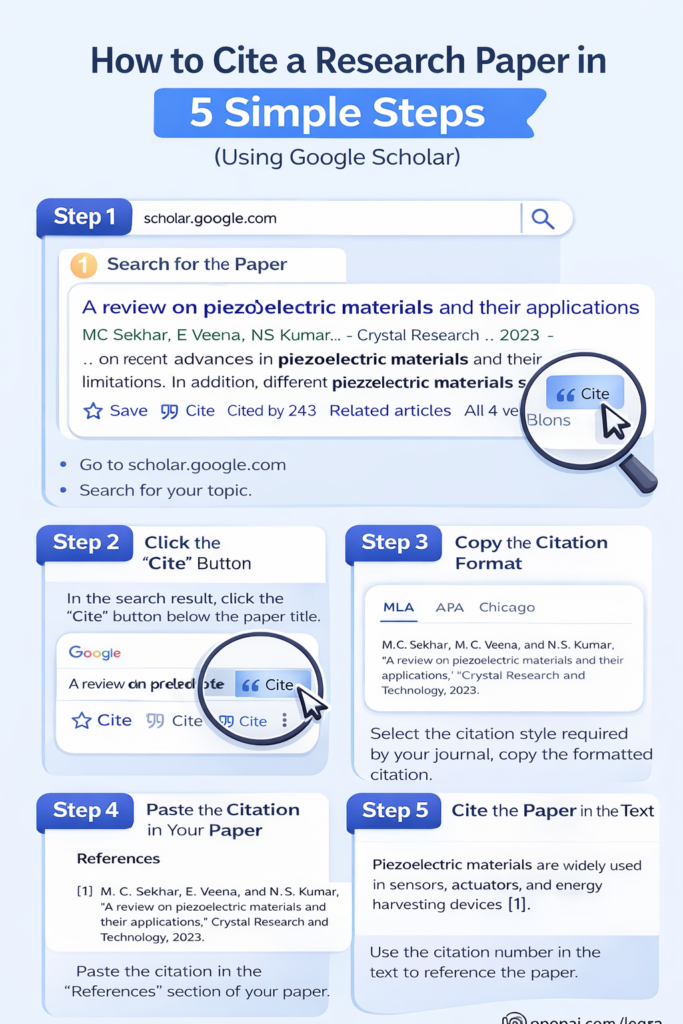
When students begin writing their first research paper, one of the questions they often ask is about citations. Many of them think citations are just something we add because journals require them. In reality, citations play a much deeper role in scientific research.
Think of scientific research as a long conversation that has been going on for decades, sometimes even centuries. Every researcher contributes a small piece to that conversation. When you cite earlier studies, you are essentially telling the reader: this idea did not begin with me; it developed from the work of other scientists who studied this problem before.
In materials science, this becomes very clear. Suppose you are studying the dielectric properties of a ferroelectric thin film. Before your work, several researchers may have studied similar materials, used different deposition techniques, or reported different electrical behaviors. When you cite those studies, you help the reader understand how your work fits into the larger scientific picture.
A good research paper therefore does two things at the same time. First, it acknowledges earlier discoveries that helped shape the field. Second, it clearly explains what new insight or improvement your study brings. Citations act as the bridge between what was already known and what your work adds to that knowledge.
In practice, citations appear in several situations. You cite earlier studies when you describe well-known experimental techniques, when you compare your results with previously reported values, or when you discuss possible physical mechanisms behind an observed behavior. In each case, the citation helps the reader verify the scientific reasoning behind your argument.
However, responsible citation is not about filling the reference list with as many papers as possible. I often remind students that a long bibliography does not automatically make a paper stronger. Every reference should serve a clear purpose. It should either support a scientific statement, provide background information about a method, or help explain how your work differs from earlier studies.
Another useful habit is to always check the original source of an idea. Sometimes students cite a review article simply because it summarizes many papers. Reviews are helpful, but whenever possible it is better to cite the original research article where the discovery was first reported. This shows that you have carefully examined the literature rather than relying on second-hand information.
Now students often ask another important question: are citations really important for a researcher’s career, or are they just part of writing a paper?
In modern academic research, citations have become an important indicator of scientific impact. When other researchers cite your work, it means they found your results useful or relevant to their own research. Over time, these citations accumulate and show how influential a researcher’s contributions have been in their field.
For example, when a scientist has a large number of citations, it often indicates that their work has shaped research directions, inspired new studies, or provided important experimental data. Universities, research institutions, and funding agencies sometimes use citation metrics—such as total citation count or the h-index—as one of several indicators when evaluating a researcher for promotions, grants, or awards.
However, it is important to remember that citations should never become the sole goal of research. A strong scientific career is built on meaningful contributions, careful experimentation, and honest reporting. High citation numbers usually come naturally when a researcher consistently produces valuable and reliable work.
From experience, I often tell my students something very simple: focus on doing good science, and the citations will follow. When your work answers an important question, introduces a useful method, or provides reliable data that others can build upon, the scientific community will naturally recognize and cite it.
In the end, proper citation practices serve two purposes. They strengthen the credibility of your research by connecting it to established knowledge, and they show respect for the scientists whose work helped make your own research possible.
Data Transparency and Reproducibility
When students begin their research journey, one concept that I always emphasize early is reproducibility. In simple terms, reproducibility means that if another researcher performs the same experiment using the same procedure, they should be able to obtain results that are reasonably similar to yours.
This idea may sound simple, but it is actually one of the pillars on which scientific research stands. Science progresses because experiments can be repeated, verified, and built upon by other researchers around the world. If an experiment cannot be reproduced, the scientific community begins to question the reliability of the result.
For this reason, transparency in reporting experimental work becomes extremely important. When you write a research paper, especially in materials science, the Materials and Methods section is not just a formality. It is essentially the instruction manual for your experiment. Another researcher should be able to read that section and clearly understand how the material was prepared, how the measurements were performed, and under what conditions the experiment was carried out.
This means that important details should never be skipped. Information such as sample preparation methods, deposition conditions, annealing temperature, instrument settings, measurement frequency, environmental conditions, and calibration procedures should all be documented carefully. Many students underestimate the importance of these details, but experienced reviewers often examine the Methods section very closely.
Another important aspect of data transparency is honest presentation of experimental results. In real experiments, data rarely looks perfectly smooth. There is always some level of noise, variation, or unexpected behavior. Sometimes a data point may not follow the overall trend. When this happens, the correct scientific approach is not to hide that point but to understand why it appeared.
From my experience supervising students, I often remind them that data is evidence, not decoration. Graphs and figures are not meant to look perfect; they are meant to represent what actually happened during the experiment. Removing inconvenient data points simply to make a graph look cleaner can create serious scientific and ethical problems.
In recent years, the scientific community has placed increasing emphasis on transparency. Many journals now encourage authors to provide raw datasets, supplementary information, or detailed experimental protocols along with the published paper. This allows other researchers to examine the original data and evaluate whether the conclusions drawn from it are reasonable.
For students, the simplest way to maintain transparency is to develop the habit of keeping a careful laboratory notebook. Record the experimental conditions, observations, and unexpected results as they occur. Even small details that may seem unimportant at the time can later become crucial when interpreting the data or responding to reviewer questions.
Ultimately, transparent reporting and reproducible experiments strengthen the credibility of scientific work. When other researchers can clearly understand how your experiment was conducted and can reproduce similar results, your research becomes a reliable contribution to the scientific community.
To be continued…………………………………..
This article is part of the Research Paper Writing Series by AdvanceMaterialsLab.com, designed to support students and early-career researchers in developing ethical, clear, and publication-ready scientific manuscripts.
Continue learning at:
🌐 AdvanceMaterialsLab.com – Building a global classroom for materials science and nanotechnology researchers