
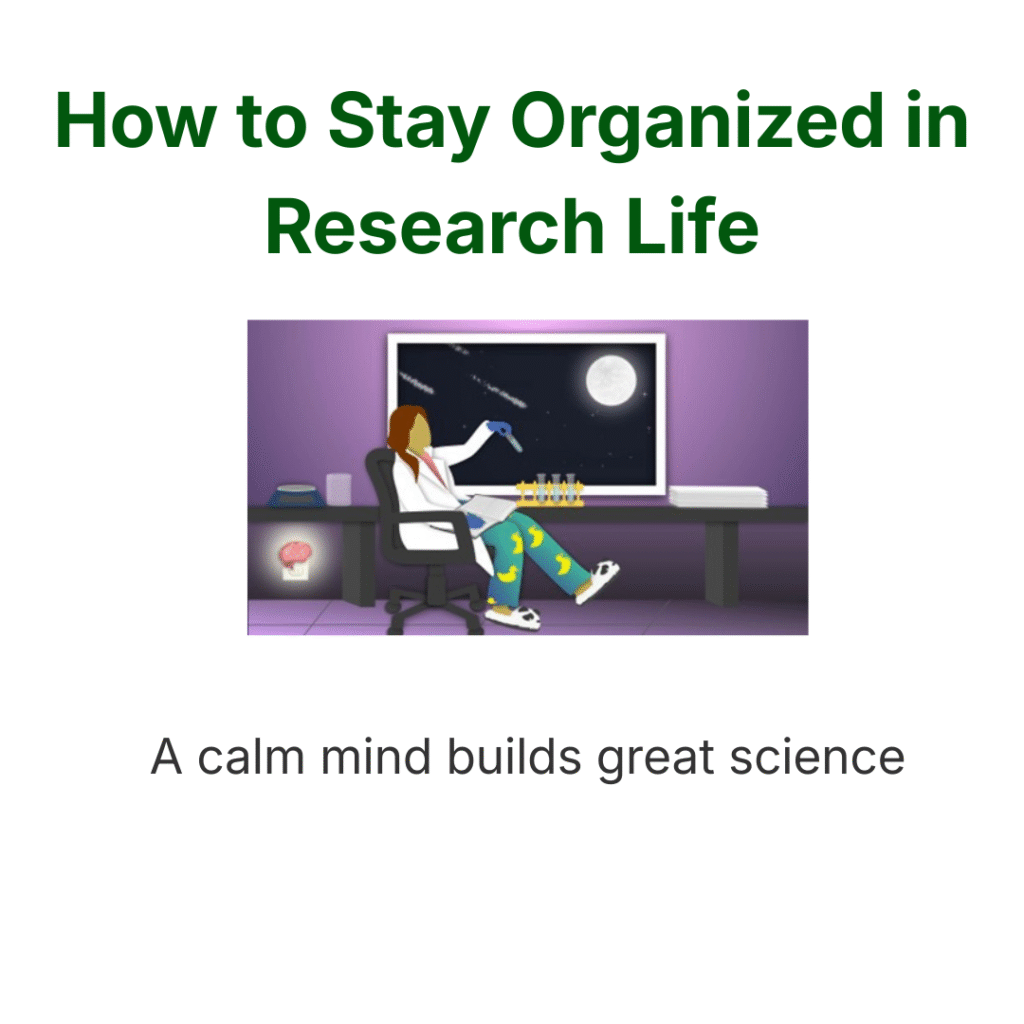
How to Stay Organized in Research Life

The clock strikes 11:47 p.m.
The lab is silent except for the hum of the centrifuge and the faint clicking of a tired keyboard. Your coffee’s gone cold. Your desktop looks like a battlefield of open tabs, half-finished graphs, and files named “final_data_last_try.csv.” You tell yourself you’ll organize it all tomorrow. But tomorrow comes with new readings, new data, new chaos. Welcome to research life — that beautiful, maddening world where curiosity fuels you, deadlines chase you, and organization often feels like a forgotten luxury. And yet, deep down, you know — the difference between struggling and succeeding in research isn’t just intelligence. It’s clarity. It’s structure. It’s learning how to stay organized when everything around you is designed to pull you apart.
The clock strikes 11:47 p.m. — the lab hums, your coffee’s cold, and your desktop looks like a battlefield of open tabs and half-finished graphs. If that scene is familiar, this guide is for you: practical, humane ways to bring calm and structure back to your research life.
The Moment, It Hits You
Every researcher reaches that breaking point once. Mine came during my Ph.D. — when I realized I had data scattered across three hard drives, a dozen pen drives, and countless sticky notes on the lab wall. When my supervisor asked for a graph, I’d made “just two months ago,” I froze. I had done it — but finding it was like finding one specific grain of sand on a beach. That evening, I sat down with nothing but a notepad and wrote one sentence:
“If I can’t find my own work, how can I ever build upon it?”
That was the moment I stopped treating organization as a chore — and started seeing it as the foundation of discovery.
Order Creates Space for Genius
There’s a strange misconception that creativity thrives in chaos. Maybe for artists. But in science, chaos kills clarity. When your files, data, and references are in order, your brain stops working like a hard drive and starts working like a thinking machine. I began every week with a map — not a strict schedule, but a simple direction.
- What’s my goal this week?
- What papers do I need to read?
- What experiments truly matter right now?
That small ritual changed everything. My mind became lighter. My days became purposeful. Organization, I learned, doesn’t make you rigid — it makes you ready.
The Digital Chaos We Don’t See
You might not see it, but digital clutter is the silent killer of focus. Hundreds of downloaded PDFs. Data files with cryptic names. Drafts titled “final_v4_new_revised_final.” It’s not laziness — it’s the side effect of trying to do too much, too fast. But here’s the truth: the more you ignore organization, the more time it steals from you.
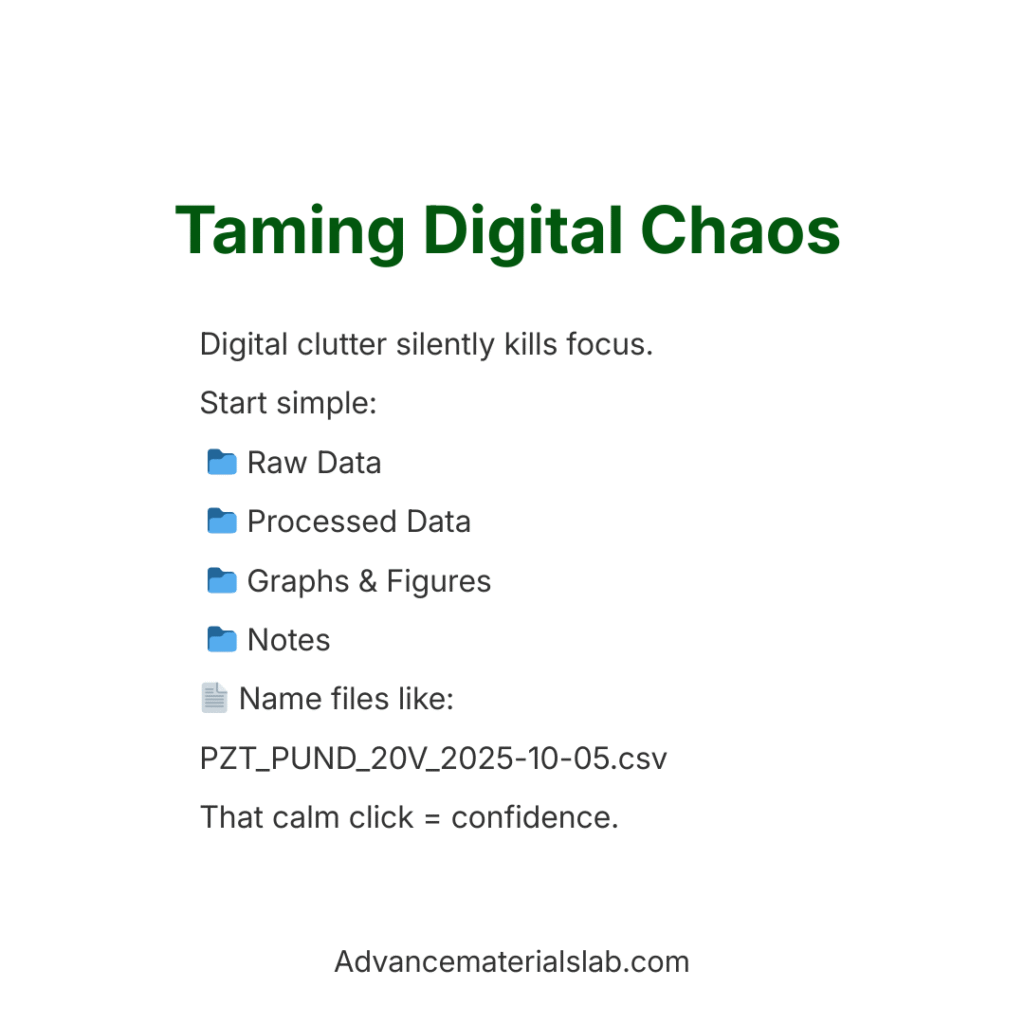
Start small. One evening, make a digital folder just for your research. Create subfolders — Raw Data, Processed Data, Graphs, Figures, Notes. Give your files names that tell a story:
PZT_Film_PUNDTest_20V_2025-10-05.csv
Now, when your supervisor says, “Can I see the original data for this?” you won’t panic — you’ll smile, open a folder, and click. That calm, confident click is the sound of freedom.
The Library That Thinks for You
Every researcher has faced the “I read it somewhere” nightmare. You remember a brilliant sentence from a paper, but you can’t recall which one. That’s where a reference manager becomes your best friend. Zotero, Mendeley, EndNote — whichever you choose, make it your digital library. Tag papers, add notes, sort them by topic. Over time, your collection will start thinking with you. You’ll start connecting dots between papers without realizing it. That’s when research becomes more than reading — it becomes conversation.
Time: The Researcher’s Most Expensive Material
We treat chemicals and samples like gold — but waste hours like dust. Time is your rarest resource. You can buy instruments, rewrite papers, even redo experiments. But you can never recover time. One day, I started blocking my hours — not every minute, but sections. Mornings for analysis. Afternoons for experiments. Evenings for writing or reading. Suddenly, my work stopped feeling endless. Boundaries brought balance. And the funny thing? I started finishing faster — and thinking deeper.
The Calm Desk Theory
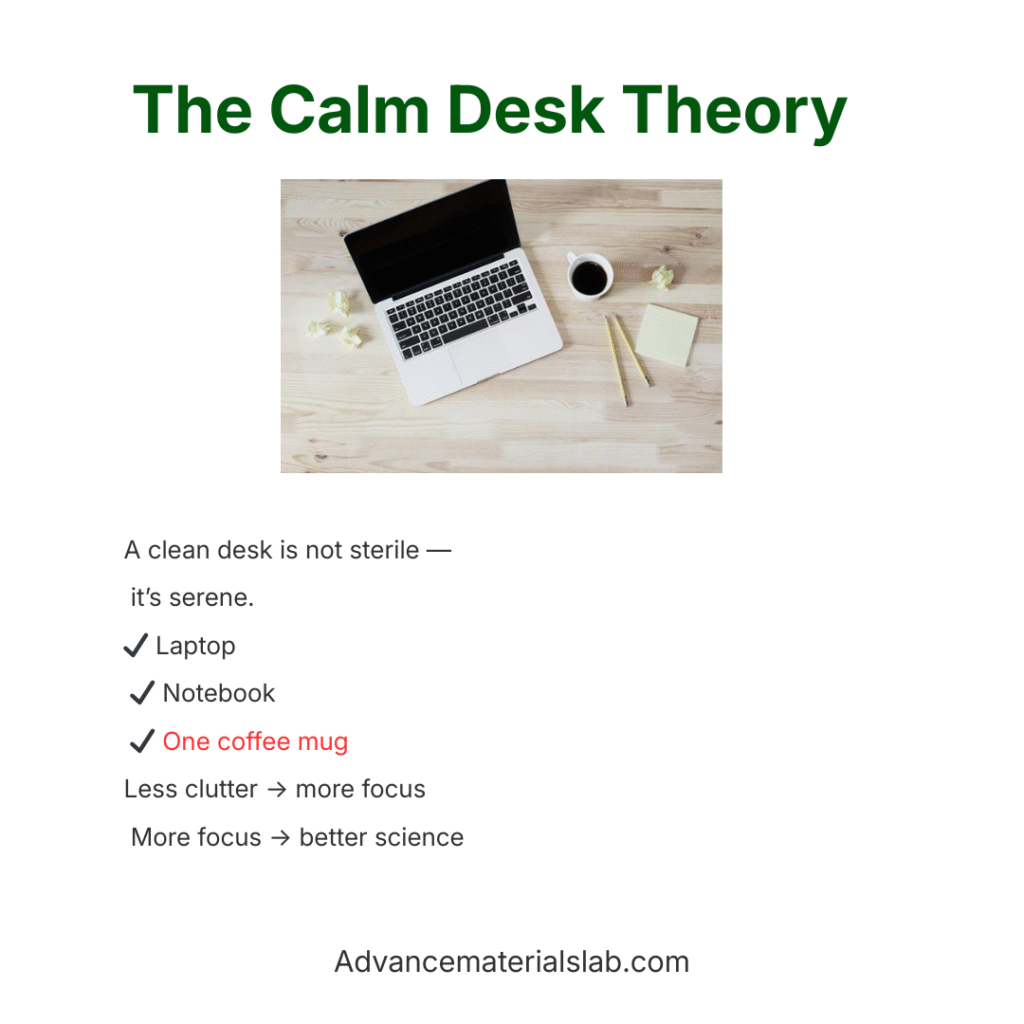
There’s something quietly powerful about a clean desk — not sterile, but serene. A few books, a laptop, your lab notebook, maybe that one comforting mug of coffee. No clutter, no noise. When your physical space is calm, your mental space follows. Try it once: clear your desk before starting a new paper. Watch how your thoughts begin to flow like water through glass. Science needs focus — not frenzy.
Reset. Refine. Repeat.
The truth is, no system stays perfect. Your experiments evolve, your writing grows, and your methods shift. That’s okay. Every month, take an hour to reset. Delete what’s outdated. Rename what’s confusing. Archive what’s done. Organization isn’t a one-time act; it’s a rhythm — a quiet, ongoing relationship with your work. Each cleanup is a small promise you make to your future self:
“When I return to this data, I’ll understand it instantly.”
And that future self will thank you.
Why Organization Isn’t About Perfection
It’s not about having color-coded folders or rigid planners. It’s about peace. It’s about walking into your lab, opening your laptop, and feeling a sense of quiet control — a knowing that you’ve got this. Because when your files, thoughts, and schedule are in harmony, your creativity can finally breathe. In that space of clarity, true research happens. That’s where ideas spark. That’s where discoveries are born.
A Closing Thought
Research will always be unpredictable — that’s what makes it beautiful. But your workflow doesn’t have to be. Stay curious, but stay clear. Stay passionate, but stay planned. Stay spontaneous, but stay structured. Because the most powerful discoveries don’t just come from brilliance — they come from a mind that’s organized enough to recognize them. And maybe, that’s the real art of research.
Frequently Asked Questions (FAQs)
Stay Organized in Research Life — Practical Answers for Students & Researchers
1. Why is organization important in research life?
Organization helps you manage time, reduce stress, and work more efficiently. A structured approach allows you to focus on key research activities like experiments, analysis, and writing instead of fighting confusion or clutter.
2. How can I start organizing my daily research routine?
Begin by planning each day with small, achievable tasks. Create a list of priorities:
- What needs to be done today?
- What is urgent?
- What can wait?
Even simple planning before starting your lab or writing session boosts productivity.
3. How do I manage digital clutter such as research papers, PDFs, and notes?
Use a dedicated folder system with clear categories, or reference managers such as:
- Mendeley / Zotero / EndNote for research papers
- Google Drive / OneDrive / Dropbox for cloud organization
Rename files with meaningful titles to find them quickly. Example:
Author_Year_Topic_Type.pdf
4. What is the most effective way to organize my research notes?
Choose one primary place — digital or physical — and stay consistent. Many researchers use:
- One master notebook
- A digital note app (Notion, OneNote, Obsidian)
- Lab records + summary notes
Organize notes weekly to maintain clarity.
5. How do I avoid feeling burned out by research workload?
Break big tasks into smaller steps and schedule focused work blocks (like 45–60 minutes each). Take short breaks to refresh mental clarity. Progress comes from steady effort, not extreme pressure.
6. What should I do when I feel stuck or lose motivation?
Take a step back, reorganize your thoughts, and revisit your goals. Sometimes a clean workspace, a walk, or discussion with peers helps reset mental energy. Creativity grows best in clarity.
7. How important is a clean research desk?
A clean desk reduces distractions and allows your mind to focus on creative and analytical thinking. Studies show productivity improves when visual clutter is removed.
8. How can I manage my time more efficiently during research?
Plan your day in time blocks:
- Mornings for writing or analyzing
- Afternoons for experiments or meetings
- Evenings for reading or planning
Time management ensures quality work with less exhaustion.
9. Should I aim for perfection in organizing my research workflow?
No — organization is not about perfection. It’s about clarity and progress. Even a simple and consistent system can create huge impact over time.
10. What is one habit that can immediately improve research productivity?
End each day with a 5-minute reflection:
- What did I achieve?
- What is the first task for tomorrow?
It sets a powerful starting point and reduces confusion the next morning.
Remember
Organization is not a talent — it’s a habit you build.
The more clarity you create, the more discovery becomes possible.
If you found this article helpful, explore more research-focused tutorials at AdvanceMaterialsLab.com

Dr. Rolly Verma
Disclosure: This is a reflective guide based on experience and practical tips. For project-specific workflows or data-management templates, check our resources section at AdvanceMaterialsLab.com.
Explore More from Advance Materials Lab
Expand your understanding of material behavior through our specialized resources on ferroelectrics and phase transitions. Each guide is designed for research scholars and advanced learners seeking clarity, precision, and depth in the field of materials science and nanotechnology.
🔗 Recommended Reads and Resources:
Ferroelectrics Tutorials and Research Guides — Comprehensive tutorials covering polarization, hysteresis, and ferroelectric device characterization.
Workshops on Ferroelectrics (2025–2027) — Upcoming training sessions and research-oriented workshops for hands-on learning.
Glossary — Ferroelectrics and Phase Transitions — Concise explanations of key terminologies to support your study and research work.