
If Capacitors Block DC, Why Are They Essential in DC Circuits?
A Complete Explanation with Practical Examples
- Dr. Rolly Verma
- February 21, 2026
- 10:34 am
Introduction: The Common Belief
One of the most common beliefs among students is that capacitors only work in AC circuits and are useless in DC-powered systems.
You’ve probably heard or even said it during viva exams: “Capacitors block DC and allow AC to pass.”
While this statement is technically correct under ideal conditions, it is not the whole truth.
If capacitors truly did not function in DC circuits, then how do our mobiles, laptops, and countless electronic gadgets — all powered by DC from batteries — rely so heavily on them?
Let’s clear up this misconception and uncover the real physics of how capacitors operate in DC circuits.
Quick Answer: Why Does a Capacitor Block DC Yet Remain Essential in DC Circuits?
Even though a capacitor blocks steady DC current after it becomes fully charged, it remains essential in DC-powered devices because real-world DC voltage is never perfectly constant. In practical circuits, small fluctuations, ripple, and sudden load changes constantly occur. Capacitors stabilize the supply voltage, filter ripple, suppress electrical noise, and act as local energy reservoirs during transient current demands.
A capacitor operates on the principle of charging and discharging, allowing current to flow only when the voltage across it changes with time. In an AC circuit, the voltage continuously varies, so the capacitor keeps charging and discharging, enabling current to flow. In contrast, when connected to a DC source, the capacitor initially charges until its voltage equals the supply voltage. Once fully charged, the voltage no longer changes, current becomes zero, and the capacitor behaves like an open circuit. That is why we say a capacitor blocks steady DC — yet it remains indispensable for maintaining stable and reliable DC operation in real electronic systems.
Governing Equation of Capacitor Current
I = C × (dV/dt)
This fundamental relation explains why current flows only when voltage changes with time.
Table of Contents
What Textbooks Say: The Simplified DC Behavior
In basic circuit theory, when a DC voltage source is connected to a capacitor through a resistor, the capacitor charges up until its voltage equals the supply voltage. Once fully charged, current ceases to flow.
This leads to the familiar interpretation:
“A capacitor allows AC to pass but blocks DC.”
This is accurate only under steady-state conditions, where the DC supply remains constant and unchanging. But in real electronic systems, voltage rarely stays perfectly steady.
What Really Happens When DC Is Applied
Let’s imagine a simple circuit where a DC battery is connected to a capacitor through a resistor.
At the instant of connection (t = 0), the capacitor initially behaves like a short circuit. Current flows rapidly as it begins to accumulate charge on its plates.
As time progresses, the voltage across the capacitor increases according to the relationship:

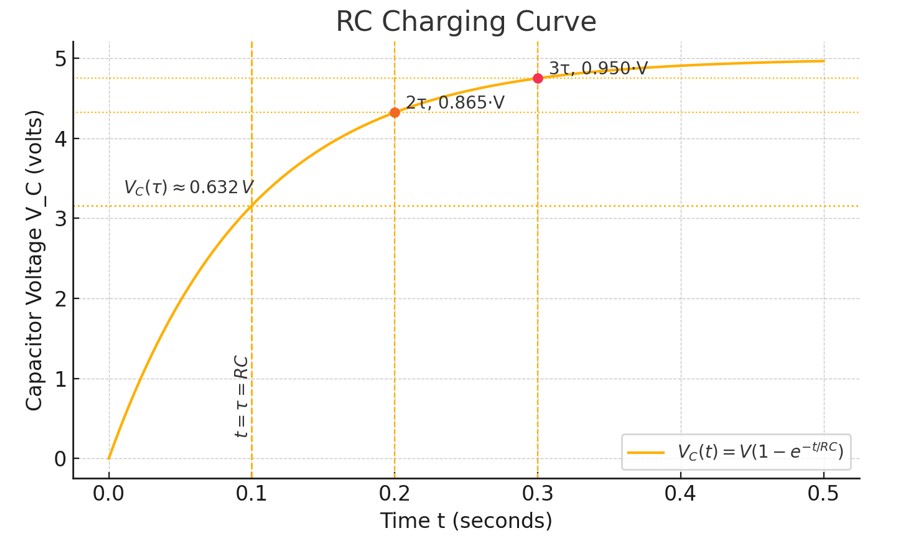
where
- R = resistance
- C = capacitance
- t = time after connection
During this process, the capacitor stores electrical energy given by:
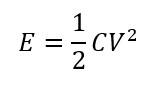
After a brief period (from milliseconds to a few seconds, depending on circuit values), the capacitor becomes fully charged. At this point, its voltage equals the battery voltage:
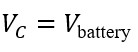
Once this happens, there is no potential difference left to drive current. The current therefore drops to zero, and the circuit behaves as an open circuit.
This is why we say a capacitor blocks DC current — not because it rejects DC, but because after being charged, it simply has no more current to allow.
If Capacitors Block DC, How Do Battery-Powered Devices Like Mobiles and Laptops Still Work?
It may seem logical to assume that capacitors have no role in DC systems since a battery provides constant voltage. However, in practical electronic systems, especially compact, high-speed devices such as smartphones and laptops powered entirely by DC, capacitors are indispensable for ensuring stable and noise-free operation. How?
This is because in real-world electronic circuits, the voltage from a battery is never perfectly constant. Every switching transistor, logic gate, and microprocessor inside a device performs millions (or billions) of operations per second, creating tiny, rapid fluctuations in current demand.
These fluctuations momentarily disturb the supply voltage, causing voltage dips and spikes, known as transients.
At this stage, capacitors act as buffers between the battery and the circuits — absorbing these fluctuations and delivering smooth, reliable power.
How the Capacitor Acts as a Power Buffer?
To counter these voltage transients, capacitors are connected in parallel with the power supply rails.
A capacitor in this configuration does not conduct DC continuously; instead, it responds dynamically to voltage variations, acting as a local energy reservoir.
In such a circuit, the current through the capacitor is governed by:
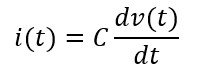
This means that current flows through the capacitor only when the voltage across it changes.
- When the load suddenly demands more current and the supply voltage begins to dip, the capacitor discharges momentarily, releasing stored energy to stabilize the voltage.
- When the load demand decreases and voltage tends to rise, the capacitor absorbs excess charge, recharging itself and preventing overshoot.
Let’s understand this behaviour taking the Water Tank Analogy
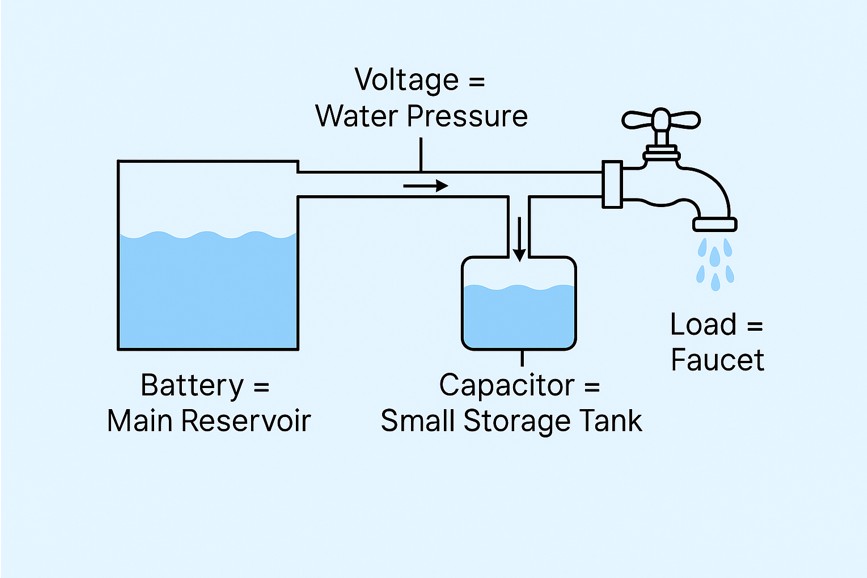
The diagram above illustrates the water tank analogy — a simple yet powerful way to understand how a capacitor stabilizes voltage in a DC circuit.
In this analogy, voltage is compared to water pressure, and electric current corresponds to the flow of water. The battery acts like a main reservoir, providing a steady flow of water through a pipe, which represents the conducting wires. The load, such as a smartphone circuit or an LED, is shown as a faucet that draws water (current) from the system.
When the faucet opens suddenly, pressure drops — just as voltage dips when current demand increases. The small tank immediately releases water, maintaining pressure.
When the faucet closes, the tank refills — like a capacitor recharging when voltage rises.
Thus, the capacitor continually stores and releases charge, keeping voltage stable even during rapid fluctuations. In electronic devices, this happens in microseconds, ensuring processors and circuits receive smooth, clean DC power.
In electronic devices, this process happens in microseconds — and it’s the reason capacitors are found near almost every IC, processor, or power rail inside battery-powered systems like laptops and smartphones.
The Physics of DC Stabilization
Every battery, no matter how good, has internal resistance and inductance.
When a circuit suddenly draws more current, the voltage across the battery terminals momentarily dips. Capacitors near the IC pins (often called decoupling capacitors) instantly discharge to fill the gap, keeping the voltage stable. Once the surge passes, they recharge from the battery. This rapid charge–discharge cycle happens millions of times per second, especially in modern high-speed digital circuits.
Why Students Get Confused?
The confusion arises because school-level DC circuit models are simplified.
In those cases:
- The voltage is constant,
- The capacitor charges once,
- Then current stops — so it “blocks DC.”
However, in real-world electronics, the DC voltage fluctuates continuously in microseconds. Therefore, the statement “capacitors don’t work in DC” is true only for ideal textbook circuits, not for dynamic real systems.
The Significance of capacitors in Battery-Powered Systems.
Even though mobile devices and laptops are powered by DC batteries, their internal circuits are far from static.
CPUs, GPUs, memory units, and sensors constantly switch states, drawing highly variable current pulses.
Without capacitors to stabilize the voltage, these transients would cause noise, instability, or malfunction.
Moreover, power management ICs (PMICs) use switching regulators to convert the battery’s voltage (around 3.7 V) into multiple regulated outputs (1.2 V, 1.8 V, 5 V, etc.). These switching converters generate ripple, which capacitors filter at both input and output stages.
Hence, capacitors are indispensable for filtering and stabilizing DC power in all modern electronic systems.
Major Roles of Capacitors in DC Circuits
Function | What It Does | Where You See It |
Filtering | Removes ripples or noise from DC voltage after rectification or switching. | Laptop and mobile power regulators. |
Decoupling / Bypassing | Provides local energy storage to ICs, preventing voltage drops during sudden current demands. | Every microprocessor, GPU, and IC pin. |
Energy Storage | Temporarily stores charge and releases it when load current spikes. | Flash circuits in cameras. |
Timing / Delay Circuits | Works with resistors to set time constants for control circuits. | Power sequencing in laptops and embedded systems. |
Coupling (Signal Paths) | Passes AC components (like audio) even in DC-driven circuits. | Audio amplifiers in mobile phones. |
Conceptual Summary
While a capacitor blocks steady DC current when connected in series, it becomes a vital component in DC-powered circuits when connected in parallel.
Its main function is to serve as a local energy reservoir, instantly responding to rapid changes in load current and voltage.
By supplying or absorbing charge as needed, it helps maintain stable voltage levels, reduce noise, and improve system reliability.
In essence, capacitors don’t oppose DC operation — they support and stabilize it. Their ability to store and release energy almost instantaneously makes them indispensable for achieving smooth, noise-free performance in all real-world DC-powered devices.
Frequently Asked Questions (FAQs)
1. Why do capacitors block DC but allow AC signals?
Capacitors block DC because once they are fully charged, the current through them becomes zero and they act like an open circuit. However, for AC signals, the voltage continuously changes direction, causing continuous charging and discharging, enabling the current to flow through the capacitor
2. What happens inside a capacitor when DC is first applied?
When DC is initially applied, the capacitor draws a current while it charges. This transient current decreases exponentially as the capacitor voltage approaches the supply voltage, until no more current flows and the capacitor behaves like an open circuit.
3. Why are capacitors used for filtering in DC power supplies?
Capacitors smooth the output of rectifiers by storing and releasing charge, reducing unwanted ripples and fluctuations. This produces a more stable DC voltage for electronic circuits, improving performance and protecting components.
4. What is the role of a capacitor in coupling and decoupling applications?
In coupling, capacitors pass AC signals from one stage to another while blocking DC offsets.
In decoupling, capacitors stabilize supply voltage by absorbing noise, spikes, or transient fluctuations, preventing interference in sensitive circuit sections.
5. How does capacitance value affect the filtering performance in DC circuits?
Higher capacitance values provide better smoothing because they can store more charge, reducing ripple amplitude. However, excessively large capacitance may cause high inrush current, physical size increase, and slower response during power-up.
6. Why is capacitor selection important in DC electronic circuits?
Different capacitors have different characteristics such as voltage rating, ESR (Equivalent Series Resistance), dielectric type, leakage current, and tolerance. Choosing the wrong capacitor may lead to overheating, noise problems, poor filtering, or failure of the circuit.
7. Can a capacitor be used to completely remove ripple in DC power supplies?
A capacitor can significantly reduce ripple, but cannot completely eliminate it. For very smooth DC, additional stages such as inductors, voltage regulators, or LC/RC filter networks are used along with smoothing capacitors.
Still have questions related to capacitors and DC circuitry? Ask in the comments, and we’ll help you explore the concepts with clarity and depth
References:
[1] Wikipedia, “Decoupling capacitor,” Wikipedia: The Free Encyclopedia, 2025. [Online].
[2] SparkFun Electronics, “Decoupling Capacitors,” SparkFun Learning Portal, 2025. [Online].
[3] TDK Corporation, “Capacitors Explained: Blocking DC and Passing AC,” TDK Tech Mag, 2024. [Online].
[4] Sierra Circuits, “What is the Use of a Decoupling Capacitor?” ProtoExpress Technical Blog, Mar. 2021. [Online].
[5] Globalwell PCBA, “Decoupling Capacitors: Functions, Types, and Best Practices,” Globalwell Technical Article, Feb. 2025. [Online].
[6] M. Abubakr, “Frequency Analysis of Decoupling Capacitors for Three Voltage Supplies in SoC,” arXiv e-Prints, 2007. [Online].
[7] R. Jacob Baker, CMOS: Circuit Design, Layout, and Simulation, 4th ed. Hoboken, NJ: Wiley-IEEE Press, 2019.

Dr. Rolly Verma
Explore More from Advance Materials Lab
If you found this guide on Thermodynamics in Materials Science helpful, you might also enjoy reading these related articles:
How to Stay Organized in Research Life — Practical tips to manage experiments, publications, and research deadlines efficiently.
Dirac Plasmon Polaritons in 2D Metamaterials — Discover how 2D quantum systems redefine light–matter interactions.
History of Piezoelectricity — A fascinating journey through the discovery and development of piezoelectric materials.
Ferroelectrics Tutorials & Research Guides — Deepen your understanding of polarization, domain dynamics, and hysteresis.
Radiant Precision Ferroelectric Tester — Learn how advanced instrumentation supports ferroelectric and dielectric measurements.
If you notice any inaccuracies or have constructive suggestions to improve the content, I welcome your feedback. It helps maintain the quality and clarity of these educational resources.