
Unlocking Non-Remnant Polarization: 5 Must-Know Points Every Student Should Know
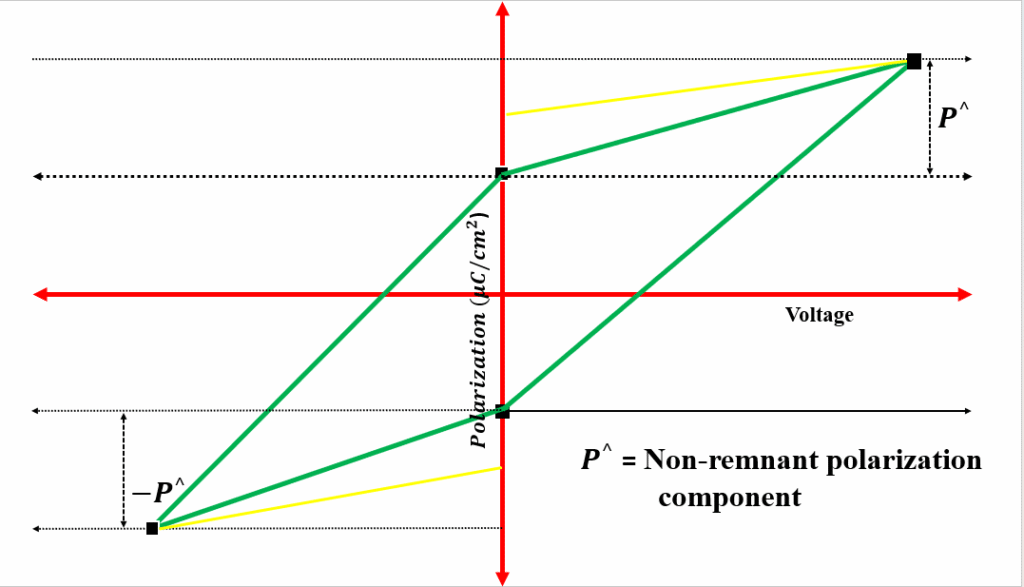
Ferroelectric materials are widely known for their remnant polarization—the spontaneous, reversible polarization retained even after the external electric field is removed. But not all polarization observed in these materials is remanent. A significant and often misunderstood component is the non-remnant polarization.
When the external electric field is removed from the ferroelectric materials, part of the induced dipole moment may vanish instantly, while another part—the remnant (or remanent) polarization—persists and can be switched by reversing the field. The vanishing component is called non‑remanent (sometimes “non‑switchable” or “non‑remnant”) polarization. Although it does not store non‑volatile information, it strongly influences how we interpret hysteresis loops, reliability tests, and functional responses such as piezoelectric and memory effects.
In this blog, we dive deep into the concept of non-remnant polarization—its origin, measurement, significance, and how it differs from remanent polarization in ferroelectrics.
Table of Contents
What is Non-Remnant Polarization?
Non-remnant polarization refers to the portion of the total polarization in a ferroelectric material that does not remain after the external electric field is removed. It is a field-dependent, reversible polarization response that disappears once the field goes to zero. In simpler terms, think of it like this: When an external field is applied to the material, it gets polarized to minimize its electrostatic energy by aligning induced dipoles in the direction of the field. Any other orientation would result in higher potential energy. Since this is a reversible and low-energy response (unlike the energy barrier-crossing in remnant switching), it quickly adjusts to follow the field. This instantaneous polarization is the non-remnant polarization. When the field is removed, this non-remnant polarization returns to its original state showing no hysteric effect. It is that part of the polarization that is not retained by the material but always aligned with the external applied field.
Why Non-Remnant Polarization is Always Aligned with the Applied Electric Field?
Non-remnant polarization is the part of a material’s polarization that appears only when an electric field is applied—and disappears when the field is turned off. It is reversible, temporary, and always points in the same direction as the applied electric field. This makes it very different from remnant polarization, which stays even after the field is removed.
Let’s break down why this alignment happens:
- Linear Dielectric Behaviour
In normal dielectric materials, the polarization increases linearly with the applied electric field, described by the equation P = εE, where ε is the permittivity and E is the electric field. Since they are directly proportional, the polarization always points in the same direction as the electric field. If the field reverses, the polarization also flips direction instantly.
- Reversible Domain Wall Motion in Ferroelectrics
In ferroelectrics, remanent polarization results from the flipping of internal electric dipole domains—an irreversible process that gives the material a memory effect of its past field direction. However, in some cases, domain walls may shift slightly when a field is applied, and return back to their original state as soon as the field is removed. This movement contributes to non-remnant polarization, and like the linear response, it also follows the direction of the field.
- Capacitive Charging Effects
In thin-film ferroelectrics or poorly designed devices, surface and interface charges may create additional, non-retentive polarization responses. For example, in ferroelectric capacitors, especially thin-film devices, non-remnant polarization is often caused by capacitive charging at the interface or within the dielectric layer. These charges accumulate only when the field is present and are distributed in a way that supports the direction of the field. Once the field is removed, the charges dissipate or redistribute among the system, and the polarization returns to zero.
How is Non-Remnant Polarization Measured?
The conventional polarization–electric field (P–E) hysteresis loops include both remnant and non-remnant components. To isolate and measure only the remnant polarization, PUND (Positive-Up Negative-Down) analysis is used which we have discussed in the blog “How to Perform PUND Measurements — A Beginner’s Lab Manual”
Importance in Research and Device Engineering
Understanding and quantifying non-remnant polarization is crucial for:
- Designing accurate ferroelectric memories, where retention is critical.
- Distinguish real ferroelectricity from artifacts in novel materials.
- Improving energy efficiency in capacitors and actuators.
- Enhancing measurement reliability by eliminating non-switchable contributions.
Conclusion
Non-remnant polarization is an inherent part of the total polarization response in ferroelectric materials. While it doesn’t represent true ferroelectric switching, its presence must be understood and carefully accounted for during material characterization, especially in emerging thin-film ferroelectric systems.
By distinguishing between remnant and non-remnant components—using techniques like PUND measurements—researchers can ensure accurate evaluation of ferroelectric properties and design more reliable devices for real-world applications.
References
- J.F. Scott, Ferroelectric Memories, Springer-Verlag, 2000.
- M.E. Lines and A.M. Glass, Principles and Applications of Ferroelectrics and Related Materials, Oxford University Press, 1977.
Dawber, M., Rabe, - K.M., Scott, J.F., “Physics of thin-film ferroelectric oxides,” Rev. Mod. Phys., 77, 1083 (2005).
- Setter, N., Damjanovic, D., et al., “Ferroelectric thin films: Review of materials, properties, and applications,” J. Appl. Phys., 100, 051606 (2006).
- Nalwa, H.S., Ferroelectric Polymers: Chemistry, Physics, and Applications, Marcel Dekker, 1995.
- Parashar et al., “Enhancement of switching/un-switching leakage current and ferroelectric properties appraised by PUND method of (Ba1-xCax) TiO3 lead free piezoelectric near MPB.” Solid State Sciences 93 (2019): 44-54.
- Somnath et al., “Full information acquisition in piezoresponse force microscopy”, Applied Physics Letters, 2015 Dec 28;107(26).
- Goswami et al., “Determination of intrinsic ferroelectric polarization in lossy improper ferroelectric systems”, Applied Physics Letters, 2016 Aug 29;109(9).
- Gallicchio et al., “Leakage currents in hafnia-based ferroelectric capacitors: modeling and validation”, Doctoral dissertation, Politecnico di Torino.
- Magagnin G et al., “Novel Electrical Characterization Method for Antiferroelectric using a Positive Up Negative Down Approach”, arXiv preprint arXiv:2501.05358. 2025 Jan 9.
- Kim DJ et al., “Observation of inhomogeneous domain nucleation in epitaxial Pb(Zr,Ti)O3 capacitors”, Applied Physics Letters. 2007 Sep 24;91(13).

Dr. Rolly Verma
Recommended Readings
Strengthen your understanding of ferroelectric and piezoelectric materials with these related articles:
- • Non-Remnant Polarization — Key Points for Ferroelectric Measurements
- • Ferroelectric Hysteresis Loop Artifacts — Causes & Correction Methods
- • How to Perform PUND Measurement — Procedure, Waveforms & Analysis
- • Piezoelectric d33 vs d31 — Comparative Benchmark for Device Design
- • YBCO High-Tc Superconductor — Properties, Structure & Applications