
Relaxor Ferroelectrics Explained: How Polar Nano Regions Shape Ergodic and Non-Ergodic States
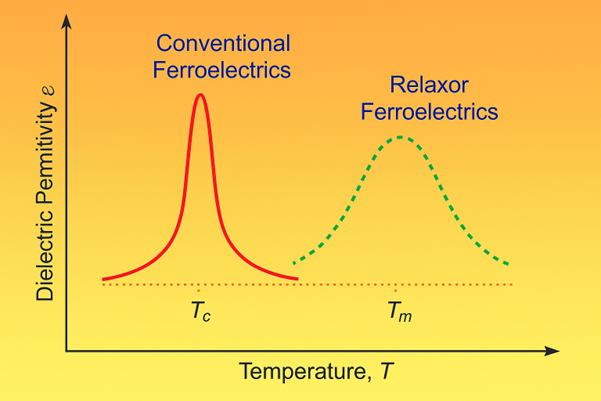
Relaxor ferroelectrics are a special group of ferroelectric materials that exhibit anomalous dielectric and polarization behavior compared to conventional ferroelectrics. In normal ferroelectrics, there is a well-defined phase transition from the ferroelectric to the paraelectric state at a specific temperature known as the Curie temperature (TC). This transition appears as a sharp peak in the dielectric constant versus temperature plot [fig 1]. However, in relaxor ferroelectrics, this transition is not sharp but spread out over a range of temperatures — a phenomenon known as a diffuse phase transition (DPT). This happens because the crystal structure of relaxors is chemically disordered, leading to regions with different local environments. As a result, instead of switching uniformly at one temperature, different regions respond differently, giving rise to a broad dielectric peak.
Another key feature of relaxors is their frequency-dependent dielectric response [fig 2]. The temperature at which the dielectric constant reaches its maximum (Tm) shifts when the measurement frequency changes — something not seen in conventional ferroelectrics.
In simple terms, while conventional ferroelectrics behave like an on–off switch at a fixed temperature, relaxor ferroelectrics act as a transitional system, responding gradually to variations in temperature and frequency. This unique behavior makes them highly useful in advanced capacitors, multilayer capacitors, transducers, actuators, and piezoelectric devices, where large electromechanical coupling and stability over a wide temperature range are desirable.
Table of Contents
Conventional vs. Relaxor Ferroelectrics
In conventional ferroelectrics (like BaTiO₃ or PbTiO₃), the transition from the ferroelectric phase to the paraelectric phase occurs sharply at the Curie temperature. The dielectric constant shows a narrow, sharp peak at this temperature, indicating a well-defined structural change.
In contrast, relaxor ferroelectrics (such as Pb(Mg₁/₃Nb₂/₃)O₃ [PMN] or Bi₀.₅Na₀.₅TiO₃ [BNT]) show a diffuse transition spread over a wide temperature range. Their dielectric permittivity exhibits a broad maximum at a temperature , which itself shifts with measurement frequency. This means that the polarization dynamics in relaxors are not uniform — different microscopic regions respond to electric fields at different timescales.
In conventional ferroelectrics (like BaTiO₃ or PbTiO₃), the transition from the ferroelectric phase to the paraelectric phase occurs sharply at the Curie temperature (). The dielectric constant () shows a narrow, sharp peak at this temperature, indicating a well-defined structural change.
In contrast, relaxor ferroelectrics (such as Pb(Mg₁/₃Nb₂/₃)O₃ [PMN] or Bi₀.₅Na₀.₅TiO₃ [BNT]) show a diffuse transition spread over a wide temperature range. Their dielectric permittivity exhibits a broad maximum at a temperature , which itself shifts with measurement frequency. This means that the polarization dynamics in relaxors are not uniform — different microscopic regions respond to electric fields at different timescales.
Why they are called “Relaxors?
The term “relaxor” comes from their relaxation-type dielectric response — similar to dipolar relaxation in glassy systems.
Key Reasons:
- Diffuse Phase Transition
Instead of a sharp ferroelectric–paraelectric transition, relaxors exhibit a broad dielectric peak over a temperature range.
2. Frequency-Dependent Permittivity
The dielectric constant changes with frequency, indicating relaxation dynamics of dipoles, not a long-range ordered ferroelectric domain behaviour.
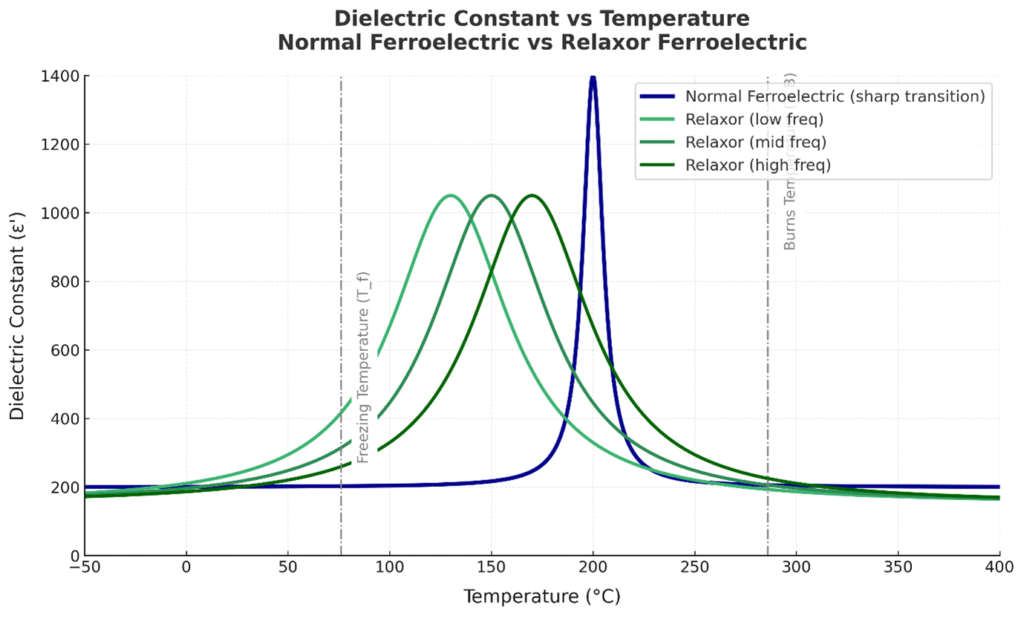
Dielectric constant (ε′) vs temperature (T) shows:
- A broad maximum at Tm (temperature of maximum permittivity)
- Tm shifts to higher temperature with increasing frequency, which is the hallmark of a relaxor.
Tm (f1) < Tm (f2) < Tm (f3)
Key Observations:
• Normal ferroelectric shows a sharp, frequency-independent peak at Curie Temperature (TC).
• Relaxor ferroelectrics show broad, frequency-dependent dielectric peaks (Tm) shifts with frequency).
• Polar Nano-Regions (PNRs) form below TB and gradually freeze below Tf, leading to relaxation-type behavior.
Explanation:
The deep blue curve (sharp, tall peak at ~200°C) represents a normal ferroelectric: a well-defined Curie temperature and a frequency-independent sharp transition.
The three relaxor curves show the broad, smeared dielectric maxima of a relaxor ferroelectric at three measurement frequencies. Notice how the temperature of the dielectric maximum shifts to higher temperature as frequency increases — this is the hallmark of relaxor (relaxation-type) behavior.
- Conventional Ferroelectric: Sharp, well-defined peak at TC
- Relaxor Ferroelectric: Broad, frequency-dependent peak at Tm
Understanding Polar Nanoregions and Their Unique Behavior
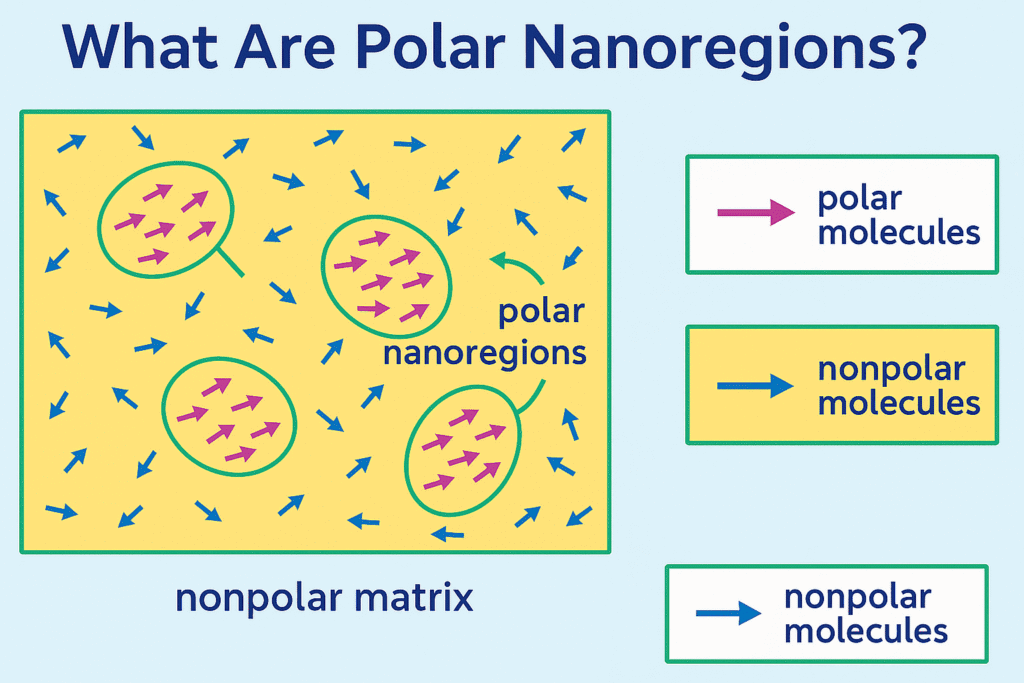
The frequency-dependent dielectric behaviour in relaxor ferroelectrics is attributed to Polar Nano Regions (PNRs), which are nanometre-sized clusters of correlated dipoles that form below the Burns temperature and govern the material’s relaxation dynamics.
These regions emerge due to chemical disorder and random electric fields within the perovskite lattice (ABO₃). For instance, in Pb(Mg₁/₃Nb₂/₃)O₃, the unequal charges of Mg²⁺ and Nb⁵⁺ ions on the B-site create local fields that favour short-range polar ordering. Even though each PNR is polar, the overall material remains macroscopically non-polar because the PNRs are randomly oriented and distributed throughout the crystal.
Below a certain Burns temperature (TB), small dynamic clusters of local polarization — called polar nano-regions — start forming.
- These PNRs fluctuate and interact, giving rise to relaxor behaviour.
- The system never fully transforms into a long-range ferroelectric phase
At the Burns temperature (TB), PNRs first appear within the otherwise non-polar crystal. As temperature decreases, these nano-polar clusters grow and start interacting. Eventually, near the freezing temperature (), they become locked in place, resulting in the non-ergodic relaxor state.
Temperature Evolution of PNRs
Temperature Range | Physical State | PNR Behavior |
Above (Burns temperature) | Paraelectric, cubic | No PNRs; material is completely disordered |
Between and | Polar nano regions appear | Dynamic, short-lived PNRs begin to form |
Below | Strongly interacting PNRs | Local dipoles start to interact cooperatively |
Below (Freezing temperature) | Frozen, glass-like state | PNRs become static — non-ergodic relaxor |
Dynamic States of Relaxor Ferroelectrics: Ergodic and Non-Ergodic States
Up to this point, we have learned that the unique dielectric response of relaxor ferroelectrics mainly arises from the dynamic interactions of Polar Nano Regions (PNRs) within the crystal lattice. As temperature changes, these PNRs evolve from a dynamic to a frozen state, giving rise to two distinct physical states — the ergodic and non-ergodic phases. These states define how the local polarization responds to external electric fields and time, ultimately controlling the macroscopic dielectric and ferroelectric properties of the material.
The transition from the ergodic to the non-ergodic state in relaxor ferroelectrics can be understood by examining the dynamics of PNRs:
Common Student Misconception:
- Ergodic and non-ergodic are States, Not types of Relaxor Ferroelectrics
Many students mistakenly believe that ergodic and non-ergodic are two different types of relaxor ferroelectrics. In reality, these terms describe the state or dynamic behaviour of the same relaxor material under specific temperature and electric-field conditions.
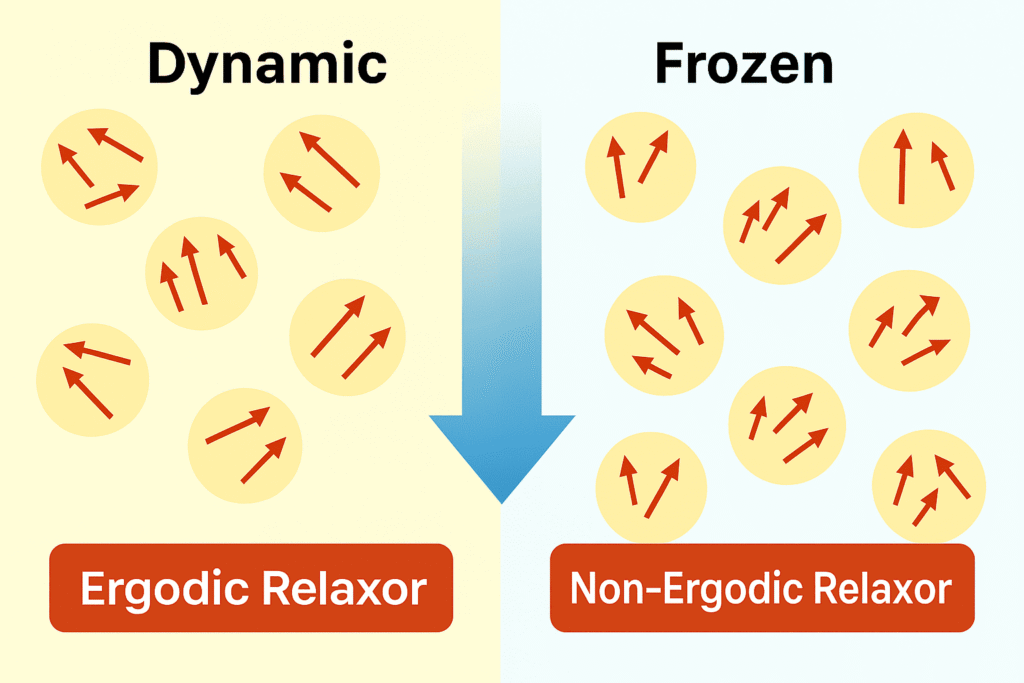
- In the ergodic state, the polar nano-regions (PNRs) are dynamic — they constantly fluctuate and reorient, showing no long-range ferroelectric order.
- In the non-ergodic state, these PNRs become frozen or static, giving rise to a remanent polarization and memory effect similar to normal ferroelectrics.
Thus, a single relaxor material can transition from an ergodic to a non-ergodic state as it cools below the freezing temperature (Tf) or when subjected to an external electric field.
Ergodic Relaxor State — The Dynamic Phase
In the ergodic state, typically observed at higher temperatures (below the Burns temperature but above the freezing temperature ), the PNRs are highly dynamic.
These nanosized regions of polarization continuously form, grow, and dissolve within the non-polar matrix. Their dipoles can easily reorient under an external electric field, meaning the system can reach thermodynamic equilibrium.
Because of this dynamic behavior, the dielectric response in the ergodic state is frequency-dependent — the higher the measurement frequency, the higher the temperature at which the dielectric constant peaks. This is why relaxors display a broad dielectric maximum () instead of a sharp peak, as seen in conventional ferroelectrics.
In simple terms, we can imagine the ergodic state as a “liquid-like” condition of PNRs — flexible, responsive, and continuously changing. When an electric field is applied, the polarization can follow it smoothly, but once the field is removed, the system quickly relaxes back to its original disordered state.
Non-Ergodic Relaxor State — The Frozen Phase
As the temperature drops below the freezing temperature (), the PNRs begin to lose mobility and eventually become frozen in random orientations. In this non-ergodic state, the system can no longer reach thermodynamic equilibrium within experimental timescales. The dipoles are locked, unable to fully respond to external stimuli.
This leads to a behavior similar to that of a dipolar glass — polarization becomes sluggish, and hysteresis appears in the electric field–polarization (–) curves.
If a strong electric field is applied, the material can be “poled” into a long-range ordered ferroelectric-like state. However, once the field is removed, the system slowly relaxes back to its disordered configuration, confirming its non-ergodic nature.
Physically, this transition from dynamic to frozen PNRs explains why relaxor ferroelectrics combine the flexibility of a paraelectric phase with the memory effects of a ferroelectric phase — a property that makes them ideal for high-performance actuators, sensors, and capacitors.
Why It Matters? Scientific and Technological Significance
Understanding the ergodic and non-ergodic behavior of relaxor ferroelectrics is not just of academic interest — it’s crucial for designing high-performance functional materials. By controlling the degree of disorder and the interaction among PNRs, scientists can tune dielectric, ferroelectric, and piezoelectric properties for specialized applications.
For example:
- PMN–PT and PZN–PT solid solutions near their morphotropic phase boundary (MPB) exhibit giant piezoelectric coefficients, thanks to the coexistence of ergodic and non-ergodic relaxor phases.
- Bi-based relaxors, such as BNT–BT, are promising lead-free alternatives for environmentally friendly actuators and sensors
Do Relaxor Ferroelectrics Occur Only in Perovskite Lattices?
No — relaxor ferroelectric behavior is not limited to perovskite lattices, although most well-known relaxors (such as PMN, PZN, and their solid solutions) are perovskite-type oxides with the general formula ABO₃.
The perovskite structure provides an ideal framework for relaxor behavior because:
- It allows B-site cation disorder (e.g., Mg²⁺/Nb⁵⁺ in PMN),
- Supports local charge imbalance and random electric fields, and
- Facilitates the formation of polar nano-regions (PNRs) below the Burns temperature.
However, relaxor-like phenomena have also been reported in non-perovskite systems, including:
- Aurivillius-type layered oxides (e.g., Bi₄Ti₃O₁₂-based compounds),
- Tungsten–bronze structured ferroelectrics (e.g., SrₓBa₁₋ₓNb₂O₆, abbreviated as SBN),
- Pyrochlore and fluorite-type oxides, and
- Polymeric and organic ferroelectrics (e.g., PVDF-based copolymers) that exhibit dipolar disorder and frequency-dependent dielectric relaxation.
Hence, while perovskites dominate relaxor research, the relaxor behavior itself is a physical phenomenon — arising from dipolar frustration, local disorder, and nanoscale polarization dynamics — not a property confined to one lattice type.
Future Research and Technological Importance
Current research on relaxor ferroelectrics is focused on understanding the atomic-scale origin and dynamics of PNRs using advanced techniques like neutron scattering, piezoresponse force microscopy (PFM), and first-principles simulations. Exploring field-induced phase transitions, temperature–frequency scaling, and lead-free relaxor systems will further enhance their technological relevance. The growing integration of AI and data-driven material design is also accelerating the discovery of novel relaxor compositions optimized for energy storage, solid-state cooling, and next-generation actuator technologies.
Key Takeaways
- Relaxor ferroelectrics differ from conventional ones by showing diffuse phase transitions and frequency-dependent dielectric behavior.
- Their unique behaviour originates from Polar Nano Regions (PNRs) — nanosized zones of local polarization within a disordered matrix.
- The evolution of PNRs with temperature governs the transition between ergodic (dynamic) and non-ergodic (frozen) states.
- These dynamic properties make relaxor ferroelectrics highly valuable in advanced electroceramic devices.
📘 Frequently Asked Questions (FAQs) on Relaxor Ferroelectrics
Non-ergodic state: PNRs become frozen below the freezing temperature (Tf), behaving like a glassy or ferroelectric system.
Tm: Temperature where dielectric constant is maximum.
Tf: Freezing temperature – PNRs stop reorienting dynamically.
• Pb(Mg1/3Nb2/3)O3 (PMN)
• Pb(Zn1/3Nb2/3)O3 (PZN)
• Pb(Sc1/2Ta1/2)O3 (PST)
• Solid solutions like PMN–PT and PZN–PT used in actuators and transducers.
References
- Bokov, A. A., & Ye, Z.-G. (2006). Recent progress in relaxor ferroelectrics with perovskite structure. Journal of Materials Science, 41(1), 31–52. https://doi.org/10.1007/s10853-005-5915-7
- Manley, M. E., Lynn, J. W., Abernathy, D. L., Specht, E. D., Delaire, O., Bishop, A. R., Sahul, R., & Budai, J. D. (2014). Phonon localization drives polar nanoregions in a relaxor ferroelectric. Nature Communications, 5, 3683. https://doi.org/10.1038/ncomms4683
- Liu, H., Shi, X., Yao, Y., Luo, H., Li, Q., Huang, H., Qi, H., Zhang, Y., Ren, Y., Kelly, S. D., Roleder, K., Neuefeind, J. C., Chen, L.-Q., Xing, X., & Chen, J. (2023). Emergence of high piezoelectricity from competing local polar order–disorder in relaxor ferroelectrics. Nature Communications, 14, 1007. https://doi.org/10.1038/s41467-023-36749-w
- Cai, L., Pattnaik, R., Lundeen, J., & Toulouse, J. (2018). Piezoelectric polar nanoregions and relaxation-coupled resonances in relaxor ferroelectrics. arXiv preprint. https://arxiv.org/abs/1801.02655
- Takenaka, H., Grinberg, I., & Rappe, A. M. (2012). Anisotropic local correlations and dynamics in a relaxor ferroelectric. arXiv preprint. https://arxiv.org/abs/1212.0867
- Cai, L., Toulouse, J., Harriger, L., Downing, R. G., & Boatner, L. A. (2015). Origin of the crossover between a freezing and a structural transition at low concentration in the relaxor ferroelectric. Physical Review B, 91(13), 134106. https://doi.org/10.1103/PhysRevB.91.134106
- Shvartsman, V. V., & Lupascu, D. C. (2012). Lead-free relaxor ferroelectrics. Journal of the American Ceramic Society, 95(1), 1–26. https://doi.org/10.1111/j.1551-2916.2011.04952.x
- Huang, S., Sun, L., Feng, C., & Chen, L. (2006). Relaxor behavior of layer-structured SrBi₁.₆₅La₀.₃₅Nb₂O₉. Journal of Applied Physics, 99(7), 076104. https://doi.org/10.1063/1.2186975
- Xu, G., & Viehland, D. (2004). Relaxor ferroelectrics: Review and perspectives. Journal of the American Ceramic Society, 87(11), 2098–2112. https://doi.org/10.1111/j.1551-2916.2004.02098.x
- Origin of polar nanoregions from displacive correlation in relaxor ferroelectrics. (2022). Journal of Materials Chemistry C, 10, 17215–17226. https://doi.org/10.1039/d2tc03204j

Dr. Rolly Verma
Explore More from Advance Materials Lab
Continue expanding your understanding of material behavior through our specialized resources on ferroelectrics and phase transitions. Each guide is designed for research scholars and advanced learners seeking clarity, precision, and depth in the field of materials science and nanotechnology.
🔗 Recommended Reads and Resources:
Ferroelectrics Tutorials and Research Guides — Comprehensive tutorials covering polarization, hysteresis, and ferroelectric device characterization.
Workshops on Ferroelectrics (2025–2027) — Upcoming training sessions and research-oriented workshops for hands-on learning.
Glossary — Ferroelectrics and Phase Transitions — Concise explanations of key terminologies to support your study and research work.
If you notice any inaccuracies or have constructive suggestions to improve the content, I warmly welcome your feedback. It helps maintain the quality and clarity of this educational resource. You can reach me at: advancematerialslab27@gmail.com