
Smart Materials: A Complete Guide
Properties, Classification, Applications, and Selection Criteria — From Piezoelectrics to Shape Memory Alloys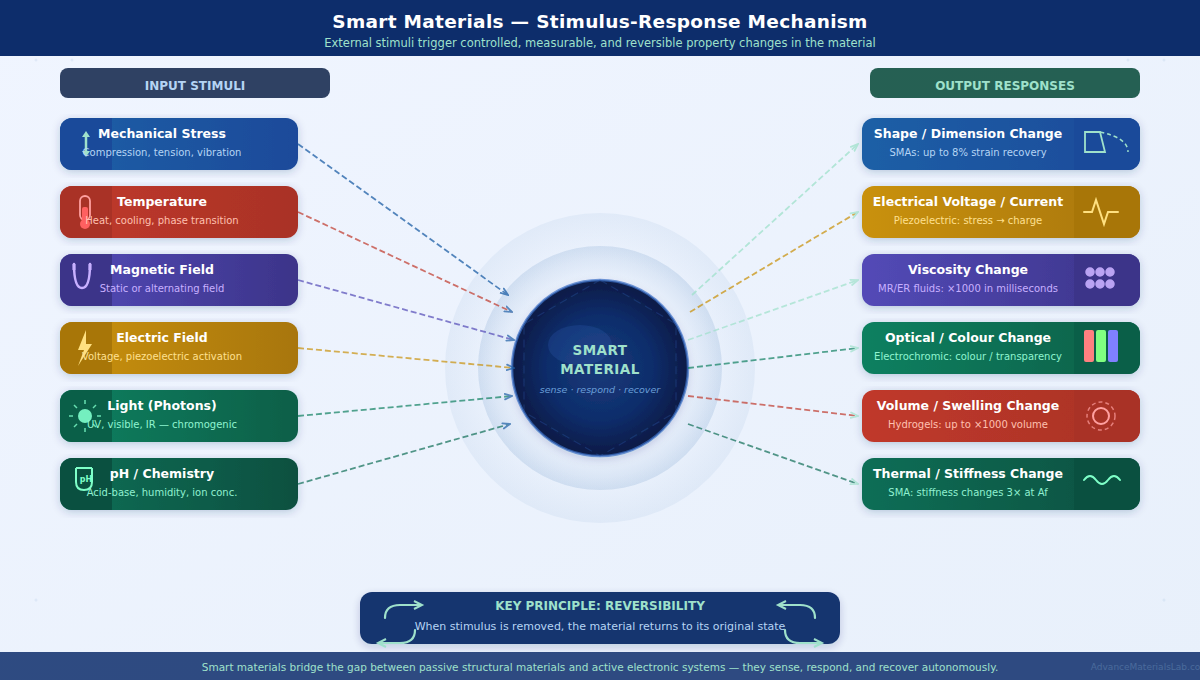
1. What Are Smart Materials? Defining the Field
Conventional engineering materials are passive — they respond to applied loads and temperatures in ways that are fixed by their composition and microstructure, and that response does not change based on the environment. A steel beam carries load; a copper wire conducts electricity; an aluminium sheet reflects light. These are valuable functions, but they are static.
Smart materials are fundamentally different. They are materials that can sense a change in their environment and respond to it in a useful, predictable, and typically reversible way. The response may be a change in shape, stiffness, electrical output, optical properties, viscosity, or any other measurable physical quantity. This sensing-and-responding behaviour is intrinsic to the material itself — not dependent on external electronics or mechanisms.
A smart material (also called a stimuli-responsive or intelligent material) is a material that exhibits a significant change in one or more physical properties in response to an external stimulus, where the change is controlled, predictable, and typically reversible.
The stimulus may be: mechanical stress, temperature, electric field, magnetic field, light, pH, humidity, chemical concentration, or radiation.
The response may be: dimensional change, electrical output, change in stiffness, change in optical properties, change in viscosity, or change in thermal properties.
The concept of smart materials sits at the intersection of crystal structure physics, materials chemistry, mechanical engineering, and electronics. At the deepest level, the smart behaviour of these materials is rooted in their atomic and crystal structure — particularly in structural asymmetry, phase transformations, and crystal symmetry — connecting them directly to the crystallographic concepts we study throughout AdvanceMaterialsLab.com.
The global smart materials market was valued at approximately $55 billion in 2023 and is projected to exceed $98 billion by 2030, growing at a compound annual growth rate (CAGR) of over 7%, according to Grand View Research. This growth is driven by applications in aerospace, biomedical devices, robotics, civil infrastructure, and consumer electronics.
2. Classification of Smart Materials
Smart materials are classified primarily by the type of stimulus they respond to and the nature of their response. The six major families are shown below:
Stimulus: Mechanical stress
Response: Electrical voltage (direct) or mechanical deformation (converse)
Examples: PZT, BaTiO₃, PVDF, BNT ceramics
Stimulus: Temperature or stress
Response: Return to pre-programmed shape
Examples: Nitinol (NiTi), Cu-Zn-Al, Fe-Mn-Si
Stimulus: Magnetic field
Response: Dimensional change (Joule effect)
Examples: Terfenol-D, Galfenol, Metglas
Stimulus: Electric field or light
Response: Reversible change in optical properties
Examples: WO₃, PEDOT, VO₂, smart glass
Stimulus: Electric or magnetic field
Response: Viscosity changes by orders of magnitude
Examples: Silicone oil + particles, carbonyl iron
Stimulus: pH, temperature, or light
Response: Volume change (swelling/shrinking)
Examples: PNIPAM, polyacrylic acid gels, DNA hydrogels
| Material Family | Input Stimulus | Output Response | Reversible? | Key Parameter |
|---|---|---|---|---|
| Piezoelectric | Stress / Electric field | Voltage / Strain | Yes | d₃₃ piezoelectric coefficient (pC/N) |
| Shape Memory Alloy | Temperature / Stress | Shape change up to 8% | Yes | Transformation temperature (Af, Ms) |
| Magnetostrictive | Magnetic field | Strain up to 0.2% | Yes | Magnetostriction coefficient λs |
| Electrorheological | Electric field (~kV/mm) | Viscosity ×1000 | Yes (ms) | Yield stress under field (Pa) |
| Magnetorheological | Magnetic field (~0.1 T) | Viscosity ×50–100 | Yes (ms) | Dynamic yield stress (kPa) |
| Electrochromic | Voltage (±1–3 V) | Colour / Transmittance | Yes | Optical density change (ΔOD) |
| Smart Hydrogel | pH / Temp / Light | Volume change up to ×1000 | Yes | LCST (lower critical solution temp) |
3. Piezoelectric Materials — Converting Stress to Electricity
3.1 Mechanism and Crystal Structure Connection
Piezoelectricity is the phenomenon in which a material generates an electric charge in response to applied mechanical stress — and conversely deforms when an electric field is applied. The word comes from the Greek piezein meaning to squeeze or press, and was discovered by Jacques and Pierre Curie in 1880.
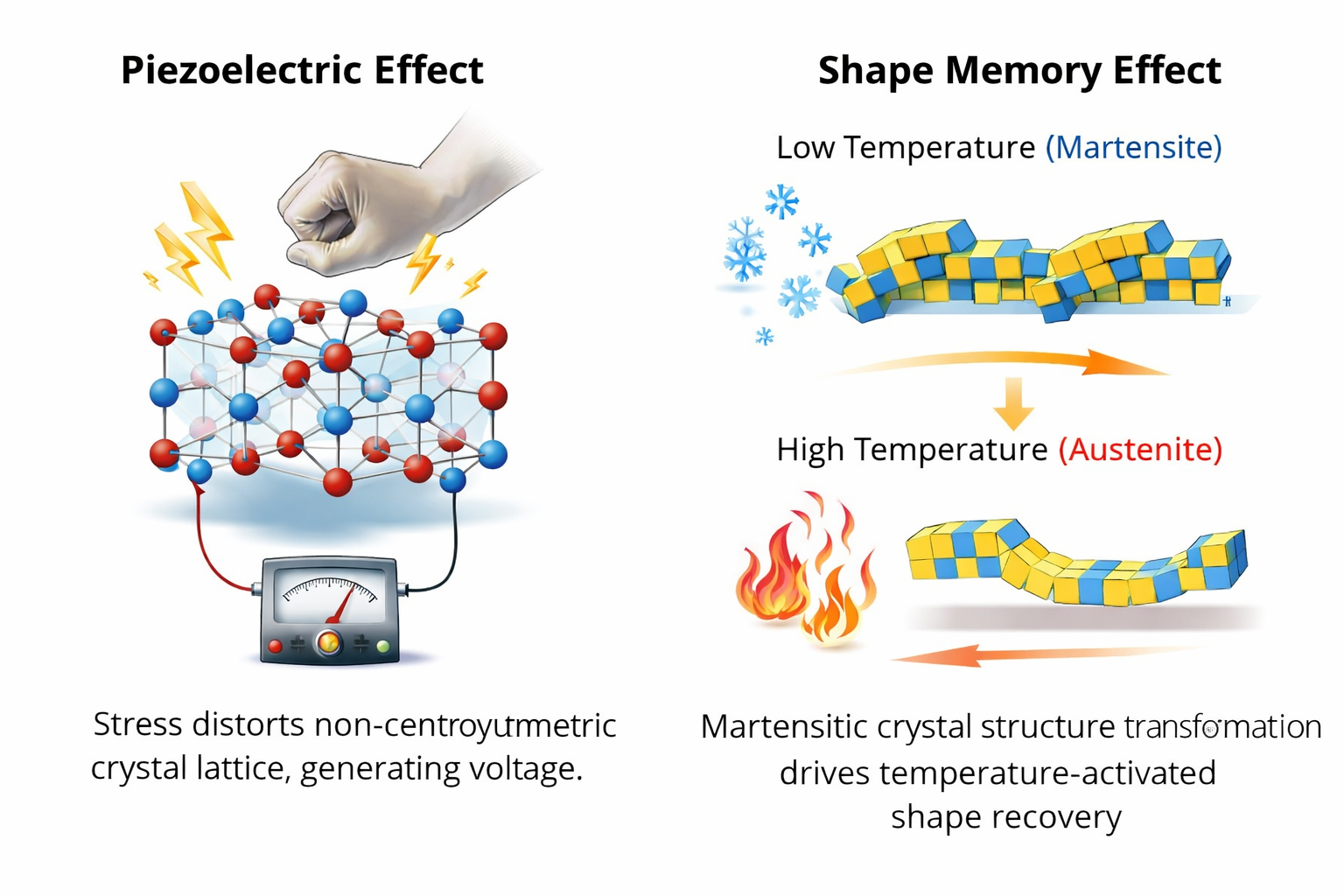
At the atomic scale, piezoelectricity arises because the crystal structure of piezoelectric materials lacks a centre of inversion symmetry. As we studied in the Introduction to Crystal Structure, of the 32 crystal point groups, only 20 are non-centrosymmetric and can exhibit piezoelectricity. When mechanical stress distorts the crystal lattice of these materials, positive and negative charge centres within the unit cell separate, creating a net electric dipole moment — measurable as a voltage across the material.
- Direct effect: Mechanical stress → Electric voltage. Used in sensors, energy harvesters, microphones, and pressure transducers.
- Converse effect: Applied electric field → Mechanical deformation. Used in actuators, ultrasonic transducers, inkjet printer heads, and precision positioning systems.
Both effects are thermodynamically related — the same material exhibits both simultaneously. The piezoelectric coefficient d₃₃ quantifies the coupling: it is the charge generated per unit applied force (pC/N) or strain per unit applied field (pm/V).
3.2 Key Piezoelectric Materials
Lead Zirconate Titanate (PZT) — Pb(Zr,Ti)O₃
PZT is the dominant commercial piezoelectric material, with d₃₃ values of 200–600 pC/N. It has a perovskite crystal structure (ABO₃ type), and its exceptional piezoelectric response arises from the proximity of its composition to the morphotropic phase boundary between tetragonal and rhombohedral phases, where polarisation rotation is maximised. However, PZT contains lead — a toxic heavy metal — driving intense research into lead-free alternatives.
Barium Titanate (BaTiO₃)
BaTiO₃ was the first ceramic piezoelectric discovered (1940s). It undergoes a ferroelectric-to-paraelectric phase transition at 120°C (Curie temperature), transitioning from tetragonal (piezoelectric) to cubic (non-piezoelectric) crystal structure. Its d₃₃ ≈ 190 pC/N — lower than PZT but entirely lead-free.
Bismuth Sodium Titanate (BNT) — Bi₀.₅Na₀.₅TiO₃
BNT is one of the most promising lead-free piezoelectric ceramics. It has a rhombohedral perovskite structure at room temperature and a large remnant polarisation of ~38 μC/cm². The piezoelectric and ferroelectric behaviour of donor- and acceptor-doped BNT ceramics — including frequency-dependent ferro-antiferro phase transitions and internal bias field effects — has been studied in detail in Verma and Rout, J. Appl. Phys. 2019, establishing the complex interplay between crystal symmetry and functional response.
PVDF — Polyvinylidene Fluoride
PVDF is a semi-crystalline polymer with piezoelectric properties arising from the alignment of C-F dipoles in its β-phase crystal structure. Unlike ceramics, PVDF is flexible, lightweight, and biocompatible — making it ideal for wearable sensors and implantable medical devices. The influence of annealing temperature on polar domain formation and energy harvesting performance of PVDF-HFP copolymer films has been investigated in Verma and Rout, J. Appl. Phys. 2020.
3.3 Engineering Applications of Piezoelectrics
| Application | Material Used | Effect Used | Industry |
|---|---|---|---|
| Ultrasonic transducers (medical imaging) | PZT | Converse + Direct | Medical |
| Inkjet printer actuators | PZT | Converse | Consumer electronics |
| Knock sensors in car engines | PZT ceramic | Direct | Automotive |
| Energy harvesting (wearables) | PVDF film | Direct | Biomedical / IoT |
| Active vibration control | PZT patches | Converse | Aerospace |
| Gyroscopes (smartphones) | PZT, quartz | Both | Consumer electronics |
| Sonar underwater sensing | PZT, BaTiO₃ | Both | Defence / Marine |
| Precision nano-positioning | PZT stack actuators | Converse | Scientific instruments |
4. Shape Memory Alloys — Materials That Remember Their Shape
4.1 The Shape Memory Effect and Superelasticity
Shape memory alloys (SMAs) are metallic materials that can be deformed at low temperature, then return to their original pre-programmed shape upon heating. This extraordinary behaviour arises from a reversible martensitic phase transformation — a diffusionless, displacive transformation between two crystal structures driven by temperature or stress.
Think of an SMA as a metal with muscle memory. You can bend it, crimp it, deform it. But heat it above a critical temperature, and it springs back to exactly the shape it was trained to remember — as if it never bent at all. This is not elastic recovery (which is instantaneous and stress-driven). This is a genuine crystal structure phase transformation driven by temperature.
The two key phases in an SMA are:
- Martensite — the low-temperature phase. Its crystal structure allows large, easily reversible deformation (twinning). It is soft and easily deformed.
- Austenite — the high-temperature parent phase. Higher symmetry crystal structure. It is stronger and stiffer.
The transformation is characterised by four temperatures: Ms (martensite start), Mf (martensite finish), As (austenite start), and Af (austenite finish). The material fully recovers its shape when heated above Af.
A related phenomenon — superelasticity — occurs when the SMA is deformed at temperatures above Af. The applied stress induces martensite (stress-induced martensite), which reverts to austenite upon stress removal, giving rubber-like elastic recovery of up to 8% strain — approximately 40 times more than conventional metals, as documented by ScienceDirect — Shape Memory Alloys.
4.2 Engineering Applications of SMAs
- Biomedical — stents and guidewires: Nitinol (NiTi) stents are compressed at low temperature, inserted into blocked arteries, then expand to their trained diameter at body temperature (37°C). Over 1 million SMA stents are implanted annually worldwide.
- Orthodontics: Nitinol archwires apply a constant, gentle force to teeth over months as the wire slowly recovers its straight shape — superior to traditional steel wires that require frequent adjustment.
- Aerospace actuators: SMAs replace heavy hydraulic actuators in aircraft morphing wings, reducing weight and complexity. NASA and Boeing have actively researched SMA-driven variable geometry chevrons for jet engine noise reduction.
- Robotics and soft actuators: SMA wires act as artificial muscles in soft robots, enabling silent, smooth motion without motors or gears.
- Seismic isolation: SMA-based dampers in buildings and bridges absorb earthquake energy through the martensitic transformation, then fully recover.
5. Magnetostrictive Materials
Magnetostrictive materials change their physical dimensions when exposed to a magnetic field — a phenomenon called the Joule magnetostrictive effect. Conversely, when mechanically deformed, they produce a change in magnetisation — the Villari effect. This bidirectional magneto-mechanical coupling makes them powerful transducers.
5.1 Key Magnetostrictive Materials
Terfenol-D (Tb₀.₃Dy₀.₇Fe₂) is the most widely used giant magnetostrictive material, with a magnetostriction coefficient λs ≈ 1000–2000 ppm (parts per million) — roughly 50× greater than conventional magnetic materials. It is used in sonar transducers, linear motors, and vibration dampers. However, it is brittle and expensive.
Galfenol (Fe-Ga alloys) is a newer magnetostrictive material with λs ≈ 400 ppm but significantly improved ductility and machinability compared to Terfenol-D. It is being developed for structural health monitoring sensors embedded directly into load-bearing components.
Magnetostriction arises because magnetic domains within the crystal reorient under an applied field, and this reorientation is coupled to lattice strain through spin-orbit coupling. The magnitude of magnetostriction depends critically on the crystal symmetry and the elastic anisotropy of the material. Single-crystal Terfenol-D shows magnetostriction 3× higher than polycrystalline material along the [111] direction — the preferred magnetic easy axis — directly connecting magnetostrictive behaviour to the crystallographic directions we study in Miller Indices.
6. Electrorheological and Magnetorheological Fluids
ER (electrorheological) and MR (magnetorheological) fluids are suspensions of polarisable particles in a carrier liquid that undergo dramatic, reversible changes in viscosity — transforming from a free-flowing liquid to a near-solid in milliseconds — when an electric or magnetic field is applied.
6.1 How They Work
When a field is applied, the suspended particles polarise and form chain-like structures aligned with the field direction. These chains resist flow, dramatically increasing the apparent viscosity and yield stress of the fluid. Remove the field and the chains dissolve instantly — the fluid flows freely again. Response time is typically 1–10 milliseconds.
6.2 Engineering Applications
- MR dampers in vehicle suspension: Lord Corporation's MR fluid dampers are used in luxury automobiles (Audi, Ferrari, Cadillac) to provide real-time suspension adjustment in under 1 millisecond — far faster than any mechanical valve
- Prosthetic knee joints: MR fluid dampers in prosthetic knees (e.g. Össur Rheo Knee) adapt their resistance in real time to the patient's gait, providing near-natural walking dynamics
- Seismic protection: Large-scale MR dampers have been installed in cable-stayed bridges and tall buildings in Japan and China to reduce vibration from wind and earthquakes
7. Chromogenic and Electrochromic Materials
Chromogenic materials reversibly change their optical properties — colour, transparency, reflectivity — in response to an external stimulus. The sub-categories are:
- Electrochromic — respond to electric voltage (e.g. WO₃, PEDOT). Used in smart windows, rear-view mirrors, and variable-tint eyewear
- Thermochromic — respond to temperature (e.g. VO₂, liquid crystals). Used in temperature-indicating labels and smart coatings
- Photochromic — respond to UV/visible light (e.g. silver halides, organic dyes). Used in photochromic lenses
Electrochromic smart glass for buildings can reduce solar heat gain by up to 70% when switched to its dark state, significantly reducing air conditioning energy consumption. The global electrochromic glass market exceeded $3 billion in 2024 and is growing at 12% CAGR, driven by green building regulations in the EU and North America. Companies like View Inc., Sage Electrochromics (Saint-Gobain), and AGC are scaling production rapidly, as reported by the International Energy Agency.
8. Smart Hydrogels and Soft Smart Materials
Smart hydrogels are three-dimensional polymer networks that can absorb large amounts of water and respond to environmental stimuli by swelling or shrinking. The most studied example is PNIPAM (poly-N-isopropylacrylamide), which undergoes a sharp volume-phase transition at its lower critical solution temperature (LCST) of ~32°C — close to body temperature, making it ideal for biomedical applications.
Applications include:
- Controlled drug delivery: pH-responsive hydrogels release drugs only in specific locations in the body (e.g. intestine at pH 7 vs stomach at pH 2)
- Tissue engineering scaffolds: Temperature-responsive hydrogels that gel at body temperature, injectable as a liquid then solidify in situ
- Soft robotics actuators: Hydrogel muscles that swell/contract in response to stimuli, enabling entirely soft robotic systems
- Agricultural sensors: Soil moisture sensors based on hydrogel swelling that trigger automated irrigation
9. Key Properties of Smart Materials
When evaluating smart materials, engineers and researchers characterise them by a specific set of functional properties. Understanding these properties is essential for both designing smart material systems and for comparing candidates during material selection.
| Property | Definition | Unit | Most Relevant Material |
|---|---|---|---|
| Sensitivity | Output per unit stimulus — how strongly the material responds | Varies (e.g. pC/N, ppm/T) | Piezoelectrics, magnetostrictive |
| Linearity | How proportionally output scales with input over the operating range | % deviation | All smart materials |
| Response time | Time to reach 90% of full response after stimulus onset | ms, μs, s | ER/MR fluids (~1 ms), hydrogels (~s to min) |
| Reversibility | Ability to return to original state after stimulus removal | % recovery | SMAs (near 100%), piezoelectrics (100%) |
| Hysteresis | Difference in response between loading and unloading cycle | % | SMAs, ferroelectrics |
| Fatigue life | Number of cycles before performance degradation | Cycles | SMAs (10⁶–10⁸), PZT (10⁹+) |
| Coupling coefficient (k²) | Fraction of input energy converted to output — efficiency of transduction | Dimensionless (0–1) | Piezoelectrics (k₃₃ ≈ 0.6–0.9 for PZT) |
| Coercive field | Field required to switch/reverse the smart state | V/m, A/m | Ferroelectrics, ferromagnetics |
| Operating temperature range | Temperature range over which smart behaviour is maintained | °C | All — critical design constraint |
| Biocompatibility | Suitability for use in contact with living tissue | ISO 10993 standard | Nitinol, PVDF, hydrogels |
10. Selection Criteria — How Engineers Choose Smart Materials
The selection of a smart material for a specific application requires balancing multiple competing requirements simultaneously. The following 10-criterion framework provides a structured approach, aligned with the methodology described in Ashby's Materials Selection in Mechanical Design.
Is the stimulus mechanical, thermal, electrical, magnetic, optical, or chemical? The stimulus type immediately narrows the material family. A pressure sensor requires a piezoelectric; a temperature-activated actuator requires an SMA; an adaptive damper requires an MR fluid.
How large must the output be? A precision nano-positioner needs micro-metre displacements (PZT stack actuator); a stent needs centimetre-scale shape change (Nitinol). Match the material's characteristic output range to the required engineering output.
Piezoelectrics respond in microseconds; MR fluids in milliseconds; SMAs in seconds to minutes; hydrogels in seconds to hours. For real-time vibration control, only piezoelectrics or MR fluids are feasible. For drug delivery, slow hydrogel response is perfectly acceptable.
SMAs are defined by their transformation temperatures — a Nitinol stent designed for body temperature (37°C) will not function properly at room temperature. PZT ceramics lose their piezoelectric properties above the Curie temperature (~250–350°C). Confirm that smart behaviour is maintained across the full operating temperature range.
How many cycles of activation are required over the component's lifetime? A piezoelectric actuator in a fuel injector cycles 10⁹+ times; an SMA stent may cycle ~10⁶ times. Specify fatigue life requirements early — they significantly constrain material choice.
For energy harvesting and transducer applications, the electromechanical coupling coefficient k² quantifies the fraction of input energy converted to output. PZT has k₃₃² ≈ 0.5–0.7 — very efficient. PVDF has k₃₁² ≈ 0.03 — less efficient but mechanically flexible. Choose based on whether efficiency or flexibility is the priority.
PZT contains lead — it cannot be used in implantable devices and is subject to RoHS restrictions in Europe. Nitinol and PVDF are biocompatible and FDA-approved. Hydrogels are generally biocompatible. For biomedical applications, material selection is governed by ISO 10993 biocompatibility standards.
Smart materials are rarely used alone — they are integrated into structures. The stiffness, strength, and coefficient of thermal expansion of the smart material must be compatible with the host structure to avoid delamination, cracking, or constraint effects that diminish smart performance.
Can the material be fabricated in the required form — thin film, fibre, bulk, powder? PZT can be tape-cast into thin films; PVDF can be spun into fibres; Nitinol can be drawn into fine wires. Terfenol-D is brittle and difficult to machine. Manufacturability constrains the design space significantly.
PZT and Nitinol are commercially mature with established supply chains. Galfenol, BNT-based lead-free piezoelectrics, and PNIPAM hydrogels are at lower technology readiness levels with higher per-unit cost. Balance performance requirements against budget constraints and technology readiness level (TRL).
11. Applications by Industry
| Industry | Application | Smart Material | Function |
|---|---|---|---|
| Aerospace | Morphing wing structures | SMA, piezoelectric | Shape change, vibration control |
| Aerospace | Structural health monitoring | PZT, Galfenol | Detect cracks and delamination in real time |
| Biomedical | Cardiovascular stents | Nitinol | Self-expanding vessel support |
| Biomedical | Ultrasound imaging probes | PZT, PMN-PT | High-frequency acoustic transduction |
| Biomedical | Controlled drug delivery | pH-responsive hydrogel | Site-specific drug release |
| Automotive | Adaptive suspension dampers | MR fluid | Real-time ride stiffness adjustment |
| Automotive | Fuel injectors | PZT stack actuator | Precision high-speed fuel metering |
| Civil Engineering | Bridge cable dampers | MR fluid, SMA | Vibration and seismic damping |
| Electronics | Smartphone gyroscopes | PZT, quartz | Angular velocity sensing |
| Electronics | Inkjet print heads | PZT | Droplet ejection actuators |
| Energy | Vibration energy harvesting | PVDF, PZT | Convert ambient vibration to electricity |
| Architecture | Smart glass windows | WO₃ electrochromic | Dynamic solar shading |
| Robotics | Soft robot actuators | SMA wire, hydrogel | Muscle-like silent actuation |
| Defence | Sonar transducers | Terfenol-D, PZT | Underwater acoustic emission and detection |
12. 2025 Frontiers — AI-Designed and 4D-Printed Smart Materials
12.1 AI-Accelerated Smart Material Discovery
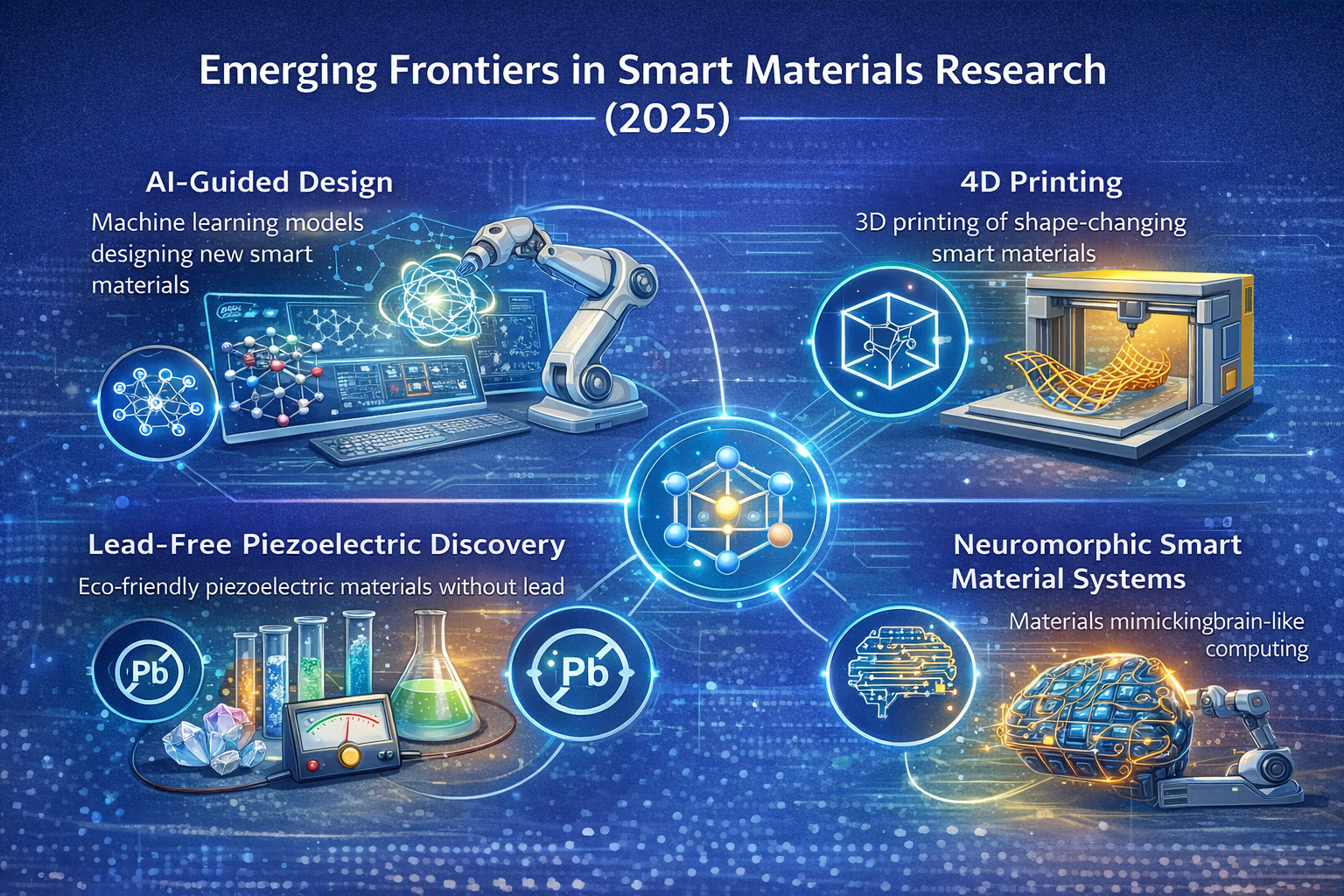
Machine learning is transforming the pace of smart material discovery. High-throughput computational screening, combined with databases like the Materials Project, now allows researchers to evaluate thousands of candidate compositions for piezoelectric, magnetostrictive, or shape-memory behaviour before synthesising a single sample. In 2024–2025, AI models have identified several novel lead-free piezoelectric compositions in the bismuth-based perovskite family with predicted d₃₃ values exceeding 300 pC/N — competitive with PZT while entirely avoiding lead.
12.2 4D Printing — Smart Structures That Change Shape Over Time
4D printing refers to 3D printing of smart materials — primarily shape memory polymers (SMPs) and hydrogels — that, when printed into a specific initial geometry, will transform into a different, pre-programmed geometry in response to a stimulus (heat, moisture, light) over time. The "fourth dimension" is time. This technology enables:
- Self-assembling structures — flat-printed constructs that fold into 3D shapes when heated, eliminating complex assembly processes
- Self-healing pipelines — pipes that close cracks autonomously using SMP liners
- Deployable space structures — NASA is actively investigating 4D-printed SMA and SMP structures for satellite deployment mechanisms that eliminate motors entirely
12.3 Lead-Free Piezoelectric Ceramics — A Regulatory and Scientific Priority
The European Union's RoHS (Restriction of Hazardous Substances) directive already restricts lead in most electronics, with piezoelectric ceramics currently exempt. This exemption is under review, creating intense pressure to develop lead-free alternatives that match PZT's performance. The most promising candidates in 2025 are:
- KNN-based systems (K₀.₅Na₀.₅NbO₃) — engineered near phase boundaries to maximise piezoelectric response (d₃₃ up to 570 pC/N achieved in single crystals)
- BNT-BT-KNN ternary systems — combining multiple lead-free perovskites at morphotropic phase boundaries
- Bismuth layered structure ferroelectrics — for high-temperature applications where PZT degrades
12.4 Neuromorphic Smart Materials
A emerging frontier is the development of materials that mimic synaptic behaviour — materials that can store, process, and respond to information directly, without a separate microprocessor. Ferroelectric tunnel junctions, VO₂ phase-transition devices, and memristive materials are being explored as hardware implementations of artificial synapses for edge-computing applications in 2025.
13. Practice Questions
- (a) The crystal must have cubic symmetry
- (b) The crystal must be centrosymmetric
- (c) The crystal must be non-centrosymmetric (lacking an inversion centre) ✔
- (d) The crystal must have hexagonal symmetry
- (a) Martensite — soft, easily deformed
- (b) Austenite — higher symmetry, parent phase ✔
- (c) Bainite — intermediate transformation product
- (d) Ferrite — BCC iron phase
- (a) It has a higher d₃₃ coefficient than PZT ceramics
- (b) It is flexible, lightweight, and biocompatible — unlike brittle PZT ceramics ✔
- (c) It has a higher Curie temperature than PZT
- (d) It contains lead which improves piezoelectric response
- (a) Several minutes
- (b) Several seconds
- (c) 1–10 milliseconds ✔ — making it suitable for real-time active control
- (d) Several microseconds
- (a) The fourth axis of motion in the printing machine
- (b) Printing with four different materials simultaneously
- (c) Time — the printed smart material transforms its shape over time in response to a stimulus ✔
- (d) The fourth state of matter used in the printing process
- (a) The ratio of output voltage to input stress
- (b) The fraction of input energy (mechanical or electrical) converted to output energy (electrical or mechanical) ✔
- (c) The number of unit cells per unit volume
- (d) The ratio of piezoelectric strain to applied temperature change
14. Key Takeaways
- DEFINITION: Smart materials sense a change in their environment and respond in a controlled, predictable, and reversible way. They are active, not passive.
- SIX FAMILIES: Piezoelectric, shape memory alloys, magnetostrictive, electro/magnetorheological fluids, chromogenic, and smart hydrogels — each responding to a different stimulus type.
- PIEZOELECTRICS: Require non-centrosymmetric crystal structure. PZT dominates commercially (d₃₃ = 200–600 pC/N); BNT and PVDF are leading lead-free alternatives. Both direct and converse effects are used.
- SHAPE MEMORY ALLOYS: Operate via a reversible martensitic phase transformation. Nitinol can recover up to 8% strain. Transformation temperatures (Ms, Mf, As, Af) are the critical design parameters.
- MAGNETOSTRICTIVE: Terfenol-D achieves λs ≈ 1000–2000 ppm. Response is bidirectional. Performance is crystallographically anisotropic — single-crystal orientation matters.
- ER/MR FLUIDS: Transform from liquid to near-solid in milliseconds under field. Used in adaptive dampers, prosthetics, and seismic protection.
- CHROMOGENIC MATERIALS: WO₃-based electrochromic glass reduces building energy consumption by up to 70%. A $3B+ market growing at 12% CAGR.
- CRYSTAL STRUCTURE IS THE ROOT CAUSE: The smart behaviour of almost every material in this guide ultimately arises from its crystal structure, symmetry, and phase transformation behaviour.
- SELECTION CRITERIA: The 10-criterion framework (stimulus type, response magnitude, speed, temperature range, fatigue life, coupling efficiency, biocompatibility, mechanical compatibility, manufacturability, cost) provides a systematic approach to smart material selection.
- 2025 FRONTIERS: AI-designed lead-free piezoelectrics, 4D printing of shape memory structures, and neuromorphic smart material devices are defining the next decade of the field.
References
All references are in IEEE citation style. All sources are peer-reviewed journals, internationally recognised textbooks, or authoritative databases.
- K. Uchino, Ferroelectric Devices, 2nd ed. Boca Raton, FL, USA: CRC Press, 2009. — Comprehensive reference for piezoelectric materials, coupling coefficients, ferroelectric crystals, and transducer design.
- R. Verma and S. K. Rout, "Frequency-dependent ferro–antiferro phase transition and internal bias field influenced piezoelectric response of donor and acceptor doped bismuth sodium titanate ceramics," J. Appl. Phys., vol. 126, no. 9, Art. no. 094103, Sep. 2019, doi: 10.1063/1.5111505. [AIP — DOI: 10.1063/1.5111505] — Author's peer-reviewed research on BNT lead-free piezoelectric ceramics: crystal structure, phase transitions, and functional response.
- R. Verma and S. K. Rout, "Influence of annealing temperature on the existence of polar domain in uniaxially stretched polyvinylidene-co-hexafluoropropylene for energy harvesting applications," J. Appl. Phys., vol. 128, no. 23, Art. no. 234104, Dec. 2020, doi: 10.1063/5.0022463. [AIP — DOI: 10.1063/5.0022463] — Author's peer-reviewed research on PVDF-HFP smart polymer films for piezoelectric energy harvesting applications.
- R. Verma and S. K. Rout, "The Mystery of Dimensional Effects in Ferroelectricity," in Recent Advances in Multifunctional Perovskite Materials. London, UK: IntechOpen, 2022, doi: 10.5772/intechopen.104435. [IntechOpen — Open Access] — Author's chapter on size and dimensionality effects in ferroelectric and piezoelectric perovskite materials.
- J. Van Humbeeck, "Shape memory alloys: A material and a technology," Adv. Eng. Mater., vol. 3, no. 11, pp. 837–850, Nov. 2001, doi: 10.1002/1527-2648(200111)3:11<837::AID-ADEM837>3.0.CO;2-0. — Landmark reference on shape memory alloys: transformation temperatures, superelasticity, fatigue, and engineering applications.
- M. R. Jolly, J. W. Bender, and J. D. Carlson, "Properties and applications of commercial magnetorheological fluids," J. Intell. Mater. Syst. Struct., vol. 10, no. 1, pp. 5–13, Jan. 1999, doi: 10.1177/1045389X9901000102. — Reference for MR fluid properties, response times, yield stress, and automotive suspension applications.
- E. Fortunato et al., "Electrochromic devices based on aqueous electrolytes: A review on the materials and device characteristics," Electrochim. Acta, vol. 202, pp. 218–234, 2016, doi: 10.1016/j.electacta.2016.04.008. — Peer-reviewed reference for WO₃ and PEDOT electrochromic materials, optical properties, and smart window applications.
- M. F. Ashby, Materials Selection in Mechanical Design, 5th ed. Oxford, UK: Butterworth-Heinemann, 2017. [Cambridge] — Standard reference for the systematic materials selection framework applied to Section 10 (Selection Criteria).
- A. Jain et al., "Commentary: The Materials Project: A materials genome approach to accelerating materials innovation," APL Mater., vol. 1, no. 1, Art. no. 011002, 2013, doi: 10.1063/1.4812323. [Materials Project — Open Database] — Source for computational crystal structure and property data used in AI-guided smart material discovery (Section 12.1).
- Q. Liu et al., "4D printing: Design, fabrication, and applications of shape-morphing structures and materials," Chem. Rev., vol. 122, no. 5, pp. 5068–5134, Mar. 2022, doi: 10.1021/acs.chemrev.1c00482. [ACS — DOI: 10.1021/acs.chemrev.1c00482] — Comprehensive 2022 review of 4D printing materials, mechanisms, and applications — referenced in Section 12.2.
