
What Is Corrosion? Chemical vs Electrochemical corrosion in 12 Points
Every corrosion problem you will ever solve — a rusting bridge, a pitted heat exchanger, a cracked pipeline weld — reduces to the same four ingredients and the same two half‑reactions. This lesson builds that foundation from the ground up, assuming no prior electrochemistry.
Welcome to the first lesson of our corrosion series. Before we can talk sensibly about preventing corrosion — coatings, inhibitors, cathodic protection, alloy selection — we need to be precise about what corrosion actually is and why it happens at all. Many students find corrosion confusing not because the chemistry is hard, but because the vocabulary is introduced too fast. So we will go slowly, and we will define every term as it appears.
1. Degradation
What degradation means, and how corrosion, wear and fracture differ from one another.
2. Corrosion
Why metals want to go back to being ore, and what that costs the world economy.
3. Chemical vs. electrochemical
Dry attack and wet attack — two mechanisms that behave very differently.
4. The electrochemical cell
Anode, cathode, electrolyte, electron flow — and the sign convention that trips everyone up.
1. Introduction to Material Degradation
1.1 What do we mean by "degradation"?
Imagine you install a brand‑new galvanised steel handrail on a coastal walkway. On day one it is bright, strong and dimensionally exact. Five years later the coating is dull and patchy, brown streaks run down the posts, and one of the welds has developed a hairline crack. Nobody hit it, nobody overloaded it. It simply sat there and got worse.
That slow, unintended worsening is what materials engineers call degradation.
Degradation of materials is the progressive, generally undesirable and usually irreversible deterioration of a material's structure, properties or dimensions as a result of its interaction with the service environment, applied loading, or both.
Three words in that definition are doing real work, so let us unpack them:
- Progressive — degradation accumulates with time. A component does not fail the instant it is exposed; damage builds up. This is why degradation is a time‑dependent problem and why we always express it as a rate (mm per year, mg per cm² per day) rather than as a yes/no state.
- Undesirable — this distinguishes degradation from deliberate processes that look chemically identical. Anodising aluminium grows an oxide layer on purpose; atmospheric oxidation of aluminium grows an oxide layer by accident. Same chemistry, opposite intent.
- Interaction with the environment — degradation is never a property of the material alone. It is a property of the material–environment pair. Stainless steel is superb in nitric acid and poor in hot chloride solutions. Asking "is this material corrosion‑resistant?" without naming the environment is a meaningless question, and GATE questions often test exactly this point.
1.2 Why do engineering materials degrade at all?
There are two separate answers, and you need both. One comes from thermodynamics, the other from kinetics.
Reason 1 — Thermodynamics: our materials are not in their most stable state
Nature stores most metals as compounds: iron as haematite (Fe2O3), aluminium as bauxite (hydrated Al2O3), zinc as sphalerite (ZnS), copper as chalcopyrite. These compounds are the low‑energy, chemically comfortable forms. To obtain pure metal we must force the reaction backwards in a blast furnace or an electrolytic cell, pumping in large amounts of energy.
The metal we then use in engineering is therefore sitting at a higher free energy than its ore. It is, thermodynamically speaking, a compressed spring. Given any chemical route back downhill — a film of moisture, a trace of oxygen, an acidic vapour — it will take it. Corrosion is not an accident or a defect. It is the metal doing exactly what thermodynamics says it should.
Polymers tell a similar story from a different direction. Their long carbon backbones and side groups contain bonds (C–H, C–Cl, C=C, ester and amide linkages) that are vulnerable to ultraviolet photons, oxygen and hydrolysis. A polymer chain is a metastable arrangement held together by covalent bonds that sunlight has enough energy to break.
Reason 2 — Kinetics: the environment supplies a pathway
Thermodynamics tells you whether a reaction can happen. It says nothing about how fast. Aluminium is thermodynamically far more reactive than iron (we will see the numbers in Section 4), yet aluminium window frames outlast steel ones. The reason is kinetic: aluminium instantly forms a thin, dense, tightly adherent Al2O3 film that blocks further attack, while iron forms a porous, flaky rust that does not.
Thermodynamics decides whether corrosion is possible. Kinetics decides whether it matters. Almost every practical corrosion‑control method — painting, inhibitors, alloying, cathodic protection — works by attacking the kinetics, not by changing the thermodynamics. Keep this sentence in mind; it will explain most of what follows.
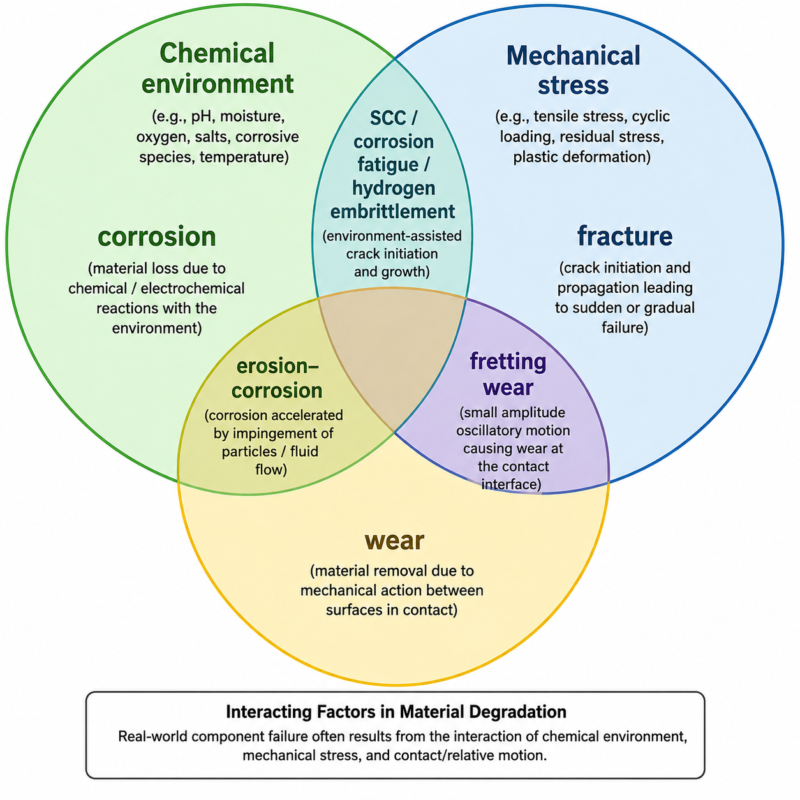
1.3 Degradation, corrosion, wear and fracture — sorting out the family
Students often use these four words interchangeably. They are not interchangeable. "Degradation" is the umbrella; the other three are specific mechanisms underneath it, distinguished by what drives the damage.
| Term | Primary driving agent | What physically happens | Typical example |
|---|---|---|---|
| Degradation | Any (umbrella term) | Loss of structure, properties or dimensions over time | Ageing of any component in service |
| Corrosion | Chemical / electrochemical reaction with the environment | Metal atoms are converted into ions or compounds and leave the metal lattice | Rusting of a steel bridge girder |
| Wear | Mechanical contact and relative motion | Material is physically detached as debris; chemistry unchanged | Abrasion of a pump impeller by sand |
| Fracture | Applied or residual mechanical stress | Bonds separate along a crack path; component splits | Fatigue crack in an aircraft wing spar |
A quick diagnostic you can apply in an exam: ask where the lost material went. In corrosion, the metal has chemically changed — it is now an ion in solution or an oxide on the surface. In wear, the metal is still metal, just somewhere else as debris. In fracture, no material is lost at all; the component has simply separated into pieces.
Where the categories overlap
Real failures are rarely pure. Some of the most dangerous industrial failures occur precisely where two mechanisms cooperate, and each combination has its own name:
- Erosion–corrosion — flowing fluid mechanically strips away the protective film, exposing fresh metal that corrodes again. Common at pipe elbows and pump casings.
- Stress corrosion cracking (SCC) — a tensile stress plus a specific corrosive species produces cracking at stresses far below the yield strength. Austenitic stainless steel in hot chloride is the classic case.
- Corrosion fatigue — cyclic loading in a corrosive medium; the fatigue limit essentially disappears.
- Hydrogen embrittlement — atomic hydrogen generated by a corrosion reaction diffuses into the lattice and drastically reduces ductility. This is the direct bridge to Lesson 4 of this series, and it is explicitly named in the GATE XE‑C syllabus.
1.4 Why does any of this matter to an engineer?
Four reasons, in rough order of importance.
Safety. Degradation is a leading root cause in catastrophic structural failures. A corroded pipeline wall or an embrittled fastener does not announce itself before it lets go.
Economics. The most widely cited estimate comes from the NACE International IMPACT study, released in 2016. It placed the global cost of corrosion at approximately US$2.5 trillion per year — about 3.4% of global GDP on a 2013 basis — and concluded that applying existing corrosion‑control practices could recover between 15% and 35% of that figure, roughly US$375 to 875 billion annually. Two honest caveats are worth knowing, because this number is often quoted without them: it was extrapolated from national studies conducted in India, the United States, Japan, Kuwait and the United Kingdom, using different methodologies and spanning years from 1970 to 2012. It is best read as an order‑of‑magnitude indicator of scale, not as a precise annual accounting.
Design life and maintenance planning. You cannot specify a 40‑year service life without a quantitative degradation rate. Corrosion allowance — the extra wall thickness added to a vessel purely to be sacrificed — is calculated directly from a predicted penetration rate.
Sustainability. Every corroded component that gets replaced represents fresh ore extraction, fresh smelting energy and fresh emissions. Corrosion control is, quietly, a decarbonisation strategy.
2. What is Corrosion?
2.1 A working definition
Corrosion is the destructive and unintended deterioration of a material — most commonly a metal — caused by chemical or electrochemical reaction with its environment, resulting in loss of material and of engineering properties.
Look carefully at what this definition includes and excludes.
- It says chemical or electrochemical reaction. That is the defining feature. If material is being lost without any chemical conversion, it is wear or erosion, not corrosion.
- It says unintended. Electropolishing dissolves metal by an identical anodic reaction, but we asked it to. Intent is what separates a process from a problem.
- It says most commonly a metal, not only a metal. Ceramics can be attacked by molten salts and glasses can be leached by alkali; polymers degrade by chain scission and oxidation. In broad usage, "corrosion" of non‑metals is often called degradation instead, and GATE follows that convention in the syllabus wording.
2.2 The natural tendency of metals to return to stable states
Here is the single most useful mental picture in the whole subject.
Extractive metallurgy takes an ore and, at great energetic expense, produces a pure metal. Corrosion takes that pure metal and, spontaneously and free of charge, converts it back into a compound chemically very similar to the ore it came from. The two processes form a closed loop, sometimes called the metallurgical cycle or the corrosion cycle.
This picture immediately explains an observation you already know: gold and platinum are found in nature as the free metal, and they also do not corrode. Their compounds are not more stable than the metal, so there is no downhill path to take. Metals that are difficult to extract are, correspondingly, easy to corrode.
2.3 Oxidation of metals — the reaction at the heart of it
Whatever the environment, corrosion of a metal always begins with the same step: a metal atom in the lattice gives up electrons and becomes an ion.
Written for specific metals:
Oxidation is the loss of electrons by a species, accompanied by an increase in its oxidation state. The name is historical — it originally described reaction with oxygen — but the modern definition has nothing necessarily to do with oxygen. A metal dissolving in hydrochloric acid with no oxygen present is still being oxidised, because it is still losing electrons.
This last point matters more than it looks. Students frequently assume corrosion requires oxygen. It does not. It requires an electron acceptor, and oxygen is only one candidate among several.
2.4 Everyday examples from engineering materials
| Material | Environment | Corrosion product | Is the film protective? |
|---|---|---|---|
| Carbon steel | Moist air, rain, road salt | Hydrated iron oxides, written as Fe2O3·xH2O ("rust") | No. The oxide occupies roughly twice the volume of the metal consumed, so it spalls off and exposes fresh steel. Attack continues indefinitely. |
| Aluminium | Air, neutral water | Al2O3, a few nanometres thick | Yes. Dense, adherent, self‑healing. This is passivation, covered in Lesson 3. |
| Zinc (on galvanised steel) | Atmosphere | Basic zinc carbonate; loose "white rust" if wet and unventilated | Partly. Zinc also protects the steel sacrificially, which matters more than its own film. |
| Copper / bronze | Urban and marine atmosphere | Green patina of basic copper sulfate and carbonate | Yes. The patina on old copper roofs is why they survive a century. |
| Silver | Trace H2S in air | Ag2S (black tarnish) | Cosmetically bad, structurally trivial — but electrically serious on contacts. |
| Steel rebar in concrete | Chloride ingress, carbonation | Expansive iron oxides | No — and actively destructive. The volume expansion cracks and spalls the surrounding concrete. |
Notice that the useful question is never "did an oxide form?" but "what kind of oxide formed?" Whether a film protects depends largely on its volume relative to the metal it replaced — quantified by the Pilling–Bedworth ratio, which we derive in Lesson 2 on dry oxidation.
3. Chemical and Electrochemical Corrosion
Corrosion happens by two mechanistically distinct routes. Telling them apart is a standard examination question and, more importantly, determines which equations you are allowed to use.
3.1 Chemical (dry / direct) corrosion
Chemical corrosion, also called dry corrosion or direct chemical attack, is the direct reaction of a metal surface with a gas or a non‑conducting liquid, in the absence of any electrolyte. Metal atoms and the reacting species exchange electrons at the point of contact; there is no separate anode and cathode and no long‑range flow of electrons or ions.
The everyday image: hold a piece of steel in a furnace at 800 °C in air. A grey‑black scale grows uniformly over the whole surface. No water is present, no ions are moving through a solution — oxygen molecules simply meet iron atoms and react.
How it proceeds after the first layer. Once a continuous scale covers the metal, the reactants can no longer touch. Further growth requires solid‑state diffusion: either metal ions diffuse outward through the scale, or oxygen ions diffuse inward. Because the scale gets thicker with time, the diffusion path gets longer and growth slows. This produces the parabolic growth law:
Two other laws are also observed. A linear law (x = klt) applies when the scale is porous or cracked and offers no diffusion barrier — growth never slows. A logarithmic law applies to very thin films at low temperature. Which law you see is really a statement about how good a barrier the scale is.
Where you meet dry corrosion in practice: gas turbine blades, boiler superheater tubes, furnace fixtures, exhaust manifolds, reheat furnace scale on steel billets, sulfidation in refinery heaters, and attack of steel by dry chlorine or hydrogen sulfide gas.
3.2 Electrochemical (wet) corrosion
Electrochemical corrosion, also called wet corrosion, occurs when a metal is in contact with an electrolyte. Oxidation and reduction take place at physically separate locations on the surface, connected by electrons flowing through the metal and by ions flowing through the electrolyte. The metal is effectively behaving as a short‑circuited battery.
This is by far the more common mechanism at ordinary temperatures, and it is responsible for essentially all atmospheric, marine, soil and process‑water corrosion. Because charge flows, the process obeys the laws of electrochemistry — which means we can measure it as a current, predict it with electrode potentials, and stop it by injecting current from outside. None of that is possible for dry corrosion.
"Wet corrosion" does not require the component to be sitting in a bucket of water. A film of adsorbed moisture a few molecules thick, condensed dew, or a damp salt deposit is a perfectly good electrolyte. This is why atmospheric corrosion accelerates sharply above a critical relative humidity — typically around 60–80% depending on the surface contaminants.
3.3 Comparison
| Basis of comparison | Chemical (dry) corrosion | Electrochemical (wet) corrosion |
|---|---|---|
| Electrolyte required | No | Yes — essential |
| Medium | Dry gases (O2, Cl2, SO2, H2S), molten metals, non‑conducting organic liquids | Aqueous solutions, moist air, soil, molten salts, body fluids |
| Typical temperature | Usually elevated (hundreds of °C) | Ambient to moderate |
| Anodic and cathodic sites | Not separated — reaction occurs at the point of contact | Physically separated, sometimes by metres |
| Charge transport | None over distance; electrons transfer locally | Electrons through the metal; ions through the electrolyte |
| Location of the product | Directly on the reacting surface, usually uniform | Often away from the anode, where the ion streams meet |
| Rate‑controlling step | Solid‑state diffusion through the scale | Charge transfer, or diffusion of reactants in the electrolyte |
| Rate law | Linear, parabolic or logarithmic | Governed by Faraday's laws; rate ∝ corrosion current density |
| Does Faraday's law apply? | Not in the electrochemical sense | Yes — this is what makes quantitative prediction possible |
| Attack morphology | Generally uniform | Uniform or highly localised (pitting, crevice, galvanic) |
| Can cathodic protection stop it? | No | Yes |
| Example | Scaling of a boiler tube at 600 °C | Rusting of a car door sill in winter |
If a question mentions a specific temperature above a few hundred degrees and a gas, think dry oxidation and reach for the parabolic law. If it mentions water, humidity, soil, seawater, an acid, or two dissimilar metals in contact, think electrochemical and reach for electrode potentials and Faraday's law. The word "galvanic" anywhere in the stem guarantees an electrochemical answer.
4. Electrochemical Cell Basics
We now build the vocabulary needed to describe a corrosion cell. If you have never studied electrochemistry, start here and do not skip anything — the rest of the series assumes every term in this section.
4.1 Oxidation and reduction
Chemistry has a bookkeeping system for electrons. Every reaction that transfers electrons has two halves, and they must happen together: electrons cannot simply be discarded into the void.
Oxidation — a species loses electrons; its oxidation state increases.
Reduction — a species gains electrons; its oxidation state decreases.
The name "reduction" is confusing until you see its origin: gaining negative charge reduces the oxidation number. Fe3+ gaining one electron becomes Fe2+ — the number went down.
The standard memory aid is OIL RIG: Oxidation Is Loss, Reduction Is Gain (of electrons). It is worth memorising because you will use it constantly.
A reaction containing both halves is called a redox reaction. For example, when zinc metal is dropped into copper sulfate solution:
Zinc dissolves; copper metal plates out. The two electrons released by each zinc atom are exactly the two consumed by each copper ion. Electron balance is always exact. If your half‑reactions do not balance in electrons, the answer is wrong.
4.2 Oxidising and reducing agents
These two terms cause more errors than any others in introductory electrochemistry, because their names appear to mean the opposite of what they do.
An oxidising agent is a species that causes another species to be oxidised. To do that, it must accept the electrons — so the oxidising agent is itself reduced.
A reducing agent is a species that causes another to be reduced. It must donate electrons — so the reducing agent is itself oxidised.
An analogy that students find sticks: an oxidising agent is like a generous host who insists on taking your coat. The host ends up holding a coat (gains electrons, is reduced); you end up without one (lose electrons, are oxidised). The agent always does the opposite of what its name suggests happens to it.
In corrosion, the roles are almost always fixed:
- The metal is the reducing agent. It donates electrons and is oxidised. It is the thing being destroyed.
- The environment supplies the oxidising agent. Common ones: dissolved O2, H+ from an acid, Cl2, Fe3+ ions, and Cu2+ ions.
In the zinc/copper example above, Zn is the reducing agent and Cu2+ is the oxidising agent.
4.3 Anode and cathode
The anode is the electrode at which oxidation occurs.
The cathode is the electrode at which reduction occurs.
These definitions are absolute. They never change, in any type of cell, under any circumstance.
Two mnemonics, both worth keeping:
- AN OX and RED CAT — ANode = OXidation; REDuction = CAThode.
- Both words starting with a vowel go together: Anode / Oxidation. Both consonant words go together: Cathode / Reduction.
The anode is where the metal corrodes. Metal atoms leave the lattice as ions only at anodic sites. The cathode is protected — it is where something in the environment gets reduced instead. Every corrosion‑control strategy ultimately works by making the metal you care about cathodic, or by starving the cathode of its reactant.
4.4 Anode/cathode versus positive/negative — clearing this up permanently
Here is the trap. Students are taught in one course that the anode is negative and in another that the anode is positive, and conclude that one of the courses was wrong. Neither was. The sign of an electrode depends on the type of cell; the oxidation/reduction definition does not.
Galvanic (voltaic) cell — the reaction is spontaneous
A galvanic cell releases energy. A battery on discharge, and every corrosion cell, is of this type. At the anode, metal atoms dissolve and leave their electrons behind in the metal. Those surplus electrons make the anode electron‑rich, hence the negative terminal. Electrons then flow through the external circuit to the cathode.
Electrolytic cell — the reaction is driven by an external supply
An electrolytic cell consumes energy. Electroplating, electrorefining, battery charging and impressed‑current cathodic protection are of this type. Here an external power source pulls electrons away from one electrode, forcing oxidation there. The electrode connected to the positive terminal of the supply is the one being drained, so the anode is positive.
| Galvanic cell (spontaneous) | Electrolytic cell (driven) | |
|---|---|---|
| Energy | Produces electrical energy; ΔG < 0 | Consumes electrical energy; ΔG > 0 for the forced reaction |
| Anode | Oxidation · NEGATIVE terminal | Oxidation · POSITIVE terminal |
| Cathode | Reduction · POSITIVE terminal | Reduction · NEGATIVE terminal |
| Direction of electron flow in the external circuit | Anode → Cathode, in both cases, always | |
| Anions in the electrolyte migrate toward | The anode, in both cases (this is why it is named the "an‑ode") | |
| Relevance to corrosion | Corrosion cells, galvanic couples, sacrificial anode protection, batteries on discharge | Electroplating, anodising, electrorefining, impressed‑current cathodic protection |
Do not try to remember the signs. Remember only two facts that never change — anode = oxidation, and anions always move toward the anode — then reason out the sign from the physics of the specific cell. In a corrosion problem you will almost always be dealing with a galvanic cell, so the anode is negative and it is the part that dissolves.
4.5 Electrolyte
An electrolyte is a medium that conducts electricity by the movement of ions rather than electrons. It must contain mobile charged species and must not conduct electronically, or it would simply short‑circuit the cell internally.
Pure, deionised water is a poor electrolyte because it contains very few ions. Add sodium chloride and its conductivity rises by orders of magnitude — which is precisely why seawater and de‑icing salt are so aggressive. Increasing electrolyte conductivity lets anodic and cathodic sites sit further apart while still passing current, so a single anode can drive corrosion over a much larger area.
Practical electrolytes in corrosion engineering include seawater, river and process water, soil moisture, condensed atmospheric moisture, acid and alkali process streams, concrete pore solution, and physiological fluid around a surgical implant.
4.6 Electron flow and ionic current — completing the circuit
An electrochemical cell is a genuine closed electrical circuit. It has two halves, carrying charge by two different mechanisms, and both must work or the cell stops.
- Electronic path (inside the metal). Electrons released at the anode travel through the metal to the cathode. In a corroding steel plate this may be a journey of only micrometres between adjacent grains; in a galvanic couple of a copper pipe bolted to a steel tank it may be metres.
- Ionic path (through the electrolyte). Positive ions (cations) migrate toward the cathode; negative ions (anions) migrate toward the anode. This ionic drift carries exactly the same current, closing the loop.
Electron flow is anode → cathode through the metal. Conventional current, defined as the direction positive charge would move, is the opposite: cathode → anode inside the metal, and anode → cathode through the electrolyte. Examiners exploit this deliberately. Read whether the question asks for electron flow or current, and answer the one that was asked.
4.7 Putting it together: the four requirements of a corrosion cell
Electrochemical corrosion cannot occur unless all four of the following are present simultaneously:
- ▸ An anode — a site where metal oxidises.
- ▸ A cathode — a site where a species in the environment is reduced.
- ▸ An electrolyte — in contact with both, carrying the ionic current.
- ▸ An electronic connection — a metallic path between anode and cathode.
This list is not merely descriptive; it is a diagnostic tool. Remove any one of the four and corrosion stops. A paint film removes the electrolyte contact. A dielectric gasket between dissimilar metals removes the electronic connection. Deaeration removes the cathodic reactant. Every prevention method in Lesson 5 is an attack on one of these four legs.
4.8 The reactions that actually occur on corroding steel
At the anode, always:
At the cathode, one of several — which one depends on the environment:
Reaction (c) is the one operating on almost every structure exposed to the weather. Note something important about it: the anodic reaction makes Fe2+, the cathodic reaction makes OH−, and these two ions migrate toward each other and meet in the electrolyte, somewhere between the two sites:
This explains a phenomenon that puzzles people the first time they see it: rust often appears where the metal has not lost thickness. The pit is at the anode; the visible brown deposit precipitates nearby. Do not use the location of rust to locate the damage.
A differential aeration illustration: a single drop of salt water on a flat steel plate, drawn in cross‑section. Label the oxygen‑rich rim of the drop as cathodic and the oxygen‑starved centre as anodic, with a ring of rust deposited between them. This classic demonstration shows that anodic and cathodic sites can arise on a chemically uniform surface purely from a difference in oxygen availability — the mechanism behind crevice and under‑deposit corrosion.
4.9 Quantifying the driving force
We can now say something numerical. Each half‑reaction has a characteristic standard electrode potential, E°, measured in volts against the standard hydrogen electrode (SHE) at 25 °C with all dissolved species at unit activity. By universal convention these are tabulated as reduction potentials.
| Half-reaction (written as reduction) | E° / V vs. SHE | Character |
|---|---|---|
| Au3+ + 3e− → Au | +1.50 | More noble — resists corrosion, tends to be the cathode |
| O2 + 4H+ + 4e− → 2H2O | +1.229 | |
| Ag+ + e− → Ag | +0.80 | |
| O2 + 2H2O + 4e− → 4OH− | +0.401 | |
| Cu2+ + 2e− → Cu | +0.34 | |
| 2H+ + 2e− → H2 | 0.000 | Reference (SHE) |
| Pb2+ + 2e− → Pb | −0.13 | More active — corrodes readily, tends to be the anode |
| Ni2+ + 2e− → Ni | −0.25 | |
| Fe2+ + 2e− → Fe | −0.44 | |
| Cr3+ + 3e− → Cr | −0.74 | |
| Zn2+ + 2e− → Zn | −0.76 | |
| Al3+ + 3e− → Al | −1.66 | |
| Mg2+ + 2e− → Mg | −2.37 |
How to use the table. When two half‑reactions are coupled, the one with the more positive E° proceeds as written (as a reduction, at the cathode); the one with the more negative E° is forced to run in reverse (as an oxidation, at the anode). The cell potential is:
(i) E° is an intensive property. If you multiply a half‑reaction by 2 to balance electrons, do not multiply E° by 2. Doubling the amount of a battery's chemistry does not double its voltage.
(ii) If you reverse a half‑reaction to write it as an oxidation, its potential changes sign. But if you use Equation 1.5 as written, the subtraction handles this for you — so pick one method and stick to it rather than doing both and cancelling your own correction.
The driving force in energy terms comes from thermodynamics:
Because of the minus sign, a positive cell potential gives a negative ΔG, which is the thermodynamic definition of a spontaneous process. Corrosion, in other words, is spontaneous whenever E°cell > 0.
Real systems are rarely at standard conditions. The Nernst equation corrects for actual concentrations:
4.10 From current to corrosion rate
Because electrochemical corrosion is charge transfer, Faraday's law converts a measured current directly into mass loss:
And for expressing that loss as a penetration rate:
4.11 Worked examples
Example 1 — Will zinc corrode when coupled to copper?
A zinc rod and a copper rod are immersed in a solution containing Zn2+ and Cu2+ at unit activity and connected externally. Identify the anode and cathode, calculate E°cell, and find ΔG° at 25 °C.
Step 1 — read the potentials. Cu2+/Cu is +0.34 V; Zn2+/Zn is −0.76 V.
Step 2 — assign the electrodes. Copper has the more positive potential, so copper is reduced — copper is the cathode. Zinc is forced to oxidise — zinc is the anode, and zinc is the metal that corrodes.
Step 3 — cell potential.
Positive, so the reaction is spontaneous. Zinc corrodes.
Step 4 — free energy. The overall reaction is Zn + Cu2+ → Zn2+ + Cu, so n = 2.
Comment. This is exactly why you never bolt a copper fitting directly to galvanised steel in a wet environment. It is also, deliberately inverted, the basis of sacrificial anode protection: attach zinc to steel and the zinc becomes the anode, dissolving so the steel does not.
Example 2 — Converting a measured current density into thickness loss
Uniform corrosion of a carbon steel plate is measured electrochemically as a corrosion current density of 15 μA cm−2. Estimate the annual mass loss per 100 cm2 and the penetration rate in mm/yr. Take MFe = 55.85 g mol−1, ρFe = 7.87 g cm−3, n = 2.
Step 1 — total current.
Step 2 — charge passed in one year. One year = 365 × 24 × 3600 = 3.154 × 10⁷ s.
Step 3 — mass loss by Faraday's law.
Step 4 — convert to thickness.
Comment and a rule of thumb worth memorising. Dividing through, 0.174 ÷ 15 = 0.0116. So for iron, 1 μA cm−2 corresponds to about 0.0116 mm/yr. This conversion lets you sanity‑check any corrosion‑current problem in seconds, and it is a genuinely useful number in practice.
Example 3 — A weight-loss coupon test
A steel coupon of total exposed area 120 cm2 loses 285 mg after 500 hours in a process water. Find the CPR in mm/yr. ρ = 7.87 g cm−3.
Use Equation 1.9 with K = 87.6, since the area is in cm2 and we want mm/yr:
Interpretation. A rate near 0.05 mm/yr is generally regarded as acceptable for carbon steel in non‑critical service; over a 25‑year design life it consumes about 1.3 mm of wall, which a normal corrosion allowance covers. But note the assumption: CPR is an average, and it is only meaningful if the attack is uniform. A coupon showing 0.05 mm/yr average could hide a pit penetrating at 2 mm/yr. Always inspect the coupon, never just weigh it.
Key Concepts to Remember
- ▸ Degradation is the umbrella term; corrosion (chemical change), wear (mechanical removal) and fracture (mechanical separation) are distinct mechanisms beneath it, distinguished by what drives the damage.
- ▸ Corrosion is thermodynamically inevitable for most engineering metals because refining pushes them to a higher free energy than their ores. Corrosion is the return journey.
- ▸ Thermodynamics decides whether; kinetics decides how fast. Nearly all practical protection works on the kinetics.
- ▸ Corrosion resistance is a property of the material–environment pair, never of the material alone.
- ▸ Chemical (dry) corrosion needs no electrolyte and is controlled by diffusion through the scale. Electrochemical (wet) corrosion needs an electrolyte and separated anodic/cathodic sites.
- ▸ Anode = oxidation. Cathode = reduction. Always, in every cell. The sign of the electrode changes with cell type; the definition never does.
- ▸ An oxidising agent is itself reduced; a reducing agent is itself oxidised. In corrosion the metal is the reducing agent.
- ▸ The four requirements — anode, cathode, electrolyte, electronic connection — must all be present. Break any one and corrosion stops.
- ▸ Electrons flow anode → cathode through the metal; ions carry the return current through the electrolyte. Conventional current runs the other way in the metal.
- ▸ Rust deposits where the Fe2+ and OH− streams meet, which is generally not where the metal was lost.
- ▸ E°cell > 0 ⟺ ΔG < 0 ⟺ corrosion is spontaneous.
Important Equations
| # | Equation | Use it for | Watch out for |
|---|---|---|---|
| 1.1 | M → Mn+ + n e− | The universal anodic reaction | Getting n right for the metal and its oxidation state |
| 1.3 | x² = kpt + C | Dry oxidation scale growth (protective scale) | Only applies when diffusion through the scale controls the rate |
| 1.5 | E°cell = E°cathode − E°anode | Deciding which metal corrodes, and the driving voltage | Never scale E° by stoichiometric coefficients |
| 1.6 | ΔG = − n F E | Converting a cell voltage into a spontaneity criterion | The minus sign; n is per mole of reaction, not per mole of metal |
| 1.7 | E = E° − (0.0592/n) log Q at 25 °C | Non-standard concentrations | 0.0592 is valid only at 298 K; Q uses activities, products over reactants |
| 1.8 | w = I t M / (n F) | Mass loss from a corrosion current | t must be in seconds if I is in amperes |
| 1.9 | CPR = K W / (ρ A t) | Penetration rate from a weight-loss coupon | K = 87.6 (mg, cm², h → mm/yr); K = 534 (mg, in², h → mpy) |
Common GATE Mistakes
- Assuming the anode is always negative. True for galvanic cells (including all corrosion cells), false for electrolytic cells. Anchor on oxidation, not on sign.
- Multiplying E° by a stoichiometric coefficient. Potential is intensive. Balancing electrons changes n, not E°.
- Forgetting n, or using the wrong n, in ΔG = −nFE. For Al → Al3+, n = 3, not 2. This single slip changes the answer by 50%.
- Double-correcting the sign by both reversing the anodic half‑reaction and using the subtraction form of Equation 1.5. Choose one route.
- Believing corrosion requires oxygen. In deaerated acid, H+ is the oxidising agent and hydrogen gas evolves. No oxygen involved.
- Mixing units in CPR. W in grams instead of milligrams, or area in in2 with K = 87.6, are the classic errors. Match K to your units before you substitute.
- Reporting electron flow when the question asked for conventional current, or the reverse. They are opposite inside the metal.
- Calling high-temperature dry oxidation "electrochemical." With no electrolyte there is no corrosion cell, and cathodic protection cannot help.
- Using the EMF series when the galvanic series is required. The EMF series assumes pure metals at unit activity; the galvanic series ranks real alloys in a real environment, usually seawater, and the two orders differ. Passive stainless steel sits near copper in seawater despite chromium's very negative E°.
- Assuming a low average CPR means the component is safe. Localised pitting can penetrate a wall while the average rate looks negligible.
- Locating the damage by locating the rust. The anodic pit and the visible deposit are usually in different places.
GATE-Level Practice Questions
The following questions were written specifically for this lesson to match the style and difficulty of GATE XE‑C. They are original practice material and are not reproduced from any past GATE paper.
Q1 (MCQ, 1 mark). During electrochemical corrosion of a metal in aerated neutral water, the anodic reaction is:
(a) O2 + 2H2O + 4e− → 4OH− (b) M → Mn+ + ne− (c) 2H+ + 2e− → H2 (d) Mn+ + ne− → M
Answer: (b). The anode is by definition the site of oxidation, i.e. electron loss by the metal. Options (a), (c) and (d) are all reductions and therefore cathodic.
Q2 (MCQ, 1 mark). Which statement about the anode is correct in all electrochemical cells?
(a) It is the negative terminal (b) It is the positive terminal (c) Oxidation occurs there (d) Cations migrate toward it
Answer: (c). The anode is defined by oxidation. It is negative in a galvanic cell and positive in an electrolytic cell, so (a) and (b) are each true only half the time. Option (d) is wrong in the opposite direction — anions migrate toward the anode; cations go to the cathode.
Q3 (MCQ, 1 mark). Which of the following is not required for electrochemical corrosion to proceed?
(a) An electrolyte (b) Dissolved oxygen (c) An anodic site (d) An electronic path between anodic and cathodic sites
Answer: (b). Oxygen is one possible oxidising agent but not the only one. In deaerated acid the cathodic reaction is 2H+ + 2e− → H2, and corrosion proceeds vigorously with no oxygen present. The other three are among the four essential requirements.
Q4 (NAT, 2 marks). A galvanic couple is formed between magnesium (E° = −2.37 V) and iron (E° = −0.44 V) in a suitable electrolyte. Calculate E°cell in volts.
Iron has the more positive potential, so iron is the cathode and magnesium is the anode.
E°cell = E°cathode − E°anode = (−0.44) − (−2.37) = +1.93 V
Engineering significance: magnesium corrodes preferentially, protecting the iron. This is exactly how magnesium sacrificial anodes on buried pipelines and water heaters work.
Q5 (NAT, 2 marks). For the reaction Zn + Cu2+ → Zn2+ + Cu, E° = 1.10 V. Calculate ΔG° in kJ mol−1. (F = 96 485 C mol−1)
Two electrons are transferred per mole of reaction, so n = 2.
ΔG° = −nFE° = −(2)(96 485)(1.10) = −212 267 J mol−1 ≈ −212 kJ mol−1
Common error: using n = 1, giving −106 kJ mol−1. Count the electrons in the balanced half‑reactions, not the number of species.
Q6 (NAT, 2 marks). A steel specimen of exposed area 250 cm2 loses 640 mg in 720 hours. Taking ρ = 7.87 g cm−3, find the corrosion penetration rate in mm/yr.
Area is in cm2 and the answer is wanted in mm/yr, so use K = 87.6.
CPR = KW/(ρAt) = (87.6 × 640) / (7.87 × 250 × 720)
= 56 064 / 1 416 600 = 0.0396 mm/yr (≈ 0.040 mm/yr)
Check: if you got roughly 39.6, you left W in grams somewhere or dropped a factor of 1000. If you got about 0.24, you used K = 534 with cm2.
Q7 (NAT, 2 marks). A copper anode dissolves under a steady current of 2.0 A for 45 minutes. Calculate the mass of copper lost. (MCu = 63.55 g mol−1, n = 2)
t = 45 × 60 = 2700 s.
w = ItM/(nF) = (2.0 × 2700 × 63.55) / (2 × 96 485)
= 343 170 / 192 970 = 1.78 g
Common error: leaving t in minutes, which inflates the answer sixtyfold. Amperes are coulombs per second.
Q8 (MCQ, 2 marks). Which combination correctly describes high-temperature scaling of a steel component in dry air at 700 °C?
(a) Electrochemical; parabolic kinetics; preventable by cathodic protection
(b) Chemical; parabolic kinetics; controlled by ionic diffusion through the scale
(c) Electrochemical; linear kinetics; requires an electrolyte
(d) Chemical; linear kinetics; controlled by charge transfer at the metal surface
Answer: (b). Dry air provides no electrolyte, so the mechanism is chemical, not electrochemical — which also rules out cathodic protection. Once a continuous adherent scale forms, growth is limited by solid‑state diffusion through it, giving parabolic kinetics. Linear kinetics would indicate a porous or cracked non‑protective scale.
Q9 (Conceptual, 2 marks). A steel plate corroding under a droplet of salt water develops a rust ring some distance from the pit. Explain why, and state which region is anodic.
Oxygen dissolves into the droplet most readily at its thin outer rim, so the rim is oxygen‑rich and supports the cathodic reaction O2 + 2H2O + 4e− → 4OH−. The droplet centre is oxygen‑starved and becomes anodic: Fe → Fe2+ + 2e−. Metal is therefore lost at the centre.
Fe2+ migrates outward and OH− migrates inward. Where the two streams meet, they precipitate Fe(OH)2, which oxidises further to rust — producing a ring between the anodic centre and the cathodic rim.
This is differential aeration corrosion, and it is the mechanism behind crevice corrosion, under‑deposit corrosion, and waterline attack. Note the key lesson: anodic and cathodic sites arose on a chemically uniform surface, purely from a gradient in oxygen availability.
Q10 (Conceptual, 2 marks). Aluminium has a far more negative standard electrode potential than iron (−1.66 V vs −0.44 V), yet aluminium window frames outlast steel ones outdoors. Resolve this apparent contradiction.
The potentials describe thermodynamics — the driving force for corrosion. On that basis aluminium is indeed far more reactive, and the comparison is correct as far as it goes.
Service life, however, is governed by kinetics — the rate. Aluminium reacts immediately to form a thin, dense, adherent and self‑repairing Al2O3 film that isolates the metal from the environment, dropping the rate to a negligible level. This is passivation. Iron forms a porous, poorly adherent rust that spalls and continually exposes fresh metal, so its rate stays high.
The general principle: a large thermodynamic driving force does not imply a fast reaction. Always check whether the corrosion product forms a protective barrier.
Where This Leads
You now hold the two ideas that organise everything ahead. First, corrosion is a metal returning to the state nature prefers, so the driving force is always there. Second, whether that driving force actually damages your component depends on how easily the four elements of a corrosion cell can assemble and how effectively any surface film obstructs them.
In Lesson 2 we take the dry route further, deriving the Pilling–Bedworth ratio and using it to predict which oxides protect and which do not. Lesson 3 develops the electrochemical route quantitatively — polarisation, passivation and Pourbaix diagrams — and Lessons 4 to 6 cover the specific forms of attack, embrittlement of metals, and polymer degradation, completing Section 6 of the GATE XE‑C syllabus.
Before moving on, test yourself honestly on one thing: can you write down the four requirements of a corrosion cell, and name a practical prevention method that defeats each one? If yes, you are ready for Lesson 2.
Further Reading
- M. G. Fontana, Corrosion Engineering, 3rd ed., McGraw‑Hill — still the most readable introduction to corrosion forms and control.
- D. A. Jones, Principles and Prevention of Corrosion, 2nd ed., Prentice Hall — stronger on the electrochemical theory and polarisation behaviour.
- W. D. Callister & D. G. Rethwisch, Materials Science and Engineering: An Introduction, Chapter 17 — the source of the CPR constants used above, and closely aligned with the GATE syllabus level.
- NACE International, International Measures of Prevention, Application, and Economics of Corrosion Technologies (IMPACT), 2016 — the origin of the widely quoted global cost figure discussed in Section 1.4.
- ASTM G193, Standard Terminology and Acronyms Relating to Corrosion — for precise definitions when terminology is disputed.