
New Battery Patent 2026: The Cell Architecture That Could Help Advance Solid-State Batteries
A recently published battery-device patent draws attention to an often-overlooked part of the solid-state battery race: how electrodes, insulating components and ion-conducting layers are assembled into a stable and safe cell.
The next generation of batteries may depend not only on discovering better materials, but on learning how to assemble those materials into mechanically stable, electrically safe and manufacturable devices.
Better Materials Are Only Half the Battery Story
When we hear about the race to develop solid-state batteries, attention usually goes to the materials: a new solid electrolyte, a lithium-metal anode, a high-capacity cathode or a material promising faster ion transport.
But discovering better materials is only part of the challenge.
Those materials eventually have to become a battery cell.
Electrodes must remain properly positioned. Positive and negative components must remain electrically isolated. Ion-conducting layers must maintain effective contact. The complete assembly must tolerate manufacturing stresses and repeated operation without compromising safety.
That engineering challenge is what makes CN224248833U interesting.
Published in China on May 15, 2026, the utility model concerns a battery device and associated electrical equipment. Its significance for MATTERQUEST is therefore not a claim that somebody has suddenly invented the definitive solid-state battery. Rather, it provides a window into the less glamorous—but essential—engineering problems that must be solved as advanced battery technologies move toward practical devices.
Better battery materials alone are not enough. They must be assembled into a cell that remains mechanically stable, electrically isolated and electrochemically functional throughout operation.
The Problem Behind the Patent
Imagine looking inside a battery cell.
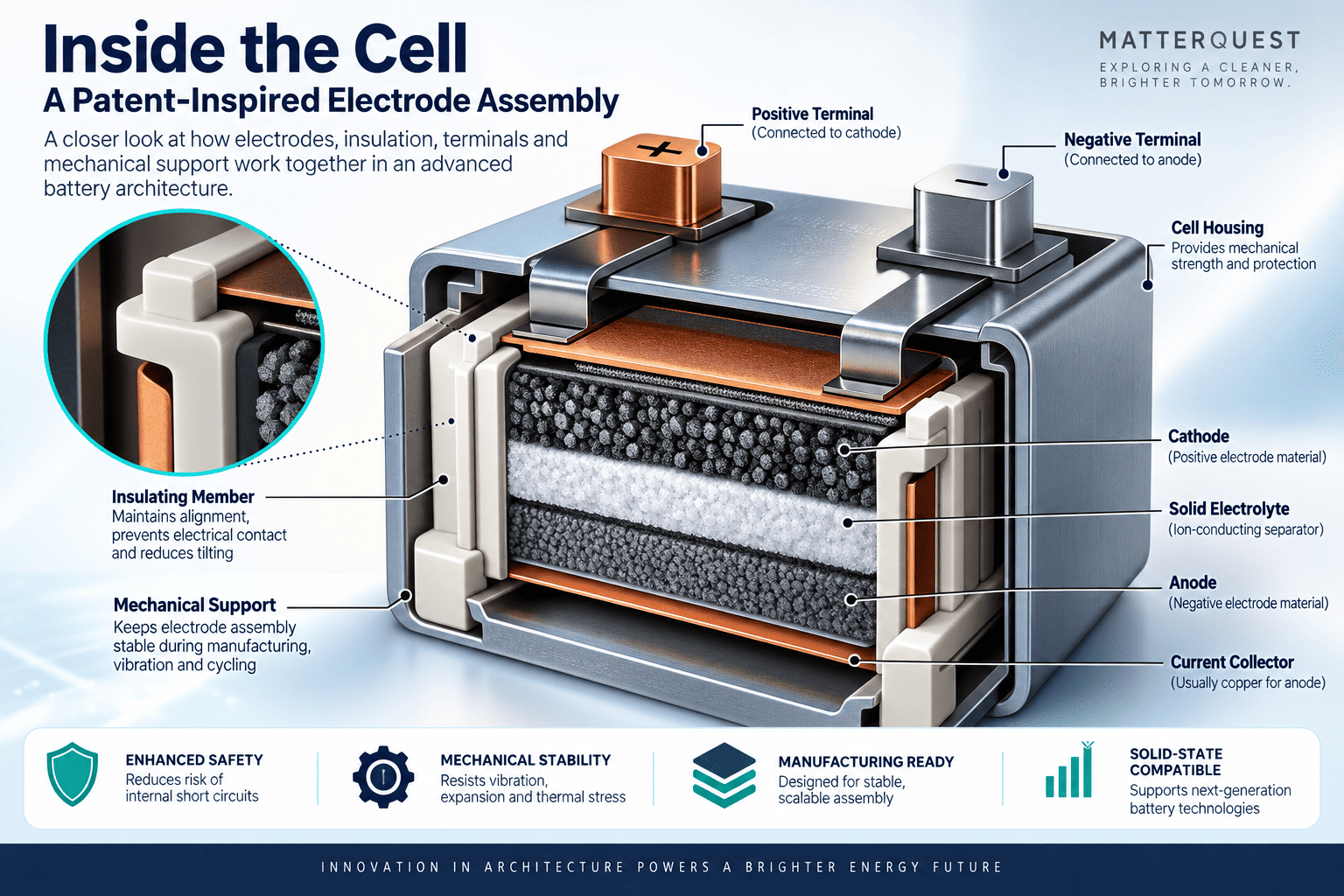
At its heart is an electrode assembly containing positive and negative electrochemical components separated so that ions can move through the cell while direct electronic contact between opposite electrodes is prevented.
That arrangement sounds straightforward.
In a real battery, however, the components do not exist in a perfectly static laboratory diagram.
They experience forces during manufacturing and assembly. They can encounter vibration and mechanical loading. Temperature changes can produce expansion and contraction, while electrochemical cycling can introduce further dimensional and interfacial changes.
If parts of an electrode assembly shift, tilt or lose their intended positioning, the consequences can become serious. Insulation may be compromised, local stresses may develop, and unwanted electrical contact can increase the risk of internal short circuits.
The patent addresses this broader cell-architecture problem, including the relationship between the electrode assembly, housing, terminals and insulating components.
The innovation story is not simply about what the battery is made from. It is also about how the battery is physically put together.
Where Solid-State Technology Enters the Picture
This is where the story becomes particularly interesting for materials scientists.
In a conventional lithium-ion cell, a porous separator physically prevents the positive and negative electrodes from touching, while an electrolyte provides the medium through which lithium ions travel.
A solid-state architecture can change that arrangement.
A suitable solid electrolyte can act as an ion-conducting medium while also contributing to the physical separation of the electrodes.
That sounds like an elegant solution. But replacing a liquid-containing electrolyte system with solid components introduces another difficult problem: solid materials must maintain effective interfaces with other solid materials.
Tiny gaps, loss of contact, mechanical deformation and interfacial instability can all influence how effectively ions cross these boundaries.
The solid-state battery challenge is no longer only “Can we discover a better solid electrolyte?” It is also “Can we build an entire cell around it that remains stable, safe and functional?”
That is why battery-architecture patents deserve attention alongside spectacular new materials discoveries.
The Solid-State Battery Race Is Becoming an Engineering Race
Solid-state batteries are often presented through headline numbers: higher energy density, longer electric-vehicle range, faster charging or improved safety.
Those targets are important. But between a promising laboratory material and a commercially manufactured battery lies an enormous engineering challenge.
From Materials Discovery to Device Engineering
For materials scientists, CN224248833U illustrates a useful shift in perspective.
Battery development can be thought of as several interconnected layers.
A breakthrough at the first level does not automatically guarantee success at the last.
That is one reason the global battery patent landscape is so interesting: intellectual-property activity can reveal where companies and inventors believe the remaining engineering bottlenecks lie.
A Technology Moving Beyond the Search for a “Miracle Material”
Solid-state battery research is increasingly extending beyond the search for a single “miracle material.”
Researchers and manufacturers are simultaneously investigating solid-electrolyte chemistry, electrode/electrolyte interfaces, lithium-metal compatibility, mechanical pressure, manufacturing processes and complete cell architectures.
This is exactly what we should expect from a technology moving from materials discovery toward device engineering.
CN224248833U should therefore be viewed within this larger technological landscape.
It does not, by itself, demonstrate that a commercially ready solid-state battery has arrived.
Nor should it be interpreted as a patent covering only an all-solid-state battery.
Its value for Patent Watch is subtler—and scientifically more interesting.
It reminds us that the future of batteries may depend just as much on how advanced materials are integrated as on the discovery of the materials themselves.
Worth Watching
The most interesting aspect of this patent is not a headline-grabbing new battery chemistry. It is the engineering problem underneath it.
Moving solid-state batteries from promising laboratory materials to dependable devices will require advances in mechanical support, electrical isolation, interface control and cell architecture alongside improvements in solid electrolytes and electrodes.
The next battery revolution will not be won by materials chemistry alone. It will be won when materials, interfaces and engineering finally work together.
Patent Watch · Editor's Note
Why we selected it: MATTERQUEST Patent Watch does not treat every newly published patent as a technological breakthrough. We select patents that reveal an interesting direction in materials science or engineering and examine what they actually tell us.
A patent is evidence of an invention or claimed technical approach—not evidence by itself of commercial readiness, mass production or proven market performance.