
Diamond Was Considered Non-Piezoelectric for a Century. Scientists Just Found an Exception
An ultrathin polycrystalline diamond membrane can produce an electrical response when bent — revealing how tiny grain boundaries can give an apparently non-piezoelectric material an unexpected new property.
Diamond has spent more than a century with a very clear reputation in physics. It is extraordinarily hard, chemically stable, thermally conductive — and, according to conventional crystallography, not piezoelectric.
In other words, bend an ordinary piece of diamond and it should not behave like the piezoelectric materials used in sensors, actuators and energy harvesters. Its highly symmetric crystal structure does not normally allow mechanical deformation to create the electrical polarization required for the conventional piezoelectric effect.
But a research team led by scientists at the University of Hong Kong has now discovered something remarkable: when diamond is made as an ultrathin polycrystalline membrane, bending it can generate a measurable electrical response.
The result does not overturn the physics of ordinary diamond. Instead, it reveals how the boundaries between tiny diamond crystals can create new behaviour that does not exist in a perfect single crystal.
A Strange Movement Inside a Petri Dish
The story began not with a complicated machine, but with something much more ordinary: a plastic Petri dish.
The researchers were storing an extremely thin diamond membrane inside the dish when they noticed that the membrane moved and flexed as the plastic lid approached or moved away.
Plastic can easily accumulate static electrical charge, so the first explanation seemed obvious. Perhaps electrostatic attraction was simply pulling on the diamond.
But the behaviour persisted even after the researchers took steps to remove surface-charge effects. That suggested that the electrical response might not simply be coming from static charge sitting on the outside of the material.
The surprise was not that diamond had changed its crystal structure — it was that imperfections between tiny diamond grains created a new electrical behaviour.
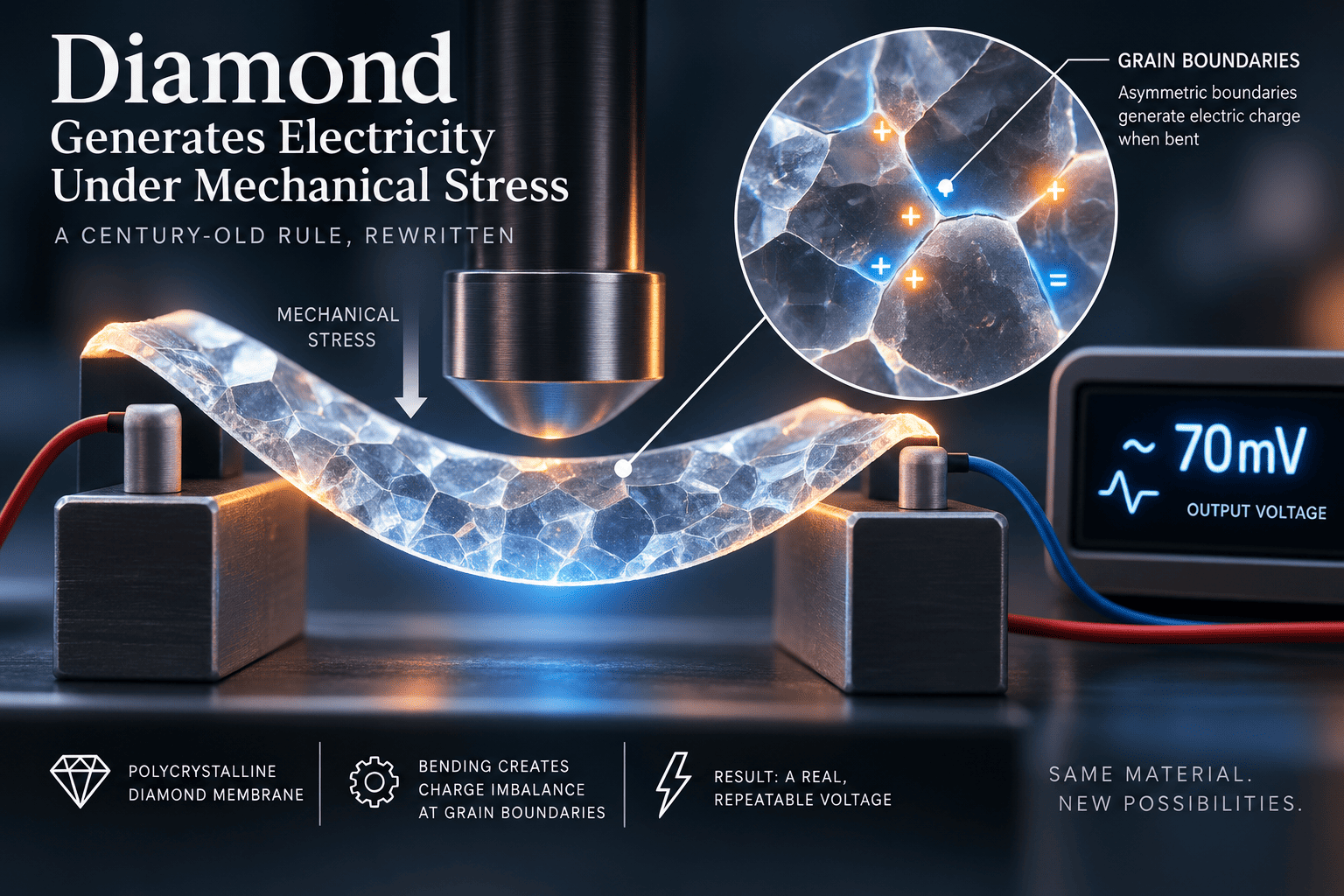
What Happened When the Diamond Membrane Was Bent?
The researchers carefully bent the diamond membranes while monitoring their electrical output and comparing the response against control samples.
At a bending strain of approximately 1.4%, the polycrystalline diamond membrane produced an electrical signal of roughly 70 millivolts.
Most importantly, the signal was repeatable. The response was observed again and again during repeated bending, demonstrating that the effect was connected to the mechanical deformation of the membrane rather than being a single accidental electrical discharge.
Why Polycrystalline Diamond Behaves Differently
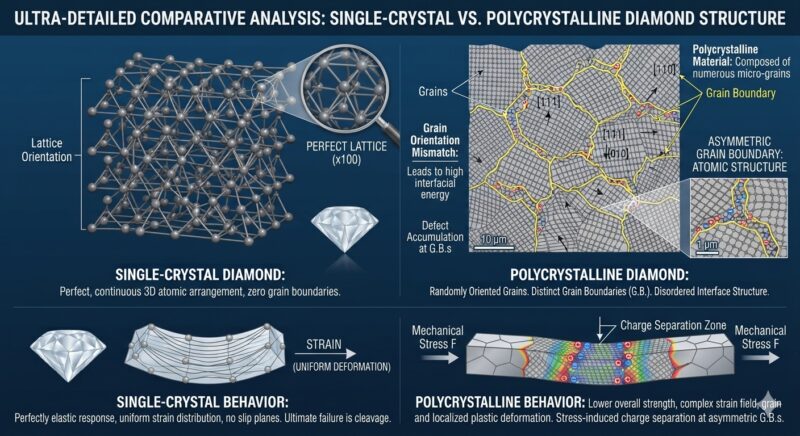
A perfect diamond crystal has a highly ordered, centrosymmetric atomic structure. That symmetry is the reason conventional diamond is not expected to display ordinary piezoelectricity.
The membrane used in this research, however, was not one continuous crystal. It was polycrystalline — meaning it contained many microscopic diamond grains joined together.
Where two grains meet, a grain boundary is formed. The atomic arrangement at that boundary can be different from the highly symmetric arrangement inside the crystal itself.
What is a grain boundary?
Imagine a tiled floor built from many perfectly ordered groups of tiles. Inside each group, the pattern is regular. But where one group meets another group rotated in a different direction, the pattern cannot match perfectly. That interface is similar to a grain boundary inside a polycrystalline material.
According to the researchers, certain grain boundaries locally break the symmetry that normally prevents diamond from behaving piezoelectrically.
When the membrane bends, these asymmetric regions can develop a small redistribution of electrical charge. Across a sufficiently large membrane containing many such boundaries, the microscopic effects can combine into a measurable voltage.
Single-Crystal Diamond
Highly symmetric atomic arrangement. The control experiment showed no comparable measurable piezoelectric voltage under the tested conditions.
Polycrystalline Diamond
Contains grain boundaries where local symmetry can be broken, allowing an electromechanical response to emerge when the membrane is bent.
A Surprisingly Large Piezoelectric Voltage Response
The most striking number in the study is the reported piezoelectric voltage coefficient.
At an optimum membrane thickness of approximately 5 micrometres, the researchers reported a piezoelectric voltage coefficient, g33, of about 82.2 mV·m/N.
That value is higher than the reported voltage coefficients of several familiar piezoelectric materials.
However, this comparison needs to be interpreted carefully. A high g coefficient does not automatically mean that polycrystalline diamond is universally “more piezoelectric” than established materials such as barium titanate or lead zirconate titanate.
The voltage coefficient depends not only on the amount of piezoelectric charge generated but also on the material's dielectric permittivity. Diamond has a relatively low dielectric constant, which helps produce a large voltage response.
Why g33 matters
The piezoelectric charge coefficient tells us how much electrical charge a material produces under mechanical stress. The voltage coefficient tells us how effectively that response appears as an electrical field or voltage. For sensor and energy-harvesting applications, a large voltage response can be particularly useful.
The Effect Survived Thousands of Bending Cycles
A useful electromechanical material must do more than generate one impressive voltage reading. It must continue working when repeatedly deformed.
In the reported experiments, the diamond membrane maintained a stable response over more than 7,000 bending cycles.
That does not yet prove long-term commercial durability, but it provides an encouraging indication that the effect can survive repeated mechanical operation.
A Material That Could Sense and Survive
Diamond already possesses a combination of properties that engineers find difficult to obtain in a single material: exceptional hardness, high thermal conductivity, chemical stability and resistance to harsh environments.
If reliable piezoelectric behaviour can now be engineered into thin polycrystalline diamond structures, the same material could potentially act both as a mechanically robust device platform and as an active sensing element.
Researchers therefore see possible future applications in self-powered sensors, miniature electromechanical systems, energy-harvesting devices and biomedical technologies.
The possibility is especially interesting for environments in which conventional piezoelectric materials may struggle because of heat, wear or chemical exposure.
Sometimes the Boundary Matters More Than the Crystal
The broader lesson from this research reaches beyond diamond.
Materials science has traditionally paid enormous attention to the ideal crystal: the perfect repeating arrangement of atoms that defines a material's fundamental structure.
But real materials are rarely perfect.
They contain interfaces, defects, vacancies, surfaces and grain boundaries — features once regarded mainly as imperfections.
Increasingly, researchers are learning that these imperfections can be deliberately used to create properties that the perfect crystal does not possess.
In this case, diamond did not suddenly violate the symmetry rules of physics. Instead, microscopic regions inside polycrystalline diamond escaped the symmetry constraints that apply to an ideal single crystal.
The discovery is less about breaking a law of physics and more about learning how cleverly engineered imperfections can create entirely new material functions.
MATTERQUEST Reality Check: This is still an early-stage research result. A measurable laboratory voltage does not yet mean commercial diamond-powered sensors are ready for production. Researchers will need to demonstrate scalable manufacturing, reliable device integration, long-term stability and independent replication before the technology can move toward widespread application.
The Takeaway
For more than a century, diamond's symmetry made its electrical behaviour appear settled.
Yet an ultrathin membrane made from many tiny diamond grains has shown that the story changes at the boundaries between those grains.
That makes this discovery more than an unusual property of one famous material. It is another example of a powerful idea reshaping modern materials science: properties can emerge not only from what a material is made of, but also from how its internal structure is organized at the smallest scales.
Sometimes the next technology is not hidden inside a completely new material. Sometimes it is waiting inside a familiar one, at a boundary scientists have looked past for decades.
Jixiang Jing et al., “Uncovering piezoelectric effect in polycrystalline diamond membranes,” Science Advances, Volume 12, Issue 12, 2026, article eaea8318.