
Ginzburg–Landau–Devonshire (GLD) Theory: A Simple Explanation with Infographics
Have you ever wondered how scientists explain the strange behaviour of materials that suddenly change their properties. For example, a ferroelectric crystal becomes depolarized at a certain critical temperature. How? To understand this, physicists use a powerful mathematical tool called the Ginzburg–Landau–Devonshire (GLD) theory. For research scholars, the Ginzburg–Landau–Devonshire theory is a powerful bridge between theory and experiment. It not only explains the physics of ferroelectrics but also equips them with tools to design, model, and analyses new functional materials across nanotechnology, energy, and electronics.
Don’t worry if this sounds complicated — let’s break it down step by step, with the help of real graphs and simple language.
What is GLD Theory?
Table of Contents
Ginzburg–Landau–Devonshire (GLD) theory is the analysis of the free energy of the material system as a function of something called an order parameter. It is based on the fact that a physical system always tries to stay in the position where its energy is the least, because that makes it most stable. It’s like a ball rolling down a slope—it finally stops at the bottom of the valley and stays there unless you give it a strong push.
Let’s understand this by taking the example of ferroelectric materials. In ferroelectrics (materials that can be electrically polarized), the order parameter is the polarization (P) and the free energy of the material system tells us how stable or unstable the material is in its different states. In short, GLD theory is like a road map that shows where the material is most comfortable (stable state) and where it feels uneasy (unstable state). Within this framework, the free energy is expressed as a function of polarization (P) and represented graphically. The form of this energy landscape varies under different physical conditions, as shown below. Let’s walk through the graph bit-by-bit so it’s crystal clear for students. I’ll keep the language simple and point to exactly what each feature means.
Mathematical Explanation
Starting Point: Free Energy Expansion
In GLD theory, the free energy F of a ferroelectric system is expressed as a power series expansion of the order parameter, which is the polarization P.
\[ F(P) = F_{0} + \alpha P^{2} + \beta P^{4} + \gamma P^{6} + \dots \]
- F0: reference energy (constant, often ignored in calculations).
- α, β, γ...: temperature-dependent expansion coefficients.
- The expansion includes only even powers of P because the system is symmetric under \(P \to -P\).
Temperature Dependence of Coefficients
The most important parameter is α, often written as:
α = α0(T−Tc)
where
T = Temperature,
Tc = Critical temperature (Curie temperature),
α0 > 0.
This means:
- For T > Tc: α > 0 → minimum at P=0 (paraelectric phase).
- For T < Tc : α < 0 → double-well potential with minima at ± P0 (Ferroelectric phase).
Finding Equilibrium Polarization
To find stable states, minimize the free energy:
For the truncated expansion up to \(P^4\):
Take derivative and set it to zero:
So equilibrium solutions:
- \(P = 0\) — paraelectric solution (no spontaneous polarization).
- \(P = \pm\sqrt{\dfrac{-\alpha}{2\beta}}\) — ferroelectric minima (valid when \(\alpha < 0,\; \beta > 0\)).
Stability Condition
For stability, the second derivative of the free energy must be positive:
Evaluate at P = 0:
Therefore it is stable at P = 0 if α > 0.
Evaluate at nonzero equilibrium points:
P = ± √( -α / (2β) ) (valid when α < 0 and β > 0).
Substituting yields d2F / dP2 = −4α, which is > 0 when α < 0.
Hence these ±P0 points are stable minima when α < 0.
Conclusion: The sign of α changes at the critical temperature T = Tc, so the energy landscape changes from a single minimum at P = 0 (α > 0) to a double-well with minima at ±P0 (α < 0). This explains the phase change at T = Tc.
Higher-order terms and first-order transition
If β < 0, the quartic term destabilizes the potential. In that case a stabilizing sixth-order term (γ P6) must be included in the free-energy expansion:
Including the γ P6 term with γ > 0 restores stability at large |P| and allows the free-energy landscape to have multiple minima with different energies. This extra term lets the GLD model describe first-order phase transitions (where polarization jumps discontinuously) observed in some ferroelectric materials.
The power series expansion in GLD theory mathematically explains how the free energy depends on polarization. The coefficients (especially α) determine whether the system is paraelectric (P = 0) or ferroelectric (P ≠ 0), and higher-order terms allow for more complex transitions.
The Free Energy Graph on Ginzburg–Landau–Devonshire (GLD) model
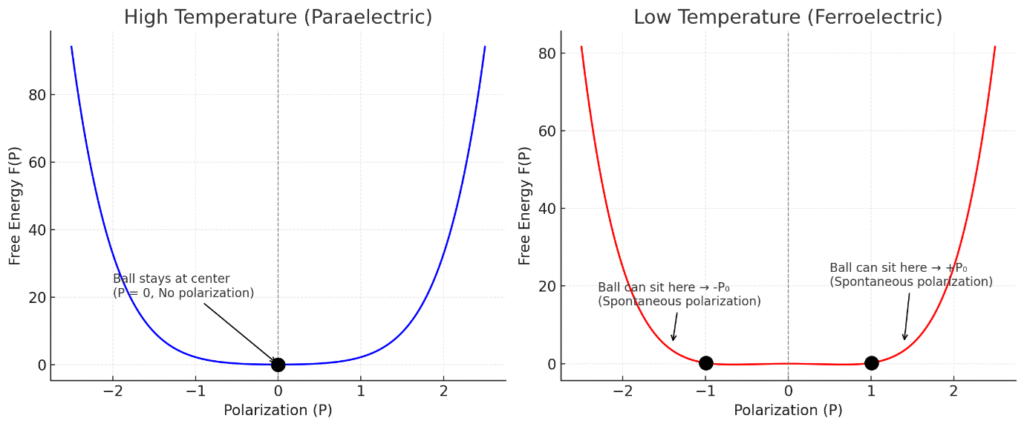
The graph shows how the system’s free energy F depends on the polarization P. The material wants to sit stable where F(P) is smallest — those are the stable polarization states.
Axes of the infographic— what they mean
- Horizontal axis (P): Polarization (how strongly the material is electrically polarized). Usually units are C/m² (often plotted per unit volume).
- Vertical axis (F(P)): Free energy (energy per unit volume). As free energy of the system gets lowered, its stability increases.
Meaning: The lowest energy is at P = 0 → no spontaneous polarization. The material behaves like a normal dielectric: it only polarizes when we apply a field and returns to zero when the field is removed.
Equilibrium occurs where slope dF/dP = 0. At P = 0 the slope is zero and the second derivative d2F/dP2 > 0 so it’s a stable minimum.
|
Meaning: The system has two equally stable states with opposite spontaneous polarization. Even with no external field, the material can sit at +P0 or −P0. That is spontaneous polarization.
|
Importance of Ginzburg–Landau–Devonshire (GLD) Theory for Scholarly researchers
The Ginzburg–Landau–Devonshire (GLD) theory is an advanced modelling technique that continues to guide research scholars in ferroelectric materials, nanotechnology, and condensed matter physics. Its value lies in its ability to connect fundamental theory with real-world applications. GLD theory explains how phase transitions occur by describing the relationship between free energy and the order parameters (such as polarization in ferroelectrics), phase-field simulations to study domain structures, switching mechanisms, and nanoscale effects. This makes it a reliable tool for predicting whether a material will remain paraelectric or develop spontaneous polarization at different temperatures.
It also helps in bridging theory with experiment, as polarization–temperature data, dielectric constants, and hysteresis loops can be analysed using GLD equations to extract material constants like α, β, and γ. These parameters are essential for understanding and designing new functional materials.
Beyond ferroelectrics, GLD-based models are useful for exploring superconductors, magnetic materials, and liquid crystals, making the theory versatile across different areas of condensed matter research. Further, it also supports innovation in nanotechnology, where size effects, thin-film structures, and superlattices require precise theoretical explanations. By tuning GLD coefficients, scholars can predict how doping, strain, or external fields influence material behaviour—knowledge that is crucial for developing next-generation sensors, actuators, memory devices, and energy materials.
Final Thought
The Ginzburg–Landau–Devonshire (GLD) theory beautifully bridges mathematics with real material behavior, making it a timeless tool in ferroelectric research. By explaining how free energy governs polarization and phase transitions, it continues to guide innovations in nanotechnology, memory devices, and advanced functional materials.

Dr. Rolly Verma
Suggested Reading
Explore related topics and deepen your understanding of ferroelectric and piezoelectric materials:
If you notice any inaccuracies or have constructive suggestions to improve the content, I warmly welcome your feedback. It helps maintain the quality and clarity of this educational resource. You can reach me at: advancematerialslab27@gmail.com