
Puja Kumari, Chief Engineer from Bokaro Steel City, stood among them. DMET Class of 2015. A decade into her career. And here's what made her journey unique: she was the only "presently sailing officer" being honoured that day.
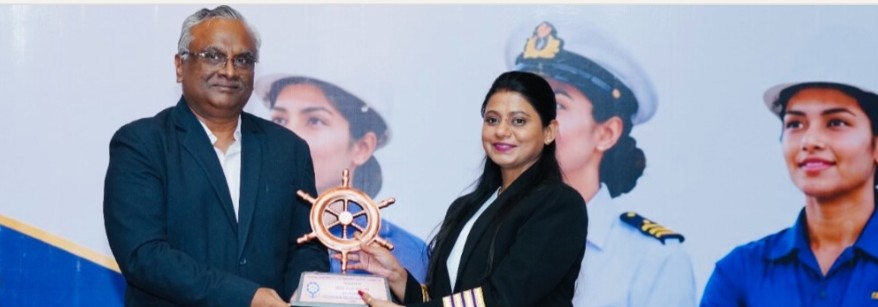
While building her career to Chief Engineer—one of the highest technical ranks on a ship—Puja had made a choice that most in her field eventually step away from. She was still actively sailing. Still signing contracts that take her to sea for 4-6 months at a stretch. Still working in engine rooms where temperatures hit 45°C. Still troubleshooting critical problems in the middle of the ocean, miles from any help.
Most marine engineers transition to shore-based roles after gaining sea experience. It's a natural career progression—using your expertise on land, working regular hours, being home with family.
Puja could have made that move years ago. She had earned it. She had proven herself.
But she chose to keep sailing.
And that choice—to stay where the work demands the most, where the sacrifice is greatest, where you're away from everything familiar for months at a time—that's what makes her story powerful.
🏭 A Girl from Bokaro Steel City
Bokaro Steel City is built around BSL—one of India's biggest steel plants. If you grew up there, engineering isn't a dream. It's just what people do. Your father works at the plant. Your uncle works there. Your neighbours work there. The steel plant offers government jobs, stability, pension, a predictable life.
Most children from Bokaro who study engineering end up at BSL or similar companies. Safe jobs. Close to home. Near family.
But Puja Kumari looked at those huge furnaces—fixed in one place, never moving—and thought about something different. Engines on ships. Machines that travel across oceans. Engineering that takes you places.
She applied to DMET in Kolkata —a four-year program to become a marine engineer. It meant leaving home. Leaving everything familiar. For someone from a landlocked city like Bokaro, it meant leaving land itself.
🚢 The Hard Truth About Ships
Here's what they don't tell you in the brochures: Marine engineering leads to ships. And ships mean being away from home for 4-6 months at a time. Not weeks. Months.
It means missing your mother's birthday. Your best friend's wedding. Diwali with family. Your father's health scare. Your niece taking her first steps.
It means video calls that cut off because internet connectivity at sea is terrible. It means WhatsApp messages that don't deliver for days. It means watching life happen without you.
And for women, it's even harder. Engine rooms weren't built for women. Ships run on crews that are 99% male. Every time you join a new ship, you start over. Proving yourself. Again and again.
Most women who train as marine engineers have a plan: Work on ships for a few years. Get the experience. Then move to a shore job. An office. A normal life where you come home every evening.
Puja graduated in 2015. That's over ten years ago.
She's still sailing.
💙 "This Award Belongs to Every Woman"
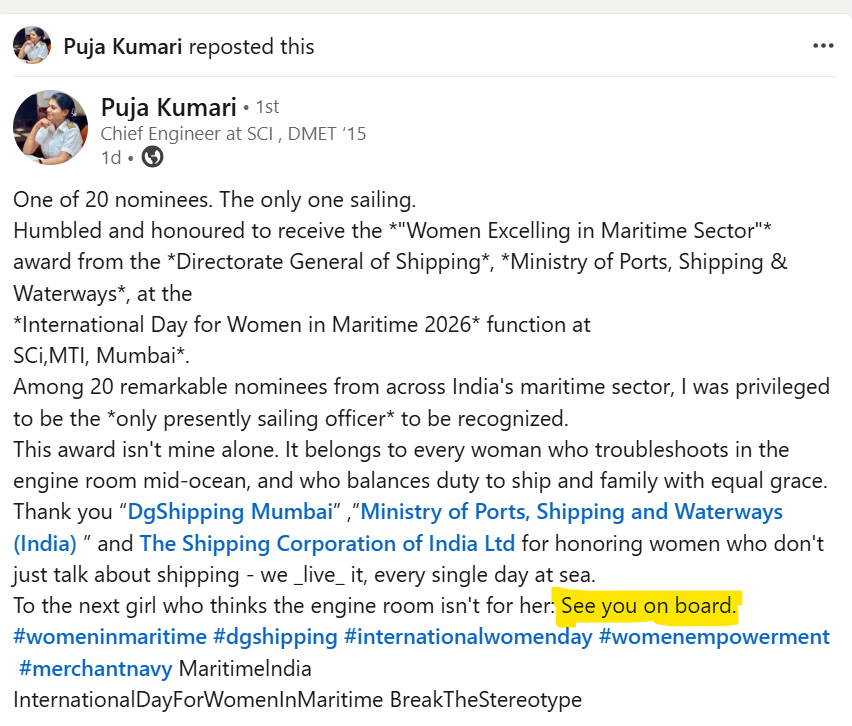
After receiving her award, Puja wrote on LinkedIn: "This award isn't mine alone. It belongs to every woman who troubleshoots in the engine room mid-ocean, and who balances duty to ship and family with equal grace."
That line—"balances duty to ship and family with equal grace"—that's everything.
Because there is no balance. Not really. Balance means equal time, equal attention. What Puja does is choose: total focus on the ship while sailing, intense presence with family during leave, then back to the ship. It's not balance. It's juggling two full-time commitments and somehow not dropping either.
The "Grace" Part
That's the hardest. It's staying calm when you miss something important. It's being present on a video call when you're exhausted. It's not being angry at your family for needing you when you can't be there. It's not being angry at the ship for taking you away from them.
It's making peace with a choice that will always be difficult.
⚓ See You on Board
Puja's message to young women is simple: "To the next girl who thinks the engine room isn't for her: See you on board."
Not "See you in the maritime industry."
Not "See you in a maritime career."
But "See you on board." On the ship. At sea.
The maritime industry needs women in offices, yes. But it also needs women on ships. In engine rooms. Standing watches at 3 AM. Fixing fuel systems in the middle of the ocean. Rising to Chief Engineer and staying there.
That's the path Puja is building. Not just for herself. For everyone who comes after.
🌟 The Girl Who Needs This Story
Right now, somewhere in India, there's a girl who needs to see Puja's story.
Maybe she's in high school level, choosing between science and commerce, wondering if engineering is "for girls like her."
Maybe she's in engineering college, tired of being the only woman in class, wondering if it's worth it.
Maybe she's a young marine engineer, exhausted after her first contract at sea, wondering if she should quit while she can.
That girl needs to know: Ten years into this career, you can still be sailing. Still choosing it. Still succeeding. Still being recognized nationally for doing it.
The award is wonderful. But the real message is what happens after the ceremony.
Puja Kumari goes back to sea.
🌊 The Simple Truth
The ocean doesn't care about awards. The engine doesn't care about recognition. The ship needs someone who knows what they're doing, who can handle the pressure, who will fix problems at 2 AM in rough seas.
Puja Kumari is that person.
And to every girl reading this—in Bokaro, in small towns, in big cities, anywhere—who thinks maybe she could do something difficult, something unconventional, something that makes people ask "Why would you choose that?"
See you on board. 🚢