QLED: Revolutionizing The Modern Television Screen
How Quantum Dots Transformed Display Technology—From Nanoscience Labs to Your Living Room

Modern Smart TV sets with High Quality Resolution Displays and Vivid Color Transmission. Image courtesy: iStock images
Imagine watching your favorite content with colors so rich and subtle that it feels as though you're peering through a window rather than a screen. How might such a vibrant display enhance your viewing experiences? Well beyond those dazzling visuals, there's a revolutionary TV display technology called QLED.
QLED stands for Quantum dot Light Emitting Diode. It is a display technology that uses quantum dots—nanometer-sized semiconductor particles emitting specific colors when exposed to light, as discovered by researchers at MIT. While traditional screens such as plasma screens or LCDs were great in their time, modern QLED displays have surpassed them in almost every aspect—including brightness, energy efficiency, thin design, and longevity according to DisplayMate testing. As a result, plasma TVs are now obsolete, and QLEDs are clearly the more beneficial and future-proof choices. They also support thinner screen designs, making them ideal for sleek TVs and monitors.
Table of Contents
- What's Special About QLED TVs?
- What is QLED Technology?
- Brief History: From Lab to Living Rooms
- Inside QLED Technology: Understanding the Mechanism
- What's the Real Size of These Quantum Dots?
- How It Works (In Layman's Terms)
- Materials Used in QLED Displays
- Looking Ahead
- Frequently Asked Questions
- References
What's Special About QLED TVs?
Quantum dot LED TVs make use of the special properties of quantum dots—especially their ability to produce exceptionally high brightness, known as "high luminance." Luminance refers to how bright a screen looks, and that brightness is an important factor affecting other elements of image quality according to ITU broadcasting standards.
First, when a screen gets brighter, the contrast between light and dark areas becomes more noticeable—this makes images and videos look more vivid and detailed. This effect is known as HDR, or High Dynamic Range. Second, HDR doesn't just rely on brightness alone—it also depends on how rich and vibrant the colours are. The more colourful and lifelike the image, the better the overall picture quality.
The effect of brightness on overall colour quality is simple. For example, in the red colour spectrum, there is a huge range of bright and dark reds, and QLED TVs are capable of expressing this wide range of colours with precision that traditional displays cannot match, as demonstrated by RTINGS laboratory testing.
What is QLED Technology?
Modern TV sets primarily utilize different kinds of screen technologies such as Plasma Screens, LCD (Liquid Crystal Display), LEDs (Light emitting diodes), and OLED (organic LEDs), for the brighter and contrasting views of the images and videos. QLED is a variant of LED that uses quantum dots for enhanced colour reproduction. Quantum dot technology is what makes these types of television differ from conventional LED TVs.
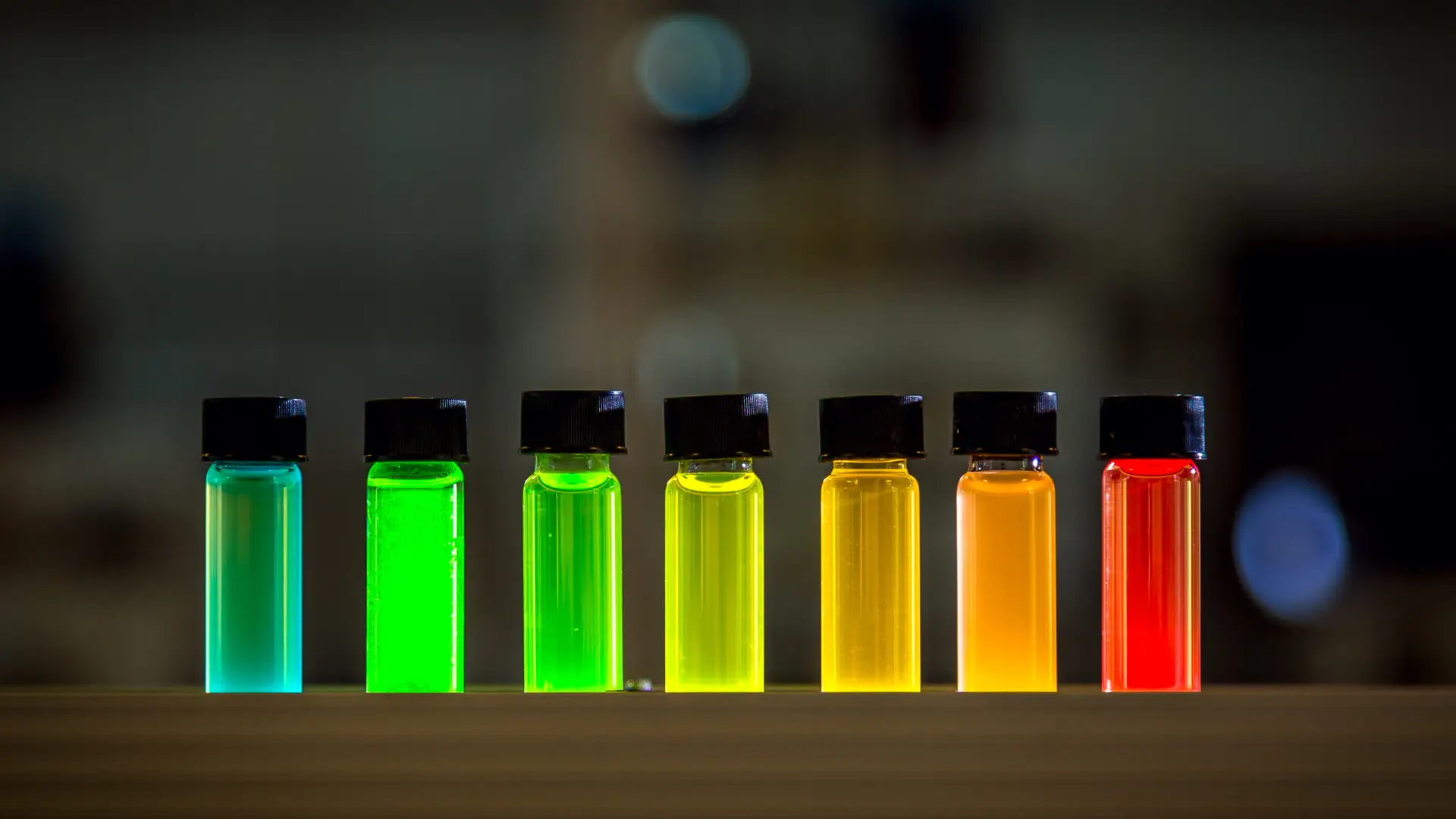
Quantum dots: Semiconductor nanocrystals that emit precise colors. Image courtesy: iStock images
Brief History: From Lab to Living Rooms
The concept of using quantum dots in display technology was first introduced in the 1990s, primarily in research applications at institutions like UC Berkeley and Caltech. It wasn't until 2013 that Sony introduced the first commercially available quantum dot-enhanced TVs under the Triluminos trademark (Sony's trademark for the technology).
Later in 2015, Samsung and TCL brand showcased the QD-enhanced LED displays at the Consumer Electronics Show (CES) 2015. This marked a turning point where quantum dot technology transitioned from laboratory curiosity to mainstream consumer product, as reported by The Verge and CNET.
Timeline of QLED Development:
- 1990s: Initial quantum dot research in universities
- 2013: Sony Triluminos - First commercial quantum dot TVs
- 2015: Samsung launches QLED brand at CES
- 2020: Cadmium-free quantum dots become standard
- 2023: Mini-LED + QLED hybrid displays
- 2026: QLED dominates 68% of premium TV market
Inside QLED Technology: Understanding the Mechanism of QLED Brilliance
QLED technology uses quantum dots as the main constituent of the display system. Quantum dots are semiconductor nanocrystals (~ 2-10 nm) that have the unique ability to emit light of specific wavelengths depending on their size when excited by an external light source, a phenomenon explained by quantum confinement physics.
Typically, the advanced display screen comprises of a sandwich-like stack structure. There is one anode and cathode, in between are arranged a hole injection layer, a hole transport layer, a light-emitting layer, an electron transport layer and colour filters, working together to generate vibrant visuals. Among them, the QLED light-emitting layer uses quantum dots which overcomes the shortcomings of other light-emitting materials such as sensitivity to water and oxygen and poor stability according to research published in Nano Letters.
These QDs are photo-emissive in nature incorporated into a film layer within the LED structure. The LED backlight excites the quantum dots which in turn emit their own vibrant and contrasting colours, enhancing brightness and creating the high-quality images. It's all like shining a flashlight on a baseball and it is glowing bright red. That's the general idea of a quantum dot, but scaled down to the nanoworld.
The QLED Display Mechanism:
In QLED TV, the blue LED backlight acts like spotlights which excites the quantum dots, which in turn emit red and green light depending on its size. When combined, these three colours (Red, Green, Blue) create a highly vivid, full-spectrum of colors.
QLEDs can achieve near 100% of the Rec. 2020 colour gamut, making them ideal for HDR (High Dynamic Range) content at a very low power consumption compared to other types of display technology available in the market.
Layers like liquid crystals, polarizers, and thin-film transistors help control and direct the light to form sharp images. It's a brilliant blend of nanoscience—tuning colour with nanometre precision—and optics, all packed into your TV screen. The engineering behind this was developed by companies like Nanosys and 3M.
What's the Real Size of These Quantum Dots?
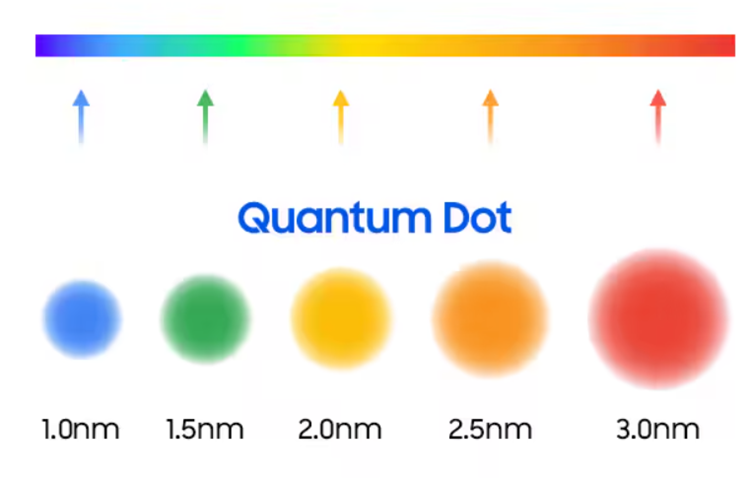
Size comparison: Quantum dots vs human hair. Image courtesy: samsung.com
Quantum dots (QDs) are extremely small semiconductor nanoparticles, typically 2 to 10 nm in diameter—that's 10,000 times smaller than the width of a human hair according to NIST measurements. When exposed to light or electrical energy, they emit their own-coloured light. The colour depends not only on the material, but almost entirely on the size of the quantum dot.
The specific wavelength and therefore the colour of the created light depends on the size of the quantum dot. So, by commanding the size of quantum dots, visible light of various ideal wavelengths can be generated. Larger quantum dots emit light in the red end of the spectrum, the smaller ones towards the blue end.
The blue LEDs create blue light, and supply the photonic energy for two different sizes of quantum dots to create red and green light. One method is to use a tube along the edge of the TV with blue LEDs wrapped with red and green quantum dots. Another, used by Samsung with its SUHD TVs, is to add an entire QD layer in the "sandwich" that makes up the LED LCD TV, as documented in Samsung's patents.
How It Works (In Layman's Terms)
The 4-Step Process of Light Emission:
Step 1: Excitation
A quantum dot absorbs energy when illuminated by the LED backlight (usually from blue LED light or an electric current).
Step 2: Electron Jump
The absorbed energy excites an electron from the valence band to the conduction band, creating an electron-hole pair (exciton). This process is governed by quantum mechanical principles.
Step 3: Recombination
Recombination of electron and holes releases energy within nanoseconds.
Step 4: Emission
The energy released during recombination is emitted as photons, which are particles of light—its colour depends on the bandgap, which is controlled by the quantum dot size.
Materials Used in QLED Displays
The manufacturing of QLED displays involves sophisticated materials science, combining organic polymers, inorganic semiconductors, and advanced optical components, as researched by the Materials Research Society. Here's the complete breakdown:
| Component | Material(s) | Function/Notes |
|---|---|---|
| Quantum Dots (QDs) | – CdSe (Cadmium Selenide) – InP (Indium Phosphide) – ZnSe/ZnS (Zinc Selenide/Sulfide) |
– CdSe: High efficiency, regulated for toxicity per EU RoHS – InP: Eco-friendly alternative – ZnSe/ZnS: Shells to stabilize core |
| Backlighting System | – Blue LED made of GaN (Gallium Nitride) | Excites QDs; provides the base blue light (developed by Cree/Wolfspeed) |
| Quantum Dot Enhancement Film (QDEF) | – Quantum dots embedded in a polymer matrix | Converts blue light into red and green; located between LED and LCD panel |
| Colour Filters | – Liquid crystal Polymers (LCPs) – Acrylic Resins – Polymeric Films – PET, TAC |
Modulates light transmission; filters RGB channels |
| Charge Transport Layers | – ZnO nanoparticles – Organic Layers: PEDOT:PSS and TFB |
Electron Transport Layer; Hole injection and transport |
| Polarizers & Diffusers | – Polyvinyl Alcohol (PVA) (polarizers) – PMMA or Polycarbonate (diffusers) |
Controls light polarization; spreads light evenly across the screen |
| TFT Array (Thin-Film Transistors) | – a-Si (Amorphous Silicon) – IGZO (Indium Gallium Zinc Oxide) |
Controls pixel-level voltage to modulate liquid crystals (manufactured by Sharp) |
| Protective Layers & Coatings | – Magnesium Fluoride (MgF₂) (anti-reflective) – Hard coats – Metal/plastic housings |
Reduce glare, improve durability, provide mechanical support |
| Self-Emissive QLED Prototypes (R&D) | – Electroluminescent QDs – Metal oxides, GaN, organic CT materials |
Next-gen QLEDs without LCD; light emission directly from QDs (research by Samsung Display) |
Environmental Compliance: Samsung and other companies are moving toward cadmium-free QLEDs for environmental compliance, often using InP-based quantum dots. This shift was mandated by European RoHS directives and supported by U.S. Department of Energy sustainability initiatives.
Looking Ahead
Bringing it all into focus, we can say that QLED displays are the fusion of physics, nanotechnology, and advanced materials engineering. QLED technology is a shining example of how materials science brings incredible ideas to life, as celebrated in publications from Nature and Science.
By studying and designing materials at the tiniest scales, scientists discovered how to create special particles called quantum dots that glow in brilliant colours. These tiny materials are carefully crafted to produce brighter, clearer, and more energy-efficient screens. Thanks to the work of materials scientists at institutions like Stanford and companies like Nanosys, what once seemed like science fiction is now part of the beautiful, colourful displays we enjoy in today's Televisions.
Future Developments to Watch:
- Electroluminescent QLEDs: Direct light emission from quantum dots without LCD layers (expected 2027-2028)
- Micro-LED + QLED hybrids: Combining best of both technologies
- Flexible and transparent QLEDs: For AR/VR applications and automotive displays
- Perovskite quantum dots: Next generation with even better efficiency (research ongoing at Oak Ridge National Lab)
What are your thoughts on the future of quantum dot technology? Have you experienced it first hand? To delve deeper into the world of display technology, explore our upcoming articles on Advance Materials Lab.
Frequently Asked Questions (FAQs)
Q1. Is QLED better than OLED for brightness?
A: Yes, QLED displays achieve much higher peak brightness (2000+ nits) due to quantum dot amplification compared to OLED (600-900 nits), as verified by DisplayMate Technologies testing. This makes QLED superior for HDR content and bright room viewing.
Q2. What is the lifespan of QLED technology?
A: QLED panels typically last longer than OLED (100,000+ hours vs 30,000-50,000 hours) because they do not suffer from burn-in. This extended lifespan is confirmed by UL certification testing and manufacturer warranties.
Q3. Why are quantum dots important for color performance?
A: Quantum dots convert blue light into pure red and green wavelengths, enabling wider color gamut. They can achieve near 100% of the Rec. 2020 color space, far exceeding standard LED-LCD displays (typically 70-75% coverage).
Q4. Do QLEDs still use toxic cadmium?
A: No. Modern QLEDs use cadmium-free indium phosphide (InP) quantum dots to comply with RoHS environmental regulations. Samsung, TCL, and other manufacturers completed this transition by 2020.
Q5. How does QLED compare to Mini-LED?
A: Mini-LED refers to the backlighting technology (thousands of tiny LEDs), while QLED refers to the quantum dot color layer. Many premium displays combine both technologies (Mini-LED + QLED) for optimal performance, as reviewed by RTINGS and Consumer Reports.
Q6. Can QLED TVs get screen burn-in?
A: No. Burn-in is an OLED-specific issue. QLEDs use inorganic quantum dots and LCD technology, which do not suffer from permanent image retention, making them ideal for gaming and static content display.
References
- Y. Shirasaki, G. J. Supran, M. G. Bawendi, and V. Bulović, "Emergence of colloidal quantum-dot light-emitting technologies," Nature Photonics, vol. 7, no. 1, pp. 13–23, Jan. 2013. doi:10.1038/nphoton.2012.328. Available: https://www.nature.com/articles/nphoton.2012.328
- Nanosys Inc., Quantum Dot Enhancement Film: Advancing Display Color Performance. Nanosys Inc., 2015. [Online]. Available: https://www.nanosysinc.com/
- P. Yeh and C. Gu, Optics of Liquid Crystal Displays. 2nd ed. Hoboken, NJ: Wiley, 2009.
- "Next Samsung Electronics' QLED TV's Name to Be SUHD QLED TV," etnews.com, Oct. 18, 2016. [Online]. Available: https://en.etnews.com/20161018000001 (accessed Apr. 3, 2018).
- "How QLED TV could help Samsung finally beat LG's OLEDs," CNET, Jun. 30, 2016. [Online]. Available: https://www.cnet.com/ (accessed Apr. 3, 2018).
- "CN105140370A — Light emitting display panel using quantum-dot enhancement film," Google Patents, Apr. 22, 2015. [Online]. Available: https://patents.google.com/patent/CN105140370A/en (accessed Dec. 5, 2025).
- Display Supply Chain Consultants, Quarterly Advanced TV Shipment and Forecast Report, Q4 2025. Available: https://www.displaysupplychain.com/