
What Is the Sol-Gel Method? Working Principle, Process in 7 easy Steps and Applications
A step-by-step classroom tutorial on wet-chemical nanomaterial synthesis — with a real research case study on zinc oxide (ZnO) nanomaterials
Welcome to the class. Today we take up one of the most elegant and widely used techniques in all of materials chemistry — the sol-gel method. If you have ever wondered how researchers make nanoparticles, ultra-thin ceramic coatings, or high-purity oxide powders without melting anything at extreme temperatures, the answer very often is: they grew the material from a liquid, molecule by molecule. By the end of this lecture you will understand exactly how a clear solution transforms, step by step, into a solid nanomaterial — and you will follow a complete, real research recipe for synthesizing zinc oxide (ZnO) nanomaterials from start to finish.
The sol-gel method is a wet-chemical synthesis technique in which a liquid solution of molecular precursors (a “sol”) is converted into an interconnected solid network (a “gel”) through hydrolysis and condensation reactions, and then dried and heat-treated to obtain the final material. Because the solid is built from molecules mixed in solution, the sol-gel method gives high chemical purity, atomic-level homogeneity, and precise control over particle size — all at much lower processing temperatures than conventional melting or solid-state routes. It is used to make nanoparticles, thin films, fibers, aerogels, and dense ceramics.
Series: Synthesis Methods Hub | Prerequisites: Basic chemistry (bonds, reactions); helpful: How to Read an XRD Graph in 7 Easy Steps
Reading time: ~35 minutes | Includes: Kitchen-chemistry analogies, full reaction chemistry, 7 process steps in detail, a real ZnO research case study with verified numbers, SVG process diagram, comparison tables, practice MCQs, key takeaways, FAQs, IEEE references
SEO Keywords: what is sol-gel method, sol-gel process steps, sol-gel working principle, sol-gel synthesis of ZnO, hydrolysis and condensation, xerogel vs aerogel, sol-gel applications
1. Introduction — Why Learn the Sol-Gel Method?
Let us begin with a question that puzzles many newcomers. Suppose you want to make zinc oxide — a ceramic with a melting point of roughly 1975 °C. The traditional approach, called the solid-state reaction method, is essentially very sophisticated grinding and baking: you mix oxide or carbonate powders, grind them thoroughly, and heat them above 1000 °C for many hours so that atoms slowly diffuse across particle boundaries and react. It works — but the mixing is only as good as your grinding, the temperatures are punishing, and controlling particle size at the nanometer scale is nearly impossible.
The sol-gel method flips this logic completely. Instead of forcing solid particles to react, we dissolve the ingredients as individual molecules or ions in a liquid. In solution, mixing is perfect — the components are intermingled at the atomic scale from the very first moment. Chemistry then does the construction work for us: the dissolved molecules react with water, link together into nanometer-sized particles, and those particles join into a continuous solid network — all near room temperature. A gentle heat treatment at the end crystallizes the product.
Think of making fruit jelly. You start with a free-flowing liquid (the sol), in which gelatin molecules are dispersed. On standing, those molecules link into a continuous three-dimensional network that traps the liquid inside — the mixture no longer pours, yet it is still mostly liquid by weight. That is a gel. The sol-gel method is precisely this transformation, performed with inorganic building blocks instead of gelatin, followed by drying and heating to convert the jelly-like solid into a ceramic nanomaterial.
Why does this matter to you as a materials science student? Because the sol-gel method sits at the heart of modern nanotechnology. Antireflective coatings on lenses, gas-sensing films, transparent conducting oxides, photocatalytic surfaces, bioactive glasses for bone repair, and countless published nanoparticle syntheses all rest on this one technique. The foundational chemistry was systematized in the landmark review by Hench and West [1] and the classic monograph of Brinker and Scherer [2], and it remains one of the most cited bodies of work in materials chemistry. Although its roots reach back to nineteenth-century silica chemistry, the field's modern explosion of sophistication is chronicled in the American Chemical Society's review Sol–Gel Chemistry and Materials in Accounts of Chemical Research. If you plan to work in a synthesis lab — or simply to read research papers intelligently — you must understand it.
2. What Is the Sol-Gel Method? Key Terms Defined
Science becomes much easier once the vocabulary is precise. Let us define every term you will meet, in the order you will meet it. Please read this section slowly — everything that follows is built on these definitions.
2.1 Sol
A sol is a stable dispersion of solid colloidal particles — typically 1 to 100 nanometers in size — suspended in a liquid. The particles are so small that gravity cannot settle them; random collisions with solvent molecules (Brownian motion) keep them permanently afloat. Milk is an everyday sol-like colloid: tiny fat and protein particles dispersed in water. In our context, the sol contains nanometer-scale oxide or hydroxide particles formed by chemical reactions in the solution.
2.2 Gel
A gel is what forms when those colloidal particles (or growing polymer chains) link together into a single, continuous, three-dimensional solid network that spans the entire container, with the liquid phase trapped inside its pores. The defining moment is connectivity: one interconnected skeleton from wall to wall. Macroscopically, the liquid stops flowing — tilt the beaker and nothing pours out. For a rigorous treatment of these definitions, the introductory chapter “A Sol and a Gel, What Are They?” from Springer Nature makes excellent further reading.
2.3 Precursor
A precursor is the starting molecule that carries the metal atom we want in our final material. Two families dominate:
- Metal alkoxides, with the general formula M(OR)ₙ, where M is the metal and OR is an alkoxide group (an alcohol minus one hydrogen, e.g., –OCH₃, –OC₂H₅). Tetraethyl orthosilicate, Si(OC₂H₅)₄ — universally abbreviated TEOS — is the most famous example, used to make silica. Alkoxides are the “classical” sol-gel precursors [1], [2].
- Metal salts such as acetates, nitrates, and chlorides — for example, zinc acetate dihydrate, Zn(CH₃COO)₂·2H₂O, the workhorse precursor for ZnO [4]. Salt-based routes are cheaper and easier to handle than many alkoxides and are extremely common for transition-metal oxides.
2.4 Xerogel and Aerogel
These two terms describe what the gel becomes after drying — and the difference is entirely about how you remove the liquid.
| Property | Xerogel | Aerogel |
|---|---|---|
| Drying method | Ordinary evaporation at ambient pressure | Supercritical drying (no liquid–vapor interface) |
| What happens to the network | Capillary forces pull pores inward — the gel shrinks and densifies substantially | Network preserved almost intact — minimal shrinkage |
| Typical porosity | Moderate; significantly reduced from the wet gel | Extremely high (often >90% air by volume) |
| Typical use | Powders, dense films, monoliths after sintering | Thermal insulation, ultralight materials, catalysis supports |
2.5 Putting It Together — The One-Sentence Definition
The sol-gel method is a wet-chemical synthesis route in which molecular precursors in solution undergo hydrolysis and condensation to form a colloidal sol, which evolves into a continuous gel network, and which upon aging, drying, and heat treatment yields an oxide material in the desired form — powder, film, fiber, or monolith.
Notice the phrase “desired form.” This shape versatility is a signature strength: because the material passes through a liquid stage, you can spin-coat it into a film, draw it into fibers, cast it into a mold, or precipitate it as a powder — decisions made before the material solidifies. We exploit exactly this in the ZnO case study of Section 6.
3. The Working Principle — Hydrolysis and Condensation Chemistry
Every sol-gel synthesis, however complicated it may look in a research paper, is powered by just two chemical reactions working as a team: hydrolysis and condensation. Master these two, and you can read any sol-gel paper with confidence. We will use a metal alkoxide M(OR)ₙ to illustrate, because the chemistry is cleanest there; the same logic extends to salt-based routes [3].
3.1 Reaction 1 — Hydrolysis: Water Activates the Precursor
Hydrolysis (from the Greek hydro, water, and lysis, to split) is the reaction of the precursor with water. A water molecule attacks the metal center and replaces an alkoxide group (–OR) with a hydroxyl group (–OH), releasing an alcohol molecule:
M–OR + H₂O → M–OH + R–OH
Hydrolysis: an alkoxide ligand (–OR) is replaced by a reactive hydroxyl group (–OH); alcohol (R–OH) is the by-product.Why does this matter? Because the M–OH group is the reactive handle. An intact alkoxide is relatively inert toward other precursor molecules; a hydrolyzed one is primed to bond. Hydrolysis is the “switching on” of the precursor. Depending on how much water is supplied, one, several, or all n alkoxide groups may be replaced — a control knob we return to in Section 5.
3.2 Reaction 2 — Condensation: Building the M–O–M Bridge
Condensation is the reaction in which two activated molecules join, forming the crucial metal–oxygen–metal (M–O–M) bridge — the backbone bond of every oxide ceramic — while expelling a small molecule. It occurs in two variants [1], [2]:
M–OH + HO–M → M–O–M + H₂O
Water (oxolation) condensation: two hydroxylated species join, releasing water.M–OH + RO–M → M–O–M + R–OH
Alcohol condensation: a hydroxylated species reacts with an unhydrolyzed alkoxide, releasing alcohol.Each condensation event forges one new M–O–M link. Repeat this millions of times and the dissolved molecules knit themselves into oligomers (small clusters of a few units), then nanoparticles, then — as particles and chains connect — the space-filling network we call a gel. This is inorganic polymerization: exactly analogous to how organic monomers polymerize into plastics, except our “polymer” is a ceramic oxide network.
Imagine LEGO bricks floating in a pool, each with its studs covered by protective caps (the –OR groups). Hydrolysis removes the caps, exposing the studs (–OH). Condensation is two exposed studs clicking together (forming M–O–M). At first you get small assemblies drifting freely (the sol). Eventually enough assemblies connect that a single LEGO structure spans the entire pool — the water can no longer slosh freely. That instant is gelation.
3.3 The Two Structural Pathways — Polymeric vs. Particulate Gels
Depending on the relative speed of hydrolysis versus condensation, the network grows in one of two characteristic ways [2]:
- Polymeric (chain-like) growth: when condensation is slow and selective (typical of acid-catalyzed silica), the network builds as weakly branched chains that entangle — producing fine-pored, homogeneous gels ideal for dense films and fibers.
- Particulate (cluster-like) growth: when condensation is fast (typical of base-catalyzed systems and most transition-metal routes, including ZnO), dense colloidal particles form first and then aggregate into a network — producing gels that yield nanopowders and porous structures.
Keep this distinction in mind: it explains why the same two reactions can produce materials as different as optical-quality glass coatings and fluffy nanoparticle powders.
4. The Sol-Gel Process — All 7 Steps Explained in Detail
We now walk through the complete process in laboratory order. Every sol-gel synthesis you will ever read is a variation on these seven steps. Study the flow diagram first, then read each step carefully.
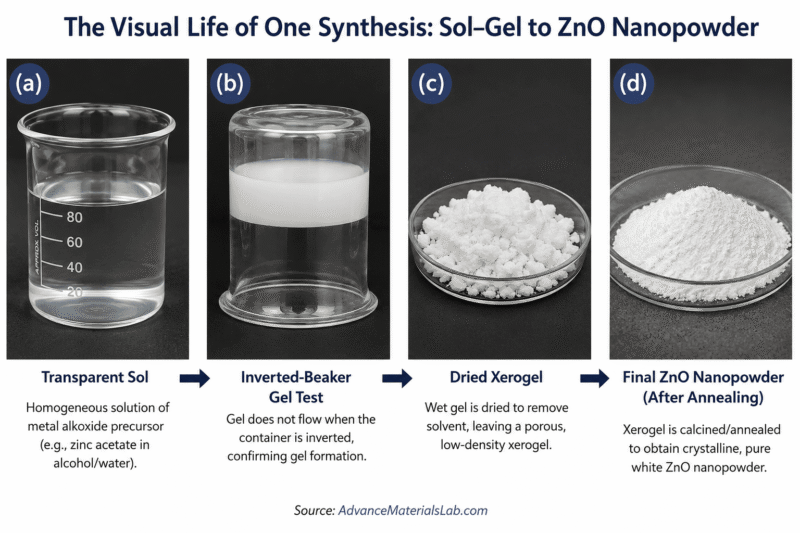
Fig. 1: The sol-gel process flow. A molecular precursor solution evolves through sol and gel stages; the drying route (evaporative vs. supercritical) decides between xerogel and aerogel; heat treatment produces the final crystalline material. | Source: AdvanceMaterialsLab.com
Step 1 — Precursor Selection and Solution Preparation
Everything begins with choices: which precursor, which solvent, and what concentration. The precursor must dissolve completely and react at a controllable rate. Silicon alkoxides such as TEOS hydrolyze slowly and forgivingly; many transition-metal alkoxides hydrolyze so violently that they precipitate uselessly the instant they meet moisture — which is why chemists often prefer metal salts (acetates, nitrates) for elements like zinc, or add chemical modifiers to tame reactive alkoxides [3]. The solvent — commonly an alcohol like ethanol, isopropanol, or 2-methoxyethanol — must dissolve both the precursor and the water needed for hydrolysis, since water and alkoxides are otherwise immiscible. The solution is stirred until perfectly clear and homogeneous. A cloudy starting solution is a failed experiment before it has begun: turbidity means uncontrolled precipitation has already occurred.
Step 2 — Hydrolysis: Activating the Molecules
Water is now introduced — either added deliberately in measured amounts, absorbed from humid air, or generated in situ by side reactions. As covered in Section 3, each water molecule converts an M–OR group into a reactive M–OH group. The experimenter controls this step through the water-to-precursor molar ratio (often labeled r or h), the temperature, and frequently a catalyst: a small amount of acid (e.g., HCl, HNO₃) or base (e.g., NH₄OH) that dramatically accelerates hydrolysis and steers the growth pathway (Section 3.3). Nothing looks different to the eye yet — the solution remains clear — but at the molecular level the precursors are being switched on.
Step 3 — Condensation and Sol Formation
Activated molecules now begin linking through M–O–M bridges. Dimers become trimers, trimers become oligomers, and oligomers grow into discrete colloidal particles a few nanometers across. The liquid is now officially a sol. It may still look transparent — particles below ~50 nm scatter little visible light — though a bluish tinge under side illumination (the Tyndall effect) betrays their presence. Crucially, the sol is still a liquid: it can be poured, filtered, spin-coated onto a wafer, or dip-coated onto glass. This is the moment of shaping. Whatever geometry you give the sol now is the geometry your final material will inherit.
Step 4 — Gelation: The Sol-to-Gel Transition
Condensation continues, and particles and chains connect to one another. At a well-defined moment — the gel point — the growing clusters merge into one single network spanning the whole container. Viscosity, which had been climbing gradually, diverges sharply; the classic laboratory test is simply inverting the beaker: if nothing flows, you have a gel. It is worth pausing on how remarkable this state is. The gel may still be over 90% liquid by mass, yet it behaves as an elastic solid, because a continuous ceramic skeleton — often only nanometers thick in its branches — now runs from wall to wall, immobilizing the liquid in its pores.
Step 5 — Aging: Strengthening the Network
Aging (also called ripening) means leaving the gel in contact with its pore liquid, typically for hours to days. Far from idle waiting, three constructive processes operate [2]:
- Continued condensation: unreacted M–OH and M–OR groups inside the network keep forming new M–O–M cross-links, stiffening the skeleton.
- Syneresis: as new bonds form, the network contracts slightly and expels pore liquid — you may see clear liquid appear on top of the gel.
- Ostwald ripening: material dissolves from small, highly curved (high-energy) regions and redeposits at particle necks, thickening the joints of the network exactly where strength is needed.
A well-aged gel survives the mechanical stresses of drying; a poorly aged one cracks into fragments. In many practical recipes — including our ZnO case study — aging of the sol itself is also used to improve homogeneity and film quality before coating.
Step 6 — Drying: Removing the Liquid (Xerogel vs. Aerogel)
Now the pore liquid must go, and physics makes this the most dangerous step. As liquid evaporates from nanometer-sized pores, curved liquid–vapor menisci form, generating enormous capillary pressures that pull the pore walls inward. Under ordinary evaporative drying the network shrinks substantially and may crack; the product is a xerogel (from the Greek xeros, dry). If instead the liquid is removed under supercritical conditions — heated and pressurized beyond its critical point so that no liquid–vapor interface (and hence no capillary force) ever exists — the network is preserved almost perfectly, giving an ultralight, extraordinarily porous aerogel [2]. Aerogels are no laboratory curiosity: NASA used silica aerogel — more than 99% open space by volume — to softly capture comet dust intact on its Stardust sample-return mission. For thin films the drying problem is mild (the film is thin and adheres to a substrate); for large monoliths it is the central engineering challenge.
Step 7 — Calcination and Densification: The Final Heat Treatment
The dried gel is usually amorphous and still carries organic residues — acetate groups, alkoxide fragments, solvent traces, hydroxyls. A programmed heat treatment finishes the job in stages: at roughly 200–400 °C organics burn out and residual water leaves; at higher temperatures (commonly 400–600 °C for ZnO; higher for refractory oxides) the amorphous network crystallizes into the thermodynamically stable phase, and with further heating the particles sinter and densify. The choice of final temperature is a deliberate trade-off: hot enough for full crystallization and purity, cool enough to prevent excessive grain growth that would destroy the nanostructure. You can verify success directly by X-ray diffraction — sharp Bragg peaks replacing the broad amorphous hump — as explained in our tutorial on amorphous vs. crystalline XRD patterns.
Precursor solution → Hydrolysis → Condensation (sol) → Gelation → Aging → Drying (xerogel/aerogel) → Calcination. Interviewers love asking candidates to recite this sequence and to explain why each step exists. Memorize the sequence, but understand the purpose of each stage — that is what separates a top answer from a rote one.
5. Process Parameters — The Control Knobs of Sol-Gel Synthesis
If the seven steps are the engine, the parameters below are the driver's controls. Research papers on sol-gel synthesis are, in essence, systematic studies of turning these knobs. The trends summarized here follow the classical treatments in [1]–[3].
| Parameter | What It Controls | Typical Trend |
|---|---|---|
| pH / catalyst type | Relative rates of hydrolysis vs. condensation; growth pathway | Acidic → chain-like polymeric gels, fine pores; basic → particulate gels, discrete nanoparticles |
| Water : precursor ratio (r) | Degree of hydrolysis | Low r → partial hydrolysis, slower network growth; high r → complete hydrolysis, faster particle formation |
| Precursor concentration | Collision frequency; gelation time; particle number density | Higher concentration → faster gelation, often larger final crystallite size |
| Temperature | All reaction rates; solvent evaporation | Higher T → faster hydrolysis/condensation and shorter gel times |
| Solvent | Precursor solubility, viscosity, drying behavior, film wetting | High-boiling solvents (e.g., 2-methoxyethanol) give smoother films |
| Stabilizers / chelating agents | Precursor reactivity; sol stability against precipitation | e.g., monoethanolamine (MEA) or acetylacetone slow reactions and keep sols clear for weeks |
| Aging time | Network strength; homogeneity | Longer aging → stronger gel, better films — up to a practical optimum |
| Calcination temperature/time | Crystallinity, crystallite size, residual organics | Higher T → better crystallinity but larger grains (Scherrer analysis quantifies this) |
Students often treat the recipe as a black box and change several parameters at once — new concentration, new temperature, new aging time — then cannot explain why the product changed. Good synthesis science is one variable at a time. When you read a strong research paper, notice how the authors vary a single knob and track its effect on XRD crystallite size, morphology, or optical properties.
6. Real Research Case Study — Sol-Gel Synthesis of ZnO Nanomaterials
Theory becomes knowledge only when you see it applied. We now follow a complete, representative research protocol for sol-gel ZnO — assembled from the peer-reviewed literature, principally the pioneering colloidal work of Spanhel and Anderson [5] and the comprehensive thin-film review by Znaidi [4]. This acetate-based route is one of the most reproduced syntheses in nanoscience, so the recipe below is one you may well perform yourself during a project or dissertation.
6.1 Why ZnO? Meet the Material
Zinc oxide is a direct wide-band-gap semiconductor — band gap ≈ 3.37 eV at room temperature, corresponding to an absorption edge near 368 nm in the ultraviolet — with an unusually large exciton binding energy of ≈ 60 meV, which keeps its UV light emission efficient even at room temperature [6]. It crystallizes in the hexagonal wurtzite structure (lattice parameters a = 0.3250 nm, c = 0.5207 nm; c/a ≈ 1.602, close to the ideal 1.633). Add its low toxicity, low cost, and piezoelectric character, and you see why ZnO nanomaterials appear in UV photodetectors, gas sensors, solar-cell electrodes, sunscreens, and antibacterial coatings.
6.2 The Recipe, Mapped to Our 7 Steps
Step 1 — Precursor solution
Dissolve zinc acetate dihydrate, Zn(CH₃COO)₂·2H₂O (molar mass 219.50 g/mol), in 2-methoxyethanol to make a 0.5 M solution — that is, 5.49 g of the salt per 50 mL of solvent (verify: 219.50 g/mol × 0.5 mol/L × 0.050 L = 5.4875 g ≈ 5.49 g). Add monoethanolamine (MEA) as a stabilizer at a molar ratio MEA : Zn²⁺ = 1 : 1. The MEA molecules coordinate to zinc ions, moderating their reactivity and preventing premature precipitation of zinc hydroxide — this is the “chemical modifier” strategy of Section 5 in action. Note also a subtlety: the dihydrate salt carries its own water of crystallization, which supplies part of the water needed for hydrolysis [4].
Steps 2–3 — Hydrolysis, condensation, and sol formation
Stir the solution at 60 °C for 2 hours. Warmth accelerates the hydrolysis of acetate-zinc complexes to Zn–OH species and their condensation into Zn–O–Zn linked oligomers and sub-nanometer clusters. The result is a clear, transparent, homogeneous sol. Spanhel and Anderson showed by optical spectroscopy that such solutions contain quantum-sized ZnO clusters that grow by aggregation — a beautiful direct observation of the sol stage [5].
Steps 4–5 — Aging
Age the sol at room temperature for 24 hours. During aging, cluster growth and equilibration continue, and film-forming quality improves markedly — freshly mixed sols tend to give hazy, non-uniform coatings, while aged sols give smooth, adherent films [4]. (For nanopowder synthesis, a base such as NaOH is instead added to drive the sol through gelation/precipitation; the washed gel is then dried.)
Step 6 — Shaping and drying
For a thin film: spin-coat the aged sol onto a cleaned glass or silicon substrate at ~3000 rpm for 30 s, then pre-heat at ~300 °C for 10 minutes to evaporate solvent and decompose organics. Repeat the coat–preheat cycle to build thickness layer by layer — a defining convenience of sol-gel film deposition.
Step 7 — Annealing (calcination)
Anneal at 500 °C for 1 hour in air. Residual acetate and MEA burn out, and the amorphous Zn–O network crystallizes into wurtzite ZnO. Compare 500 °C with the 1975 °C melting point of ZnO — the sol-gel route reaches a crystalline ceramic at barely a quarter of that temperature.
6.3 Confirming Success — The XRD Fingerprint of Wurtzite ZnO
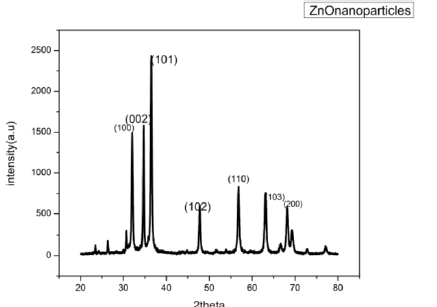
How do we know we made ZnO and not something else? X-ray diffraction. Using Cu-Kα radiation (λ = 0.15406 nm), wurtzite ZnO shows a characteristic three-peak signature between 31° and 37° (2θ). All positions below are computed from the hexagonal d-spacing formula with a = 0.3250 nm, c = 0.5207 nm, and they match the standard reference card JCPDS No. 36-1451, maintained by the International Centre for Diffraction Data (ICDD):
| Plane (hkl) | d-spacing (nm) | 2θ position (°) | Remark |
|---|---|---|---|
| (100) | 0.2815 | 31.77 | First of the signature triplet |
| (002) | 0.2604 | 34.42 | Intensified in c-axis-oriented films |
| (101) | 0.2476 | 36.25 | Strongest peak in random powders |
| (102) | 0.1911 | 47.54 | — |
| (110) | 0.1625 | 56.59 | — |
| (103) | 0.1477 | 62.85 | — |
| (112) | 0.1379 | 67.94 | — |
6.4 Worked Example — Crystallite Size from the Scherrer Equation
Nanocrystals produce broadened XRD peaks, and the Scherrer equation converts that broadening into a size estimate [7]:
D = Kλ / (β cos θ)
D = crystallite size; K ≈ 0.9 (shape factor); λ = X-ray wavelength; β = FWHM of the peak in radians (instrument-corrected); θ = Bragg angle (half of 2θ).Problem: The (101) peak of our annealed ZnO film appears at 2θ = 36.25° with a corrected full width at half maximum (FWHM) of 0.42°. Find the crystallite size (λ = 0.15406 nm).
Solution. Convert the width to radians: β = 0.42 × (π/180) = 7.330 × 10⁻³ rad. The Bragg angle is θ = 36.25°/2 = 18.125°, so cos θ = 0.9504. Then:
D = (0.9 × 0.15406 nm) / (7.330 × 10⁻³ × 0.9504) = 0.13865 / 6.966 × 10⁻³ ≈ 19.9 nm
The crystallites are ≈ 20 nm — genuinely nanoscale, achieved at only 500 °C.Two cautions for your own analysis: the FWHM must first be corrected for instrumental broadening, and the Scherrer value is a volume-averaged coherent-domain size, not necessarily the particle size seen in electron microscopy. Both points are treated in depth in our tutorials on subtracting instrumental broadening and common XRD mistakes beginners make.
6.5 The Research Lens — Why Chemists Choose Sol-Gel for Functional Oxides
The lesson generalizes far beyond ZnO. In functional electroceramics — piezoelectrics, ferroelectrics, energy-storage dielectrics — the synthesis route decides the microstructure, and the microstructure decides the properties. In our own work on donor- and acceptor-doped bismuth sodium titanate (BNT) ceramics, controlling composition and processing produced dense micrometer-grained microstructures whose dielectric, ferroelectric, and piezoelectric responses depended directly on that structural control [8]. And when oxides are pushed to the nanoscale — precisely where sol-gel excels — dimensional effects begin to modify functional properties themselves, a frontier we have reviewed for ferroelectrics in [9]. Sol-gel chemistry, in other words, is not merely a preparation step; it is the first act of property engineering.
Precursor: zinc acetate dihydrate (219.50 g/mol) · Solvent: 2-methoxyethanol · Stabilizer: MEA (1:1 with Zn) · Sol: 0.5 M, 60 °C, 2 h · Aging: 24 h · Anneal: 500 °C · Product: wurtzite ZnO, signature peaks at 31.77°, 34.42°, 36.25° (2θ) · Scherrer size in our worked example: ≈ 20 nm.
7. Advantages and Limitations of the Sol-Gel Method
No synthesis method is universally best; a professional chooses the tool to fit the problem. Here is the honest balance sheet, consistent with the assessments in [1]–[3].
| Advantages | Limitations |
|---|---|
| High chemical purity — precursors can be distilled/recrystallized to exceptional purity | Alkoxide precursors can be expensive and moisture-sensitive |
| Molecular-level mixing → outstanding compositional homogeneity, ideal for doped and multi-component oxides | Long processing times — aging and drying may take days |
| Low processing temperature relative to melting or solid-state routes | Large volume shrinkage during drying; cracking risk in monoliths |
| Product-form versatility: powders, dense films, fibers, monoliths, aerogels from one chemistry | Residual organics/hydroxyls if calcination is incomplete |
| Fine control of particle size, porosity, and microstructure via process parameters | Scale-up to industrial tonnage is less straightforward than for some competing routes |
| Easy, uniform doping — just dissolve the dopant salt in the same sol | Properties are sensitive to many coupled variables — reproducibility demands discipline |
8. Applications of Sol-Gel Materials
The applications follow logically from the strengths above: wherever purity, thin uniform coatings, nanoscale control, or low-temperature processing matter, sol-gel appears.
8.1 Thin Films and Coatings — the Largest Application Area
Spin- or dip-coating a sol is among the cheapest ways known to deposit a uniform oxide film without vacuum equipment. Commercial examples include antireflective and scratch-resistant coatings on optics, self-cleaning TiO₂ photocatalytic layers on glass, protective and anticorrosive coatings, and transparent conducting oxide films — including doped ZnO films studied as indium-free electrode alternatives [4], [6].
8.2 Nanopowders and Nanostructures
Sol-gel is a standard laboratory route to oxide nanoparticles — ZnO, TiO₂, SiO₂, Fe₂O₃, and doped variants — with crystallite sizes tunable through concentration and calcination temperature, exactly as our Scherrer example quantified. Sol-gel-derived ZnO seed layers are also the usual starting point for growing ZnO nanorod arrays used in sensors and piezoelectric nanogenerators [6].
8.3 Functional Electroceramics
Multi-component perovskites — BaTiO₃, PZT, BNT-based lead-free piezoelectrics — benefit enormously from the atomic-scale cation mixing of chemical routes, which promotes phase purity and uniform dopant distribution in the sintered ceramic [3], [8].
8.4 Optics, Energy, and Biomedicine
Sol-gel silica yields optical-quality glasses and graded-index components at temperatures far below glass melting [1]. Aerogels serve as world-record thermal insulators and lightweight supports. In energy, sol-gel films function in dye-sensitized and perovskite solar-cell electron-transport layers, battery coatings, and electrochromic windows. In biomedicine, sol-gel bioactive glasses bond to bone, and porous silica matrices host controlled drug-release systems [3].
8.5 Gas Sensors
Sol-gel ZnO and SnO₂ films are classic resistive gas sensors: their nanoscale grains give enormous surface-to-volume ratios, so adsorbed gas molecules measurably change film resistance — a direct payoff of the small crystallite sizes the method delivers [6].
9. Sol-Gel vs. Other Synthesis Methods
To place sol-gel on your mental map of synthesis techniques, compare it with the other routes you will meet in coursework and viva questions.
| Criterion | Sol-Gel | Solid-State Reaction | Hydrothermal | Co-precipitation |
|---|---|---|---|---|
| Mixing scale | Molecular | Particle (µm) | Molecular/ionic | Molecular/ionic |
| Typical temperature | Low (RT synthesis; 400–600 °C calcination) | Very high (>1000 °C) | Moderate (100–250 °C, autoclave) | Low (RT–100 °C + calcination) |
| Particle size control | Excellent (nm-scale) | Poor (µm-scale) | Excellent, with shape control | Good |
| Thin-film capability | Excellent (spin/dip coating) | None | Limited | Limited |
| Equipment cost | Low (beakers, hotplate, furnace) | Low–moderate (high-T furnace) | Moderate (autoclaves) | Low |
| Main drawback | Slow; drying shrinkage | Inhomogeneity; coarse grains | Batch size; pressure vessels | Stoichiometry drift for multi-cation systems |
A practical reading of this table: for bulk ceramic tonnage, solid-state remains industry's workhorse; for shaped nanocrystals, hydrothermal shines; but for thin films, doped nanopowders, and multi-component oxides at modest cost, sol-gel is very often the first method a researcher reaches for.
10. Summary — The Complete Picture
Let us close the loop on today's lecture. The sol-gel method builds solid materials from the bottom up: molecular precursors dissolved in a liquid are activated by hydrolysis (M–OR → M–OH) and stitched together by condensation (forming M–O–M bridges) into colloidal particles — the sol. Continued linking joins those particles into a container-spanning network — the gel. Aging strengthens the network, drying removes the pore liquid (gently by evaporation to a xerogel, or capillary-force-free by supercritical extraction to an aerogel), and calcination burns out organics and crystallizes the product.
The ZnO case study showed every principle in action: a stabilized zinc acetate sol in 2-methoxyethanol, aged 24 hours, spin-coated, and annealed at just 500 °C, delivers phase-pure wurtzite ZnO with ≈ 20 nm crystallites — verified quantitatively by XRD peak positions and the Scherrer equation. The deeper message of the whole lecture is this: in materials chemistry, the route is part of the material. Choose the synthesis, and you have already begun choosing the properties.
Practice Questions (MCQs) — Test Yourself
Attempt each question before looking at the highlighted answer. These are framed in the style of GATE, CSIR-NET, and viva-voce questions.
Q1. In the sol-gel process, a “sol” is best described as:
Q2. Which pair of reactions drives the entire sol-gel transformation?
Q3. The essential difference between a xerogel and an aerogel lies in:
Q4. During aging of a gel, the slight contraction of the network that expels pore liquid is called:
Q5. In the sol-gel synthesis of ZnO from zinc acetate dihydrate, monoethanolamine (MEA) is added primarily to:
Q6. A sol-gel ZnO film shows its (101) reflection at 2θ = 36.25° (Cu-Kα, λ = 0.15406 nm) with a corrected FWHM of 0.42°. Using the Scherrer equation with K = 0.9, the crystallite size is approximately:
Key Takeaways
Definition: The sol-gel method converts molecular precursors in solution into a colloidal sol and then a continuous gel network, which is dried and heat-treated into the final oxide material.
Two reactions rule everything: hydrolysis (M–OR → M–OH) activates precursors; condensation forges the M–O–M bridges that build the ceramic network.
Seven steps: precursor solution → hydrolysis → condensation (sol) → gelation → aging → drying → calcination. Each exists for a reason — be ready to explain why.
Xerogel vs. aerogel is decided purely by drying: evaporation shrinks the network (xerogel); supercritical drying preserves it (aerogel).
Control knobs: pH/catalyst, water ratio, concentration, temperature, stabilizers, aging, and calcination schedule set particle size, porosity, and morphology.
ZnO case study: zinc acetate + MEA in 2-methoxyethanol (0.5 M, 60 °C, aged 24 h), annealed at 500 °C, yields wurtzite ZnO with the (100)/(002)/(101) triplet at 31.77°/34.42°/36.25° and ≈ 20 nm Scherrer crystallites.
Strengths: purity, molecular-level homogeneity, low temperature, easy doping, and product versatility (films, powders, fibers, aerogels).
Limitations: slow processing, drying shrinkage/cracking, moisture-sensitive alkoxides, and multi-variable sensitivity — change one parameter at a time.
Frequently Asked Questions
What is the sol-gel method in simple words?
In simple words, the sol-gel method is a way of making solid materials from a liquid solution. Chemical ingredients dissolved in a liquid react with water to form tiny nanoparticles (the sol); these particles then link into a jelly-like solid network (the gel); finally, drying and heating convert the gel into the finished ceramic or nanomaterial. Think of it as growing a solid from a liquid, the way fruit jelly sets — but with inorganic building blocks.
What are the main steps of the sol-gel process?
The seven steps are: (1) preparing the precursor solution, (2) hydrolysis, which activates the precursor molecules, (3) condensation, which links them into a colloidal sol, (4) gelation, where the sol becomes a continuous solid network, (5) aging, which strengthens the network, (6) drying, which removes the pore liquid to give a xerogel or aerogel, and (7) calcination or annealing, which removes organics and crystallizes the final material.
What is the difference between a sol and a gel?
A sol is a liquid: a stable dispersion of separate colloidal particles (about 1–100 nm) that flows and can be poured or coated. A gel is a solid-like state: the particles have linked into one continuous three-dimensional network spanning the whole container, with liquid trapped inside its pores, so the material no longer flows. Gelation is the transition from the first state to the second.
Why is zinc acetate used in the sol-gel synthesis of ZnO?
Zinc acetate dihydrate is inexpensive, non-toxic, highly soluble in the alcohols used as sol-gel solvents, and decomposes cleanly during annealing, leaving pure ZnO. Its water of crystallization even supplies part of the water needed for hydrolysis. Combined with a stabilizer such as monoethanolamine, it forms clear, stable sols that are ideal for spin- or dip-coating thin films — which is why it is the most common ZnO precursor in the literature.
What is the difference between a xerogel and an aerogel?
Both come from the same wet gel; only the drying differs. A xerogel forms when the pore liquid evaporates normally — capillary forces shrink and partially collapse the network, giving a denser solid. An aerogel forms when the liquid is removed under supercritical conditions, where no liquid–vapor interface exists, so no capillary forces act and the delicate network survives almost intact — producing an ultralight solid that can be more than 90% air.
Is the sol-gel method better than the solid-state method?
Neither is universally better; they solve different problems. Sol-gel offers molecular-level mixing, nanoscale particle size control, low processing temperatures, and easy thin-film deposition — ideal for nanomaterials, coatings, and doped multi-component oxides. The solid-state method is simpler, cheaper at large scale, and remains the industrial standard for bulk ceramics, but it needs very high temperatures and gives coarse, micron-sized grains with poorer homogeneity.
References
- L. L. Hench and J. K. West, "The sol-gel process," Chemical Reviews, vol. 90, no. 1, pp. 33–72, 1990. doi: 10.1021/cr00099a003. The classic review that systematized sol-gel science — the standard starting citation for the field.
- C. J. Brinker and G. W. Scherer, Sol-Gel Science: The Physics and Chemistry of Sol-Gel Processing. San Diego, CA: Academic Press, 1990. The definitive monograph; source for gelation, aging (syneresis, ripening), and drying physics discussed in Sections 3–4.
- A. E. Danks, S. R. Hall, and Z. Schnepp, "The evolution of 'sol–gel' chemistry as a technique for materials synthesis," Materials Horizons, vol. 3, no. 2, pp. 91–112, 2016. doi: 10.1039/C5MH00260E. A modern, student-friendly review covering salt-based (non-alkoxide) routes and applications.
- L. Znaidi, "Sol–gel-deposited ZnO thin films: A review," Materials Science and Engineering: B, vol. 174, no. 1–3, pp. 18–30, 2010. doi: 10.1016/j.mseb.2010.07.001. Primary source for the acetate/MEA/2-methoxyethanol ZnO recipe in the case study of Section 6.
- L. Spanhel and M. A. Anderson, "Semiconductor clusters in the sol-gel process: quantized aggregation, gelation, and crystal growth in concentrated zinc oxide colloids," Journal of the American Chemical Society, vol. 113, no. 8, pp. 2826–2833, 1991. doi: 10.1021/ja00008a004. Pioneering study of ZnO sol formation and cluster growth — direct experimental evidence for the sol stage.
- Ü. Özgür, Ya. I. Alivov, C. Liu, A. Teke, M. A. Reshchikov, S. Doğan, V. Avrutin, S.-J. Cho, and H. Morkoç, "A comprehensive review of ZnO materials and devices," Journal of Applied Physics, vol. 98, no. 4, 041301, 2005. doi: 10.1063/1.1992666. Authoritative source for ZnO fundamentals: 3.37 eV band gap, 60 meV exciton binding energy, wurtzite structure, and device applications.
- B. D. Cullity and S. R. Stock, Elements of X-Ray Diffraction, 3rd ed. Upper Saddle River, NJ: Prentice Hall, 2001. Standard textbook for Bragg's law, hexagonal d-spacing formula, and Scherrer analysis used in Section 6.
Series Navigation — Synthesis Methods Hub
Synthesis Methods Current
The Sol-Gel Method Next
Hydrothermal Synthesis (coming soon) Related
How to Read an XRD Graph Related
Amorphous vs. Crystalline XRD
How to Read an XRD Graph in 7 Easy Steps — the full workflow behind the phase identification used in our ZnO case study.
How to Subtract Instrumental Broadening — the mandatory correction before any Scherrer calculation.
10 Common XRD Mistakes Beginners Make — avoid the classic errors when analyzing your sol-gel products.
Amorphous vs. Crystalline XRD Patterns — how to recognize an incompletely calcined (still amorphous) gel.