
What Are Relaxor Ferroelectrics? Polar Nanoregions, Ergodic and Non-Ergodic States Explained
From Diffuse Phase Transitions to the Physics of Frozen Polar Nanoregions
Series: Ferroelectrics & Perovskite Hub | Level: Intermediate–Advanced | Prerequisites: Why Is Perovskite Piezoelectric? & Ferroelectric Hysteresis — The P–E Loop
Reading time: 30 minutes | Includes: conventional-vs-relaxor comparison table, PNR temperature-evolution map, Vogel–Fulcher relation, misconception callout, 3 annotated figures, practice MCQs, 12 FAQs, IEEE references
SEO Keywords: relaxor ferroelectrics, ergodic and non-ergodic states, polar nanoregions, diffuse phase transition, Burns temperature, freezing temperature, Vogel–Fulcher relation, PMN, BNT, frequency-dependent dielectric constant
Introduction — What Makes a Ferroelectric a "Relaxor"?
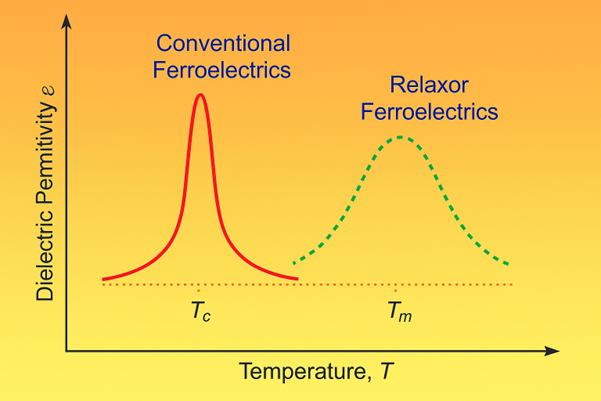
Relaxor ferroelectrics are a special class of ferroelectric materials that show anomalous dielectric and polarization behaviour compared with conventional ferroelectrics. In a normal ferroelectric, there is a well-defined phase transition from the ferroelectric to the paraelectric state at a single temperature — the Curie temperature (TC) — which appears as a sharp peak in the dielectric constant versus temperature plot (Figure 1). In relaxor ferroelectrics, this transition is not sharp but spread over a range of temperatures, a phenomenon known as a diffuse phase transition (DPT).
Why does this diffuseness arise? Because the crystal structure of a relaxor is chemically disordered, producing regions with different local environments. Instead of switching uniformly at one temperature, different regions respond at different temperatures, giving rise to a broad dielectric peak. A second defining feature is the frequency-dependent dielectric response (Figure 2): the temperature of maximum permittivity (Tm) shifts to higher values as the measurement frequency increases — something never observed in conventional ferroelectrics.
In simple terms, a conventional ferroelectric behaves like an on–off switch at a fixed temperature, whereas a relaxor responds gradually to changes in temperature and frequency — more like a dimmer than a switch. This makes relaxors extremely useful in multilayer capacitors, transducers, actuators, and piezoelectric devices, where large electromechanical coupling and stable performance over a wide temperature window are required.
Conventional vs. Relaxor Ferroelectrics
In conventional ferroelectrics such as BaTiO₃ or PbTiO₃, the ferroelectric-to-paraelectric transition occurs sharply at the Curie temperature. The dielectric constant (ε′) shows a narrow, frequency-independent peak at TC, indicating a well-defined structural change from a polar to a non-polar phase. (If the perovskite ABO₃ structure of these materials is new to you, revise it first — the same lattice hosts most relaxors.)
In contrast, relaxor ferroelectrics such as Pb(Mg1/3Nb2/3)O₃ (PMN) or Bi0.5Na0.5TiO₃ (BNT) show a diffuse transition spread over a wide temperature range. Their permittivity exhibits a broad maximum at Tm, and Tm itself shifts with measurement frequency. This tells us that polarization dynamics in relaxors are not uniform — different microscopic regions respond to electric fields on different timescales.
| Property | Conventional ferroelectric | Relaxor ferroelectric |
|---|---|---|
| Phase transition | Sharp, at a single Curie temperature (TC) | Diffuse, spread over a broad temperature range |
| Dielectric peak | Narrow and tall at TC | Broad maximum at Tm |
| Frequency dependence of the peak | Essentially none — peak stays at TC | Strong — Tm shifts to higher temperature with increasing frequency |
| Curie–Weiss law above the peak | Obeyed immediately above TC | Strong deviation; obeyed only well above Tm (above the Burns temperature) |
| Long-range polar order | Develops below TC (macroscopic domains) | Absent in zero field; only short-range polar nanoregions form |
| Typical examples | BaTiO₃, PbTiO₃ | PMN, PZN, PST, PMN–PT, BNT-based systems |
Why Are They Called "Relaxors"? Two Experimental Signatures
The name comes from their relaxation-type dielectric response, which resembles dipolar relaxation in glassy systems. Two experimental signatures justify the name.
Signature 1 — The Diffuse Phase Transition
Instead of a sharp ferroelectric–paraelectric transition, relaxors show a broad dielectric peak spread across a temperature range.
Signature 2 — Frequency-Dependent Permittivity
The dielectric constant changes with measurement frequency, indicating relaxation dynamics of dipoles rather than the switching of long-range-ordered ferroelectric domains.
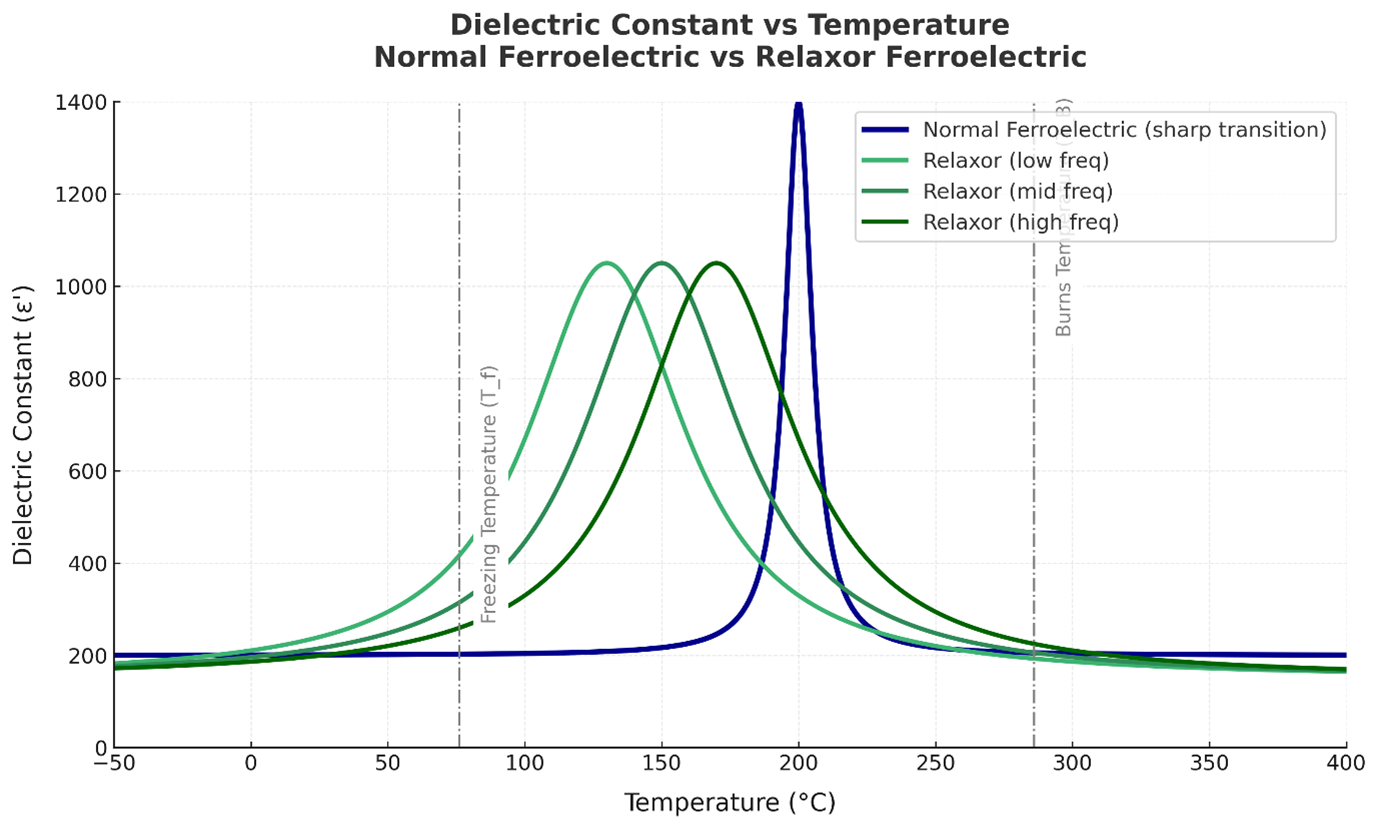
How to Read the ε′–T Plot
Three observations summarise relaxor behaviour on the ε′–T plot. First, the normal ferroelectric (the sharp, tall curve) has one frequency-independent peak at TC. Second, the relaxor curves show a broad maximum at Tm that shifts to higher temperature as frequency increases — the experimental hallmark of a relaxor. Third, polar nanoregions form below the Burns temperature (TB) and progressively freeze below the freezing temperature (Tf), which is the microscopic origin of the relaxation-type response.
Polar Nanoregions: The Microscopic Origin of Relaxor Behaviour
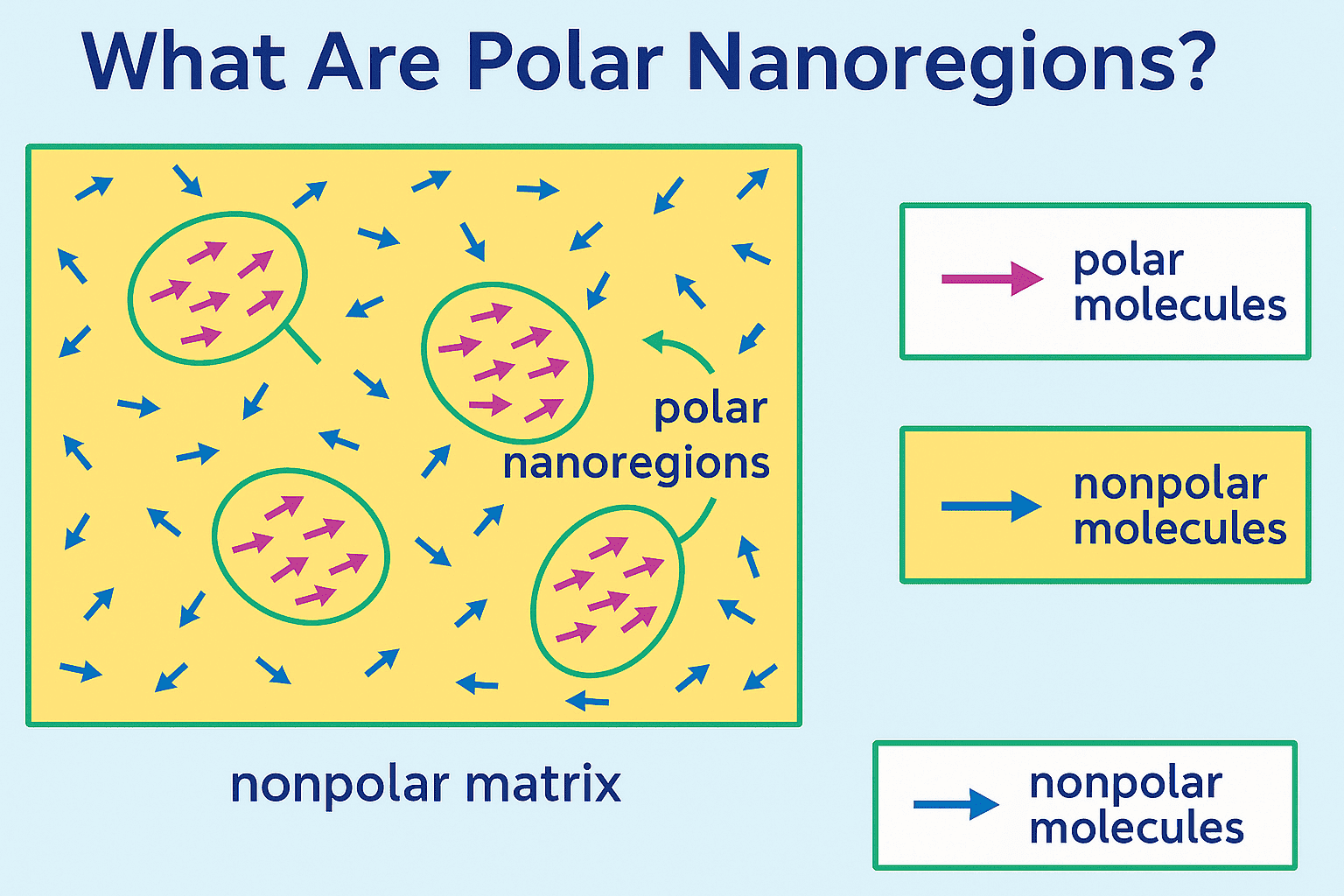
The frequency-dependent dielectric behaviour of relaxors is attributed to polar nanoregions (PNRs) — nanometre-sized clusters of correlated dipoles that form below the Burns temperature and govern the material's relaxation dynamics.
Where Do PNRs Come From?
PNRs emerge because of chemical disorder and random electric fields within the perovskite lattice (ABO₃). In Pb(Mg1/3Nb2/3)O₃, for example, the unequal charges of Mg²⁺ and Nb⁵⁺ ions sharing the B-site create local fields that favour short-range polar ordering. Although each PNR is polar, the material as a whole remains macroscopically non-polar because the PNRs are randomly oriented and distributed throughout the crystal. Crucially, the system never develops long-range ferroelectric order on its own — it is the size, dynamics, and interaction of the PNRs that evolve with temperature.
Temperature Evolution of PNRs
| Temperature range | Physical state | PNR behaviour |
|---|---|---|
| Above TB (Burns temperature) | Paraelectric, cubic | No PNRs; the material is fully disordered and follows the Curie–Weiss law |
| Between TB and Tm | Ergodic relaxor | Dynamic, short-lived PNRs nucleate, fluctuate, and reorient freely |
| Between Tm and Tf | Strongly interacting PNRs | PNRs grow, slow down, and begin to interact cooperatively |
| Below Tf (freezing temperature) | Non-ergodic, glass-like state | PNR dynamics freeze; dipoles become static in random orientations |
At TB, PNRs first appear inside the otherwise non-polar crystal. On cooling, these nano-polar clusters grow and start interacting, and near the freezing temperature Tf they become locked in place — producing the non-ergodic relaxor state described in the next section.
Ergodic and Non-Ergodic States of Relaxor Ferroelectrics
Up to this point, we have seen that the unusual dielectric response of relaxors arises from the dynamic interactions of PNRs within the crystal lattice. As temperature changes, the PNRs evolve from a dynamic to a frozen condition, giving rise to two distinct physical states — the ergodic and non-ergodic states. These states define how local polarization responds to external electric fields and to time, and they ultimately control the macroscopic dielectric and ferroelectric properties of the material.
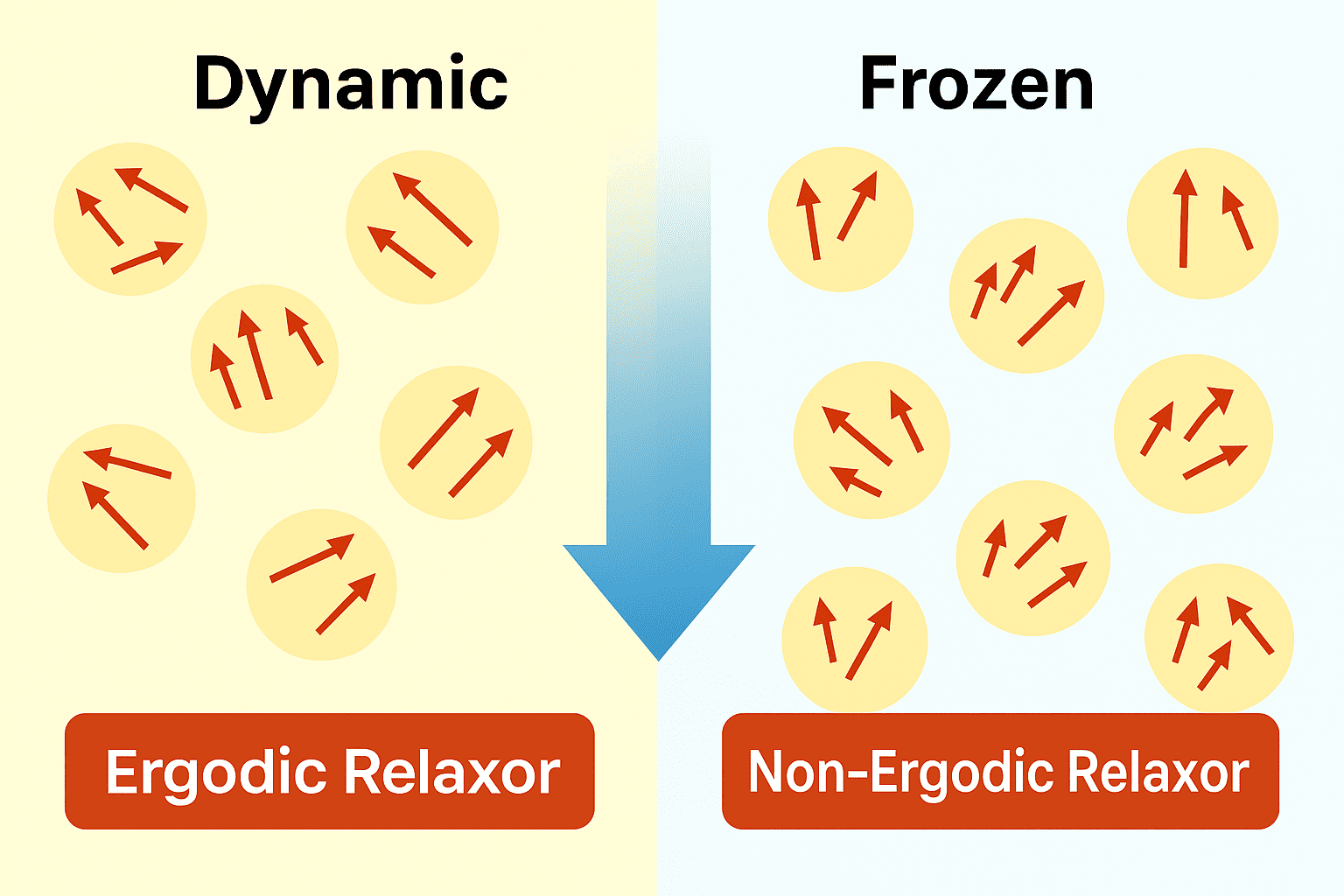
Ergodic and non-ergodic are states, not types, of relaxor ferroelectrics.
Many students believe that ergodic and non-ergodic refer to two different classes of relaxor materials. In reality, these terms describe the state, or dynamic behaviour, of the same relaxor material under specific temperature and electric-field conditions. In the ergodic state the PNRs are dynamic — they continuously fluctuate and reorient, with no long-range ferroelectric order. In the non-ergodic state the same PNRs become frozen, producing remanent polarization and memory effects similar to a normal ferroelectric. A single relaxor therefore transitions from ergodic to non-ergodic as it cools below the freezing temperature (Tf), or when subjected to a sufficiently strong external electric field.
Ergodic Relaxor State — The Dynamic Phase
The ergodic state is observed between the Burns temperature and the freezing temperature (Tf < T < TB). Here the PNRs are highly dynamic: nanosized regions of polarization continuously form, grow, and dissolve within the non-polar matrix. Their dipoles reorient easily under an external electric field, so the system can explore all its configurations and reach thermodynamic equilibrium — which is precisely what "ergodic" means in statistical mechanics.
Because of this dynamic behaviour, the dielectric response in the ergodic state is strongly frequency-dependent: the higher the measurement frequency, the higher the temperature at which ε′ peaks. This is why relaxors display a broad dielectric maximum at Tm rather than the sharp peak of a conventional ferroelectric. The frequency dispersion of Tm follows the empirical Vogel–Fulcher relation:
f = measurement frequency
f₀ = attempt frequency
Ea = activation energy
kB = Boltzmann constant
Tf = freezing temperature
The divergence of the relaxation time as Tm approaches Tf is direct evidence that PNR dynamics slow down and eventually freeze — behaviour closely analogous to structural glasses and spin glasses.
Intuitively, the ergodic state is a "liquid-like" condition of PNRs — flexible, responsive, and continuously changing. When an electric field is applied, the polarization follows it smoothly; when the field is removed, the system quickly relaxes back to its disordered state, leaving no remanent polarization.
Non-Ergodic Relaxor State — The Frozen Phase
As the temperature drops below Tf, the PNRs lose mobility and eventually become frozen in random orientations. In this non-ergodic state, the system can no longer reach thermodynamic equilibrium within experimental timescales — it is trapped in one region of its configuration space. The dipoles are locked and cannot fully respond to external stimuli.
The result is behaviour resembling a dipolar glass: polarization becomes sluggish, and hysteresis appears in the polarization–electric field (P–E) loops. If a sufficiently strong electric field is applied, the material can be poled into a long-range-ordered, ferroelectric-like state with measurable remanent polarization. In many non-ergodic relaxors this field-induced state persists after the field is removed, and the disordered state is recovered only on heating above Tf — a signature of broken ergodicity.
Physically, this crossover from dynamic to frozen PNRs explains why relaxor ferroelectrics combine the field-responsiveness of a paraelectric phase with the memory effects of a ferroelectric phase — the very combination that makes them ideal for high-performance actuators, sensors, and capacitors.
Why It Matters: Scientific and Technological Significance
Understanding ergodic and non-ergodic behaviour is not just of academic interest — it is central to designing high-performance functional materials. By controlling the degree of chemical disorder and the interaction among PNRs, researchers can tune dielectric, ferroelectric, and piezoelectric properties for specific applications. Two examples illustrate this:
- PMN–PT and PZN–PT single crystals near their morphotropic phase boundary (MPB) exhibit giant piezoelectric coefficients, owing to the delicate balance between relaxor (short-range) and ferroelectric (long-range) polar order.
- Bi-based relaxors such as BNT–BT are among the most promising lead-free alternatives for environmentally friendly actuators, sensors, and energy-storage capacitors, where a field-induced ergodic-to-ferroelectric transition delivers large recoverable strain. Doping strongly modulates this behaviour: donor and acceptor substitution in BNT ceramics shifts the frequency-dependent ferro–antiferro transition and introduces internal bias fields that reshape the piezoelectric response [11].
Do Relaxor Ferroelectrics Occur Only in Perovskite Lattices?
No — relaxor behaviour is not restricted to perovskites, although the best-known relaxors (PMN, PZN, and their solid solutions) are perovskite-type oxides with the general formula ABO₃. The perovskite structure is an ideal host because it permits B-site cation disorder (for example Mg²⁺/Nb⁵⁺ in PMN), supports local charge imbalance and random electric fields, and thereby facilitates the formation of PNRs below the Burns temperature. (Dimensional and size effects add a further layer to this story in thin films and nanostructures — see the discussion of dimensional effects in ferroelectricity in [12].)
However, relaxor-like phenomena have also been reported in several non-perovskite systems:
- Aurivillius-type layered oxides, e.g. Bi₄Ti₃O₁₂-based compounds and La-modified SrBi₂Nb₂O₉;
- Tungsten–bronze structured ferroelectrics, e.g. SrxBa1−xNb₂O₆ (SBN);
- Pyrochlore- and fluorite-type oxides; and
- Polymeric and organic ferroelectrics, e.g. irradiated or terpolymer PVDF-based systems, which show dipolar disorder and frequency-dependent dielectric relaxation.
Relaxor behaviour is therefore a physical phenomenon — arising from dipolar frustration, local disorder, and nanoscale polarization dynamics — not a property confined to one lattice type.
Future Research Directions
Current research focuses on resolving the atomic-scale origin and dynamics of PNRs using neutron and X-ray diffuse scattering, piezoresponse force microscopy (PFM), pair distribution function (PDF) analysis, and first-principles simulations. Field-induced phase transitions, temperature–frequency scaling, and lead-free relaxor systems remain highly active areas. Increasingly, machine-learning-assisted materials design is accelerating the discovery of relaxor compositions optimised for dielectric energy storage, electrocaloric solid-state cooling, and next-generation actuator technologies.
Practice Questions
Test your understanding with the following questions. Every correct answer is grounded in the content above — useful revision for viva, GATE, and CSIR-NET preparation.
Key Takeaways
Relaxor ferroelectrics differ from conventional ferroelectrics by showing a diffuse phase transition and a frequency-dependent dielectric maximum (Tm).
Their behaviour originates from polar nanoregions (PNRs) — nanosized zones of local polarization that form below the Burns temperature (TB) within a chemically disordered matrix.
The temperature evolution of PNRs governs the transition between the ergodic (dynamic) state and the non-ergodic (frozen) state below the freezing temperature (Tf).
Ergodic and non-ergodic are states of the same material, not two different classes of relaxors.
These tunable dynamics make relaxors indispensable in multilayer capacitors, medical ultrasound transducers, precision actuators, and emerging energy-storage devices.
The Vogel–Fulcher relation f = f₀ exp[−Ea/kB(Tm − Tf)] connects the frequency dispersion of Tm to the freezing of PNR dynamics.
Frequently Asked Questions (FAQs) on Relaxor Ferroelectrics
1. What are relaxor ferroelectrics?
Relaxor ferroelectrics are chemically disordered (usually complex perovskite) materials that show a diffuse phase transition and a frequency-dependent dielectric maximum instead of a sharp Curie point. Their behaviour is governed by polar nanoregions rather than long-range ferroelectric domains.
2. How do relaxor ferroelectrics differ from normal ferroelectrics?
A normal ferroelectric shows a sharp, frequency-independent dielectric peak at the Curie temperature (TC) and develops long-range polar order below it. A relaxor shows a broad, frequency-dependent peak at Tm and, in zero field, never develops long-range order — only short-range polar nanoregions.
3. What are polar nanoregions (PNRs)?
PNRs are nanometre-sized clusters of correlated dipoles that form below the Burns temperature within a non-polar matrix. They arise from chemical disorder and random electric fields (for example Mg²⁺/Nb⁵⁺ disorder on the B-site of PMN) and are responsible for the relaxation-type dielectric response.
4. What do "ergodic" and "non-ergodic" mean in relaxors?
In the ergodic state (between TB and Tf) the PNRs are dynamic and reorient freely, so the system can reach thermodynamic equilibrium. In the non-ergodic state (below Tf) the PNRs are frozen in random orientations and the system behaves like a dipolar glass with memory effects.
5. What is the significance of the Burns temperature (TB)?
The Burns temperature marks the onset of PNR formation on cooling. Above TB the material is a normal, fully disordered paraelectric obeying the Curie–Weiss law; below TB local polarization appears and the dielectric response begins to deviate from Curie–Weiss behaviour.
6. Why do relaxors show frequency-dependent dielectric peaks?
Because PNRs are relaxing entities with a distribution of relaxation times. At low frequencies, most PNRs can follow the field, so the peak occurs at lower temperature; at higher frequencies only the fastest PNRs respond, shifting Tm upward. The dispersion follows the Vogel–Fulcher relation.
7. What are the most common relaxor materials?
Classic examples are Pb(Mg1/3Nb2/3)O₃ (PMN), Pb(Zn1/3Nb2/3)O₃ (PZN), and Pb(Sc1/2Ta1/2)O₃ (PST), together with their solid solutions with PbTiO₃ (PMN–PT, PZN–PT). Leading lead-free relaxors include BNT-based systems such as BNT–BT and BNT–BKT.
8. What are the main applications of relaxor ferroelectrics?
Multilayer ceramic capacitors, medical ultrasound and sonar transducers, high-precision actuators, dielectric energy-storage capacitors, and electrocaloric cooling elements — all exploiting the large permittivity, giant electromechanical coupling, and broad operating-temperature window of relaxors.
9. What causes the diffuse phase transition?
Chemical (compositional) disorder. Different local cation arrangements create a distribution of local transition temperatures and random electric fields, so different regions of the crystal respond at different temperatures, smearing the transition into a broad peak.
10. Can relaxor behaviour be tuned?
Yes. The degree of relaxor character can be adjusted through composition (heterovalent substitution), B-site ordering, grain size, electric field, and solid-solution design near a morphotropic phase boundary — the strategy behind ultrahigh-piezoelectricity PMN–PT crystals and large-strain lead-free actuators.
11. Why are relaxor ferroelectrics important for research?
They sit at the intersection of ferroelectricity, glass physics, and nanoscale disorder, and they hold records for piezoelectric and dielectric performance. Understanding PNR dynamics is key both to fundamental questions of broken ergodicity and to designing next-generation electroceramic devices.
12. How is relaxor behaviour studied experimentally?
Primarily by broadband dielectric spectroscopy (ε′ and ε″ versus temperature and frequency), P–E hysteresis measurements, neutron and X-ray diffuse scattering to detect PNRs, piezoresponse force microscopy for local polar structure, and Raman/Brillouin spectroscopy for lattice dynamics.
References
All references are in IEEE citation style. All sources are peer-reviewed journals or authoritative preprint archives.
- A. A. Bokov and Z.-G. Ye, "Recent progress in relaxor ferroelectrics with perovskite structure," J. Mater. Sci., vol. 41, no. 1, pp. 31–52, 2006, doi: 10.1007/s10853-005-5915-7. [doi.org] — The definitive review of relaxor phenomenology: diffuse transitions, PNRs, ergodic/non-ergodic states.
- M. E. Manley, J. W. Lynn, D. L. Abernathy, E. D. Specht, O. Delaire, A. R. Bishop, R. Sahul, and J. D. Budai, "Phonon localization drives polar nanoregions in a relaxor ferroelectric," Nat. Commun., vol. 5, Art. no. 3683, 2014, doi: 10.1038/ncomms4683. [doi.org] — Neutron-scattering evidence for the lattice-dynamical origin of PNRs.
- H. Liu, X. Shi, Y. Yao, et al., "Emergence of high piezoelectricity from competing local polar order–disorder in relaxor ferroelectrics," Nat. Commun., vol. 14, Art. no. 1007, 2023, doi: 10.1038/s41467-023-36749-w. [doi.org] — Modern picture of how local order–disorder competition produces giant piezoelectricity.
- L. Cai, R. Pattnaik, J. Lundeen, and J. Toulouse, "Piezoelectric polar nanoregions and relaxation-coupled resonances in relaxor ferroelectrics," arXiv, 2018, arXiv:1801.02655. [arxiv.org] — PNR-mediated electromechanical response.
- H. Takenaka, I. Grinberg, and A. M. Rappe, "Anisotropic local correlations and dynamics in a relaxor ferroelectric," Phys. Rev. Lett., vol. 110, Art. no. 147602, 2013. [arxiv.org] — First-principles molecular dynamics of PNR correlations.
- L. Cai, J. Toulouse, L. Harriger, R. G. Downing, and L. A. Boatner, "Origin of the crossover between a freezing and a structural transition at low concentration in the relaxor ferroelectric KTa₁₋ₓNbₓO₃," Phys. Rev. B, vol. 91, no. 13, Art. no. 134106, 2015, doi: 10.1103/PhysRevB.91.134106. [doi.org] — Freezing versus structural transition in a model relaxor.
- V. V. Shvartsman and D. C. Lupascu, "Lead-free relaxor ferroelectrics," J. Am. Ceram. Soc., vol. 95, no. 1, pp. 1–26, 2012, doi: 10.1111/j.1551-2916.2011.04952.x. [doi.org] — Comprehensive review of BNT-based and other lead-free relaxor systems.
- S. Huang, L. Sun, C. Feng, and L. Chen, "Relaxor behavior of layer-structured SrBi₁.₆₅La₀.₃₅Nb₂O₉," J. Appl. Phys., vol. 99, no. 7, Art. no. 076104, 2006, doi: 10.1063/1.2186975. [doi.org] — Relaxor behaviour in a non-perovskite (Aurivillius) lattice, cited in Section 7.
- R. Verma and S. K. Rout, "Frequency-dependent ferro–antiferro phase transition and internal bias field influenced piezoelectric response of donor and acceptor doped bismuth sodium titanate ceramics," J. Appl. Phys., vol. 126, no. 9, Art. no. 094103, Sep. 2019, doi: 10.1063/1.5111505. [doi.org] — Author's research on doped BNT relaxor ceramics, cited in Section 6.
- R. Verma and S. K. Rout, "The Mystery of Dimensional Effects in Ferroelectricity," in Recent Advances in Multifunctional Perovskite Materials. London, UK: IntechOpen, 2022, doi: 10.5772/intechopen.104435. [doi.org] — Author's chapter on size and dimensional effects in ferroelectric/perovskite systems, cited in Section 7.
Series Navigation — Ferroelectrics & Perovskite Hub
Piezoelectric? Bipolar S–E Curve
Complete Guide Polymer vs Ceramic
S–E Loop Inversion Current
Relaxor Ferroelectrics I–t Analysis in
Ferroelectrics
Why Is Perovskite Piezoelectric? — The structural and quantum-mechanical origin of piezoelectricity in the ABO₃ lattice that hosts most relaxors.
How to Read an XRD Graph in 7 Easy Steps — The diffraction fundamentals behind the diffuse-scattering studies of PNRs mentioned above.
Bipolar S–E Curve — Complete Guide — How field-induced transitions in relaxors appear in strain–field measurements.
I–t Analysis in Ferroelectrics — Time-domain switching dynamics, the complement of the frequency-domain picture used here.
Next Tutorial: Field-Induced Phase Transitions in Lead-Free Relaxors →
Previous: Why Is Perovskite Piezoelectric?
If you notice any inaccuracies or have constructive suggestions, feedback is warmly welcome.
Contact: advancematerialslab27@gmail.com