
What is Bipolar Strain-Electric Field (S-E) Curve in Piezoelectric Materials: Complete Beginner to Advanced Guide
1. Introduction: The Student's Dilemma
Picture this: You're reading a research paper on piezoelectric materials for the first time. You encounter a graph that looks like a butterfly with its wings spread open. The x-axis says "Electric Field (kV/cm)" and the y-axis says "Strain (%)". The curve loops back on itself in a peculiar symmetrical pattern. You stare at it, trying to make sense of what you're seeing. What does this butterfly shape actually mean? Why does the strain go negative? What is this graph telling you about the material?
If you've experienced this confusion, you're not alone. The bipolar strain-electric field curve—often called the butterfly loop or S-E hysteresis curve—is one of the most important yet initially puzzling graphs in piezoelectric and ferroelectric materials research. It appears in nearly every paper on actuators, sensors, and electromechanical devices, yet many students struggle to interpret it beyond recognizing its distinctive shape.
This tutorial exists to solve that problem. By the end of this guide, you will not only understand what the bipolar S-E curve represents, but you will be able to extract quantitative information from it, explain the underlying physics that creates the butterfly shape, and confidently discuss these curves in academic and research contexts. We will build your understanding progressively, starting from the absolute basics and advancing to PhD-level conceptual depth.
📚 Table of Contents
- 1. Introduction: The Student's Dilemma
- 2. What is a Strain-Electric Field (S-E) Curve?
- 3. Understanding Bipolar: Why We Cycle the Electric Field
- 4. The Butterfly Loop Explained (Core Concept)
- 5. Step-by-Step: Reading the Graph Like a Pro
- 6. Key Parameters Extracted from S-E Curves
- 7. The Deep Physics: Why the Butterfly Shape Appears
- 8. Unipolar vs Bipolar: Understanding the Difference
- 9. Real-World Applications
- 10. Common Mistakes Students Make
- 11. Summary and Key Takeaways
- 12. References
2. What is a Strain-Electric Field (S-E) Curve?
Before we can understand the bipolar S-E curve, we need to establish what we mean by "strain" and "electric field" in the context of piezoelectric materials, and why we plot one against the other.
Understanding Strain in Piezoelectric Materials
Strain is a measure of deformation. When you apply a force to a material, it changes shape—it might stretch, compress, or shear. Strain quantifies this change as a dimensionless ratio: the change in length divided by the original length. For example, if a 10 mm long sample stretches to 10.01 mm, the strain is 0.01 mm / 10 mm = 0.001, or 0.1%. In piezoelectric materials, we're particularly interested in how strain develops not from mechanical forces, but from electrical stimulation.
Think of strain like pulling a rubber band. When you stretch it, the rubber band gets longer—that's positive strain (elongation or expansion). When you compress it, it gets shorter—that's negative strain (contraction). In piezoelectric materials, instead of pulling with your hands, you're "pulling" with an electric field.
The Converse Piezoelectric Effect
Piezoelectric materials have a remarkable property: when you apply an electric field to them, they change shape. This is called the converse piezoelectric effect (as opposed to the direct piezoelectric effect, where mechanical stress generates an electric field). When you place a piezoelectric ceramic between two electrodes and apply a voltage, creating an electric field across the material, the crystal lattice distorts. Atomic positions shift slightly, and this microscopic distortion manifests as a macroscopic change in dimensions—strain.
The relationship is elegantly simple in its basic form: apply more electric field, get more strain. But the reality is far more interesting and complex than a simple linear relationship, which is exactly what the S-E curve reveals.
Why We Plot Strain vs Electric Field
The S-E curve is simply a graph where we plot the measured strain (vertical axis) as a function of the applied electric field (horizontal axis). We systematically vary the electric field—increasing it, decreasing it, reversing it—and measure how the material responds in terms of dimensional change. This gives us a complete picture of the electromechanical coupling behavior of the material.
For many materials, you might expect a straight line: double the electric field, double the strain. But piezoelectric and ferroelectric materials exhibit hysteresis—meaning their current state depends not just on the current electric field, but on their history. This hysteresis creates the characteristic looping behavior you see in S-E curves.
3. Understanding Bipolar: Why We Cycle the Electric Field
The term "bipolar" in bipolar S-E curve refers to the nature of the electric field cycling. Let's break down what this means and why it's important.
What Does Bipolar Mean?
In a bipolar measurement, we apply an electric field that cycles through both positive and negative values. Imagine a sinusoidal voltage signal: it starts at zero, increases to a maximum positive value (+E_max), decreases back through zero, continues to a maximum negative value (-E_max), and then returns to zero again. This complete cycle takes the electric field through all four quadrants of behavior: positive field increasing, positive field decreasing, negative field increasing (becoming more negative), and negative field decreasing (returning toward zero).
The key word is "reversal." Unlike a unipolar signal that only goes from zero to some positive maximum and back, a bipolar signal actively reverses the polarity of the electric field. This reversal has profound physical consequences in ferroelectric materials because it forces the internal electric dipoles to flip—a process called polarization switching or domain switching.
Why Electric Field Reversal Matters
Think of the electric dipoles in a ferroelectric material like tiny compass needles, each pointing in a direction determined by the local atomic arrangement. When you apply a strong electric field in one direction, these "needles" align with the field, all pointing the same way. This alignment creates a macroscopic polarization—a net electric dipole moment for the entire material.
Now, when you reverse the electric field direction (going from +E to -E), you're asking all those aligned dipoles to flip 180 degrees and point the opposite way. This flipping doesn't happen smoothly or instantaneously. It requires overcoming an energy barrier, and it happens through a collective reorganization of crystal domains. This switching process is precisely what creates the distinctive features of the bipolar S-E curve.
Hysteresis Behavior: The Memory Effect
Hysteresis means that the current state of the material depends on its past. When you increase the electric field from zero to +E_max, the material follows one path. When you decrease it back to zero, it doesn't retrace the same path—it follows a different route. This creates a loop rather than a single line.
Why does this happen? Because the domain switching processes that occur during field increase are not fully reversible when you decrease the field. Some domains remain switched even when the field returns to zero, creating a "memory" of the previous maximum field. This remnant deformation is called remanent strain, and it's a hallmark of ferroelectric behavior.
If you've studied magnetic materials, you may recognize this behavior. Ferroelectric hysteresis in S-E curves is directly analogous to magnetic hysteresis in B-H curves. Just as a ferromagnet retains some magnetization after removing the magnetic field, a ferroelectric material retains some strain after removing the electric field. The physical mechanisms differ (electric dipoles vs magnetic moments), but the mathematical description and loop topology are remarkably similar.
4. The Butterfly Loop Explained (Core Concept)
Now we arrive at the heart of the matter: the butterfly loop itself. This section explains why the S-E curve has its characteristic shape and what each feature of that shape tells us about the material's behavior.
The Overall Shape: Why "Butterfly"?
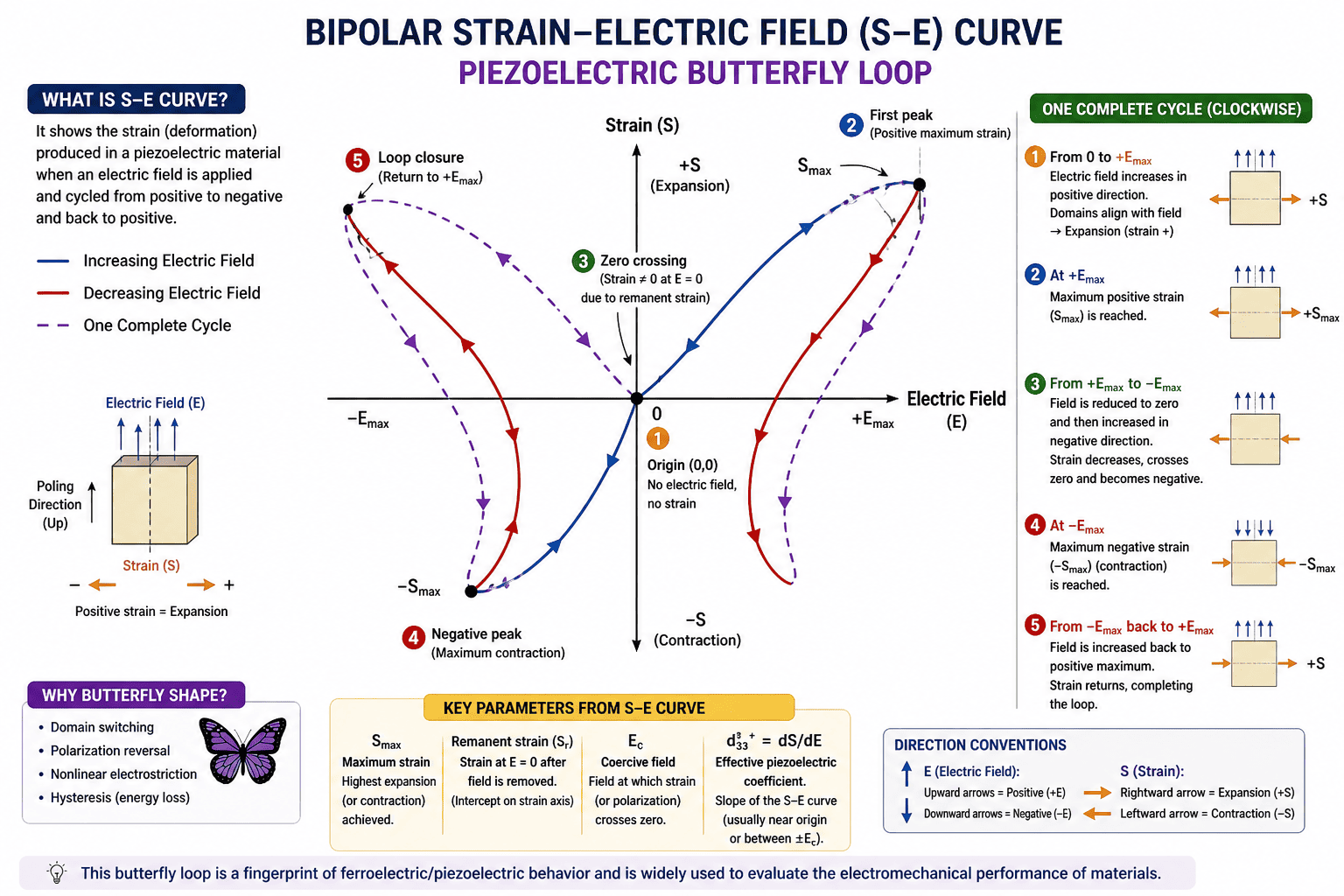
When you plot a complete bipolar S-E measurement, you typically see a curve that resembles a butterfly viewed from above with its wings spread. The curve has two "lobes"—one in the upper right quadrant (positive field, positive strain) and one in the upper left quadrant (negative field, positive strain). These two lobes are roughly symmetric about the vertical axis, creating the wing-like appearance.
Critically, even though the electric field goes both positive and negative, the strain is predominantly positive throughout most of the cycle. This is not immediately intuitive and is one of the key points of confusion for beginners. Let me explain why this happens.
Why Strain is Predominantly Positive
Here's the crucial insight: in a typical ferroelectric ceramic measured in its thickness direction, we define positive strain as expansion (thickness increase) and negative strain as contraction (thickness decrease). When you apply a sufficiently strong electric field in either direction—positive or negative—the material expands. This is because the electric field, regardless of its sign, aligns ferroelectric domains along the field direction through 180-degree domain switching.
Imagine a ferroelectric sample that starts in a "neutral" state with randomly oriented domains. When you apply a strong positive field, domains with polarization vectors pointing upward (parallel to the field) are energetically favorable, so domains flip to align this way. This alignment causes the crystal to elongate in the vertical direction—positive strain. Now, when you reverse the field to a strong negative value, domains flip again to align anti-parallel to the new field direction (pointing downward). But wait—this is still an aligned state. The crystal is still ordered, just in the opposite direction. And for many ferroelectric materials, both aligned states (all domains up or all domains down) have similar lattice distortions that cause expansion compared to a completely random domain configuration.
The result is that at both large positive and large negative fields, you see positive strain (expansion). The strain doesn't simply follow the field linearly; instead, it responds to the magnitude and alignment state created by the field.
The Zero-Strain Crossings
One of the most distinctive features of the butterfly loop is that the curve crosses the horizontal axis (zero strain) not at zero field, but at two intermediate field values—one positive and one negative. These crossing points occur at fields roughly corresponding to the coercive field (E_c), the field strength required to switch domains.
At these crossing points, the material passes through a state of minimal macroscopic strain. This happens because the material is in a partially switched, disordered state. Some domains are still aligned with the previous field direction, while others have already switched to align with the new direction. The result is a domain configuration where competing distortions partially cancel out, giving near-zero net strain.
Negative Strain: When and Why
In some regions of the butterfly loop, particularly near the coercive field crossings, the strain can become slightly negative. This negative strain represents contraction below the material's reference dimensions. It occurs during the transitional phase of domain switching when the domain structure is in a highly disordered state. The exact mechanism depends on the material, but it often involves non-180-degree domain wall motion and complex strain coupling effects.
Think of it like this: during switching, the material briefly passes through configurations that are less ordered and more compact than either fully aligned state. This transient disorder can manifest as slight contraction—hence negative strain.
5. Step-by-Step: Reading the Graph Like a Pro
Let's walk through a bipolar S-E curve point by point, following the complete electric field cycle. This will give you a systematic framework for interpreting any butterfly loop you encounter in the literature.
Stage 1: Starting at the Origin (E = 0, S = 0)
We begin our journey at the origin where both electric field and strain are zero. The material is in its initial state, typically with a complex domain structure. If the material has never been electrically cycled before (virgin state), the domains may be randomly oriented with no net polarization. If it has been cycled previously, it may have some remnant domain alignment from past cycles.
Stage 2: First Quadrant—Increasing Positive Field
As we apply an increasingly positive electric field, the strain begins to rise. Initially, the response may be relatively linear—this is the reversible piezoelectric response where domain walls move slightly but domains don't switch. The slope of this initial linear region is related to the small-signal piezoelectric coefficient.
As the field continues to increase and approaches the coercive field (E_c), domain switching begins. Domains with polarization opposite to the applied field start flipping. This switching process introduces nonlinearity—the strain increases more rapidly with field. The curve steepens as more and more domains participate in the switching process.
Eventually, we reach the maximum positive field (+E_max). At this point, most domains are aligned with the field, and the material has reached its maximum positive strain (S_max). The material is now in a saturated state—applying even higher fields would produce only minimal additional strain because nearly all domains are already aligned.
Stage 3: Decreasing the Field—The Upper Right Wing
Now we begin to decrease the electric field from +E_max back toward zero. Here's where hysteresis becomes evident: the strain does not follow the same path back down. Instead, the curve forms the upper right "wing" of the butterfly.
As the field decreases, the strain also decreases, but it remains higher than it was during the field-increase journey at the same field value. Why? Because many domains that switched during the increase remain switched even as the field weakens. The switched domains are stable—they don't immediately flip back when the field reduces.
When we return to zero field (E = 0), the strain does not return to zero. There is a remnant strain (S_rem), a permanent deformation that persists even without an applied field. This remnant strain is the structural "memory" of the field cycle—the fingerprint left by irreversible domain switching.
Stage 4: Crossing into Negative Field—The Critical Transition
As we continue reducing the field past zero into negative territory, something dramatic happens. The now-negative field opposes the domain alignment created by the previous positive field. Domains begin to switch again, this time from the upward-aligned state to the downward-aligned state.
Around the negative coercive field (–E_c), the switching process is most active. The material passes through a highly disordered state where roughly half the domains are aligned one way and half the other. This is where the curve crosses the horizontal axis—zero strain occurs at the coercive field, not at zero field.
Stage 5: Maximum Negative Field—The Upper Left Wing
Continuing to more negative fields (more negative than –E_c), domains complete their switching. By the time we reach the maximum negative field (–E_max), virtually all domains are now aligned anti-parallel to the field (pointing downward if we define negative field as downward). And remarkably, despite the field being negative, the strain is again positive and approaches the maximum value S_max.
This creates the upper left "wing" of the butterfly. The material is once again in a fully aligned state, just with the opposite polarization direction compared to the +E_max state. But both aligned states produce similar lattice distortions and thus similar positive strains.
Stage 6: Returning Through Negative to Positive—Completing the Loop
As we increase the field from –E_max back toward zero, we trace the lower left wing of the butterfly. The strain decreases as the field magnitude decreases, but again, hysteresis keeps the strain higher than during the outward journey. At E = 0, we have a negative remnant strain (or a remnant strain with opposite sign dependency on the previous sweep direction).
Continuing into positive fields, we cross zero strain again near +E_c as domains switch back to their original orientation. Finally, we return to +E_max, completing the full butterfly loop.
6. Key Parameters Extracted from S-E Curves
The bipolar S-E curve is not just a pretty shape—it's a quantitative data source. Researchers extract specific numerical parameters from these curves to characterize and compare materials. Let's examine the most important parameters and what they mean physically.
Maximum Strain (S_max)
The maximum strain is the peak value of strain achieved during the field cycle, typically occurring at or near the maximum applied field (±E_max). It represents the largest dimensional change the material can produce under the measurement conditions.
Physically, S_max tells you the actuation authority of the material—how much movement you can generate per unit length. For a piezoelectric actuator, this directly translates to displacement. A material with S_max = 0.1% means that a 10 mm thick sample will expand by 10 µm when fully activated. High-performance piezoceramics can achieve maximum strains of 0.15% to 0.20%, while lead-free alternatives typically achieve 0.05% to 0.10%.
Importantly, S_max is field-dependent. Researchers typically report the strain at a specific maximum field, such as "S_max = 0.12% at 40 kV/cm." This context is essential because applying higher fields generally yields higher strains, at least until saturation.
Remanent Strain (S_rem)
Remanent strain is the strain that remains when the electric field returns to zero after the material has been driven to maximum field. On the butterfly loop, you identify S_rem by finding the strain value where the curve intersects the vertical axis (E = 0).
Remanent strain indicates how much deformation "locks in" due to irreversible domain switching. A material with high remanent strain exhibits strong hysteresis and retains significant dimensional change even without continuous electrical power. This can be either beneficial or problematic depending on the application. For memory devices, high S_rem is desirable. For precision positioning, it introduces drift and positioning errors.
The ratio S_rem / S_max is sometimes called the remanent strain fraction, and it quantifies the degree of irreversibility in the material's response. Values typically range from 0.02 to 0.10 (2% to 10% of maximum strain remains at zero field).
Coercive Field (E_c)
The coercive field is the electric field magnitude required to reduce the strain to zero during field reversal. On the butterfly loop, E_c is identified by the horizontal coordinate of the zero-strain crossing points. Because the loop is symmetric, there are two crossing points: one at +E_c (during negative field sweep) and one at –E_c (during positive field sweep).
Physically, E_c represents the field strength needed to overcome the energy barrier for domain switching. Materials with low coercive fields switch easily and require less voltage to operate, but they may also exhibit less stable polarization states. Materials with high coercive fields are more stable but require higher operating voltages.
Typical coercive field values range from 2 to 10 kV/cm for soft piezoceramics and 10 to 20 kV/cm for hard piezoceramics. Lead-free materials often have higher coercive fields, sometimes exceeding 30 kV/cm, which is one of the challenges in their practical application.
Effective Piezoelectric Coefficient (d₃₃*)
While the small-signal piezoelectric coefficient d₃₃ is typically measured with a d₃₃ meter under very small AC fields, the large-signal effective piezoelectric coefficient d₃₃* (read as "d-33-star" or "effective d-33") is extracted from the bipolar S-E curve. It represents the electromechanical coupling under realistic operating conditions with large fields and domain switching.
The effective d₃₃* is calculated as the slope of the strain-field curve, specifically the maximum slope during the initial loading portion (first quadrant). Mathematically:
where ΔS is the change in strain and ΔE is the change in electric field over the steepest linear region of the curve. The units are typically picocoulombs per Newton (pC/N) or equivalently picometers per Volt (pm/V).
The effective d₃₃* is almost always larger than the small-signal d₃₃ because it includes contributions from both reversible piezoelectric response and irreversible domain switching. For high-quality PZT ceramics, d₃₃ might be 300-400 pC/N, while d₃₃* can reach 600-800 pC/N. This difference highlights why S-E measurements are essential for actuator design—the small-signal coefficient underestimates real performance.
Strain Hysteresis and Energy Loss
The area enclosed by the butterfly loop represents energy dissipation—the mechanical energy lost to heat during one complete electric field cycle due to friction in domain wall motion and internal stresses. Materials with wide, fat loops dissipate more energy than materials with narrow, skinny loops.
For actuator applications, high hysteresis means poor energy efficiency and heat generation. For damping applications, however, controlled hysteresis can be beneficial as it absorbs vibrational energy. Researchers quantify hysteresis by calculating the percentage difference between the loading and unloading curves at specific field values.
| Parameter | Symbol | How to Extract | Physical Meaning |
|---|---|---|---|
| Maximum Strain | S_max | Peak strain value at ±E_max | Maximum achievable deformation |
| Remanent Strain | S_rem | Strain at E = 0 after cycling | Locked-in deformation at zero field |
| Coercive Field | E_c | Field at zero-strain crossing | Field needed to switch domains |
| Effective d₃₃ | d₃₃* | Slope of steepest linear region | Large-signal electromechanical coupling |
7. The Deep Physics: Why the Butterfly Shape Appears
We've described what the butterfly loop looks like and how to read it. Now let's dive into the underlying physics that creates this distinctive shape. This section targets those seeking PhD-level conceptual understanding.
Domain Structure and Polarization in Ferroelectrics
Ferroelectric materials possess a spontaneous electric polarization below a critical temperature called the Curie temperature. This spontaneous polarization arises from a non-centrosymmetric crystal structure where positive and negative charge centers do not coincide. In perovskite ferroelectrics like BaTiO₃ or PZT, the central cation (Ti⁴⁺ or Zr⁴⁺/Ti⁴⁺) is displaced from the center of the oxygen octahedron, creating an electric dipole in each unit cell.
However, a macroscopic ferroelectric crystal is not uniformly polarized in a single direction. Instead, it breaks up into domains—regions of uniform polarization separated by domain walls. Within each domain, all the unit cell dipoles point in the same direction, but different domains can have polarizations pointing in different directions. This domain structure forms to minimize the total electrostatic and elastic energy of the system.
In a tetragonal ferroelectric, there are six possible polarization directions (along ±x, ±y, ±z crystallographic axes). Domain walls separating regions that differ by 180° in polarization direction (opposite but parallel) are called 180° domain walls. Domain walls separating regions that differ by 90° are called 90° domain walls. Both types play roles in the S-E behavior.
Domain Switching: The Fundamental Mechanism
When you apply an electric field to a ferroelectric material, you create an energy imbalance. Domains with polarization aligned parallel to the field are energetically favorable (they lower their electrostatic energy), while domains with polarization anti-parallel to the field are energetically unfavorable. If the applied field is strong enough to overcome the energy barrier for switching—which includes nucleation energy for new domains and the energy cost of moving domain walls through the crystal—domains will switch to align with the field.
The switching process is not instantaneous or simultaneous across the entire sample. It occurs through nucleation and growth of favorably oriented domains. Small nuclei of the favored polarization state form, often at defects or grain boundaries. These nuclei grow as domain walls sweep through the crystal, converting material from one polarization state to another. This switching is an irreversible process—it involves atomic displacements and does not simply reverse when you remove the field.
Why Strain Accompanies Switching
Here's the key connection to strain: when domains switch, the crystal structure distorts. In a tetragonal ferroelectric, the c-axis (the elongated axis) is longer than the a-axis. When a domain switches from having its c-axis horizontal to having it vertical (a 90° switch), the crystal locally expands in the new c-direction and contracts in the directions perpendicular to it.
When many domains collectively switch to align with an applied vertical electric field, the crystal as a whole develops a net vertical elongation—positive strain along the field direction. This strain has two contributions: intrinsic piezoelectric strain from the asymmetric unit cell response to the field, and extrinsic strain from the collective effect of domain reorientations.
The extrinsic contribution—domain switching—is the dominant factor in the large-signal S-E response. It's why the effective d₃₃* is much larger than the intrinsic piezoelectric coefficient of a single domain.
The Role of Nonlinear Electrostriction
Beyond domain switching, there's another mechanism contributing to the S-E curve shape: electrostriction. Electrostriction is a nonlinear electromechanical effect present in all dielectrics (not just ferroelectrics) where strain is proportional to the square of the electric field:
where Q is the electrostrictive coefficient. Notice that this relationship is always positive regardless of field direction—whether E is positive or negative, E² is positive, so strain is positive. This naturally creates a symmetric response around E = 0, which contributes to the butterfly shape.
In relaxor ferroelectrics and certain lead-free materials, electrostriction is the dominant mechanism rather than domain switching. These materials exhibit butterfly loops even without sharp domain switching transitions, with smoother curves reflecting the quadratic E² dependence.
Asymmetry, Imprint, and Internal Bias Fields
In an ideal symmetric material, the butterfly loop should be perfectly centered on the origin with the two wings being mirror images. In real materials, you often see asymmetries: one wing may be larger than the other, or the entire loop may be shifted horizontally (offset along the E-axis) or vertically (offset along the S-axis).
These asymmetries arise from several factors. Internal bias fields, created by trapped charges or defect dipoles aligned preferentially in one direction, can shift the loop horizontally. This makes domains easier to switch in one direction than the other—the coercive fields become unequal. This phenomenon is called imprint.
Vertical offsets can result from self-polarization or incomplete domain switching during prior cycles, leaving a net remnant deformation. Asymmetric wing sizes may indicate different domain wall mobilities for the two polarization directions, often related to defect distributions or grain orientations in polycrystalline ceramics.
Deep Physics Summary
- The butterfly shape emerges from the interplay of domain switching (irreversible, hysteretic, alignment-dependent) and electrostriction (reversible, nonlinear, quadratic in field).
- Domain switching contributes extrinsic strain through collective 90° and 180° reorientations of polarization domains, creating the hysteretic loop.
- Electrostriction contributes a symmetric, always-positive strain proportional to E², reinforcing the butterfly symmetry.
- The coercive field represents the switching threshold—the field strength where domain wall motion becomes energetically favorable and widespread switching occurs.
- Asymmetries in real materials reveal internal bias fields, defect structures, and preferential domain orientations that break ideal symmetry.
8. Unipolar vs Bipolar: Understanding the Difference
Now that you understand the bipolar S-E curve, let's clarify how it differs from the unipolar S-E curve, when each is used, and what information each provides.
What is a Unipolar S-E Curve?
A unipolar S-E measurement applies an electric field that cycles from zero to a positive maximum and back to zero, without ever reversing polarity. The field waveform is typically a triangular wave that goes 0 → +E_max → 0 → +E_max → 0, repeating for several cycles.
The resulting S-E curve is not a butterfly loop. Instead, it's a single-sided loop that sits entirely in the first quadrant (positive field, positive strain). The curve shows hysteresis—the loading path (0 → E_max) differs from the unloading path (E_max → 0)—but there's no crossing through negative fields and no second wing.
When to Use Each Measurement
Unipolar S-E curves are used when you want to characterize the material's behavior under typical actuator operating conditions. Most piezoelectric actuators operate with unipolar drive signals—they're never reverse-poled during normal use. For these applications, the unipolar curve gives you the relevant performance data: how much strain you get as a function of applied voltage, what the hysteresis looks like during normal cycling, and how efficiently the material converts electrical energy to mechanical displacement.
Bipolar S-E curves are used when you need to understand the full switching behavior and fundamental material properties. They reveal the coercive field, the symmetry of switching in both directions, the complete domain dynamics, and any imprint or internal bias effects. Bipolar measurements are essential for comparing materials scientifically and for applications where the material experiences field reversals (such as in certain sensor configurations or when intentionally re-poling the material).
Key Differences in Shape and Physics
The unipolar curve lacks the dramatic zero-strain crossing and the second wing of the butterfly because the material never undergoes full polarization reversal. Domains that switch during the 0 → E_max portion partially relax when the field returns to zero, but they don't switch back completely—they don't need to, because the field never opposes their alignment.
As a result, the unipolar curve shows a monotonic increase in strain with field (though nonlinear due to progressive domain switching) and a hysteretic decrease with some remanent strain at zero field. The loop area is smaller than for the bipolar case because you're not doing the work of reversing the polarization.
In terms of extracted parameters, the unipolar curve gives you the same S_max and effective d₃₃*, but the meaning of E_c is different—you don't see the sharp zero-crossing, so coercive field determination is less direct. Instead, researchers might report the "knee field" where the slope changes most rapidly, indicating the onset of significant domain activity.
9. Real-World Applications
Understanding the S-E curve isn't just an academic exercise—it directly informs the design and optimization of devices that impact technology and daily life. Let's explore how the parameters extracted from S-E curves translate into real-world performance.
Piezoelectric Actuators: Precision Positioning
Piezoelectric actuators are used wherever extremely precise, repeatable positioning is needed at the micro- or nanometer scale. Applications include atomic force microscope (AFM) scanners, adaptive optics mirror adjustment in telescopes, fuel injector control in automotive engines, and precision stages in semiconductor lithography equipment.
For these applications, the S-E curve tells you several critical things. First, S_max determines your displacement range—how far you can move. An AFM with a 100 µm scan range requires a piezo stack with sufficient length and S_max to produce that displacement. Second, hysteresis (the width of the S-E loop) determines positioning accuracy and the need for closed-loop feedback control. Narrow loops mean better open-loop performance; wide loops mean you need position sensors and feedback to correct for drift.
The effective d₃₃* directly translates to voltage-to-displacement sensitivity. Higher d₃₃* means more displacement per volt, which allows you to use lower voltage electronics and achieve your required range with shorter actuator stacks. This is especially important in portable or battery-powered devices.
Sensors: Harvesting Mechanical Signals
Piezoelectric sensors operate in reverse: mechanical strain generates an electric charge (the direct piezoelectric effect). However, the sensor's sensitivity is still related to the same piezoelectric coefficient d₃₃ that we extract from S-E curves. A material with high d₃₃* from the converse effect will also have high sensitivity as a sensor in the direct effect.
Applications include vibration sensors in machinery health monitoring, pressure sensors in touchscreens and medical diagnostics, acceleration sensors in automotive airbag triggers, and ultrasonic transducers in medical imaging. The S-E curve helps sensor designers select materials that balance sensitivity (high d₃₃), stability (low drift from remanent strain), and frequency response (related to hysteresis and energy dissipation).
Energy Harvesting: Converting Vibration to Electricity
Energy harvesting devices capture mechanical energy from ambient vibrations, footsteps, or structural movements and convert it to electrical energy through the direct piezoelectric effect. For these devices, you want materials with high electromechanical coupling (high d₃₃) to maximize power conversion, but you also want low hysteresis to minimize energy dissipation during cycling.
The S-E curve reveals a fundamental trade-off: materials with high d₃₃* often exhibit significant hysteresis because both arise from domain wall motion. Soft piezoceramics (easy domain switching) have high d₃₃ but also high losses. Hard piezoceramics (pinned domain walls) have lower d₃₃ but also lower losses. Selecting the optimal material requires analyzing the complete S-E curve to find the best compromise for the specific vibration frequency and amplitude of your application.
Ferroelectric Memories: Data Storage
Ferroelectric random-access memory (FeRAM) stores data by switching ferroelectric domains between two stable polarization states, representing binary 0 and 1. While FeRAM typically uses polarization-electric field (P-E) curves rather than S-E curves for characterization, the underlying physics is the same, and S-E measurements can provide complementary information about switching dynamics and retention.
For memory applications, you want a large remanent polarization that's stable over time (data retention), a low coercive field for fast, low-power writing, and sharp switching transitions for clear distinction between states. High hysteresis is actually beneficial here—it ensures the two states remain well-separated and don't drift together over time.
10. Common Mistakes Students Make
Based on years of teaching experience and reviewing student work, here are the most common misunderstandings about S-E curves and how to avoid them.
Mistake 1: Confusing P-E and S-E Curves
Students often mix up polarization-electric field (P-E) curves and strain-electric field (S-E) curves. Both show hysteresis loops, and both are measured on the same materials, but they represent fundamentally different properties.
The P-E curve (also called the ferroelectric hysteresis loop) plots electric polarization (charge per unit area) vs electric field. It's a squared-off loop that directly shows domain switching through abrupt jumps in polarization. The S-E curve plots mechanical strain (dimensional change) vs electric field. It's the butterfly-shaped curve we've been discussing.
Key difference: the P-E curve shows electrical switching behavior and is used to determine remnant polarization and coercive field for memory applications. The S-E curve shows electromechanical coupling and is used to determine strain response and piezoelectric coefficients for actuator applications. Same material, same physics underneath, but different measurable responses.
Mistake 2: Misinterpreting Negative Strain
Many students see the negative strain regions near the coercive field crossings and incorrectly conclude that the material is contracting below its original size due to the electric field's direct action. This is not quite right.
The negative strain is a transient effect during domain switching when the domain structure passes through a disordered state. It's not that the electric field directly causes contraction; rather, the field-driven reorganization of domains temporarily creates a configuration that's more compact than the reference state. The negative strain is small in magnitude and confined to a narrow field range near E_c.
The important point: negative strain doesn't mean the piezoelectric effect is somehow "reversed." It's a hysteretic, path-dependent phenomenon related to the complex energy landscape of domain configurations during switching.
Mistake 3: Ignoring the Role of Domain Switching
Some students try to explain the entire S-E curve using only the linear piezoelectric effect, thinking of it as S = d×E with some nonlinearity added. This fundamentally misses the point.
The large-signal S-E response is dominated by irreversible domain switching, not by the small-signal piezoelectric effect. The linear piezoelectric effect (strain proportional to field) is only valid for tiny AC fields superimposed on a DC bias. When you apply large bipolar fields that exceed the coercive field, you're in a completely different regime where domain populations change dramatically and history-dependent switching creates hysteresis.
Understanding this distinction is crucial: small-signal measurements give you d₃₃ (useful for small sensors), but large-signal measurements give you d₃₃* and the full hysteresis behavior (essential for actuator design). They're related but not equivalent.
Mistake 4: Assuming Symmetry When It's Not There
In textbooks, you'll often see idealized, perfectly symmetric butterfly loops. Real experimental data is almost never that clean. Students sometimes dismiss asymmetries as experimental error when in fact these asymmetries carry important physical information about defect structures, internal bias fields, and preferential domain orientations.
If you see a loop that's shifted horizontally, consider imprint effects from defect dipoles. If one wing is larger than the other, think about asymmetric domain wall motion or grain texture in the ceramic. If the loop drifts over multiple cycles, fatigue and degradation may be occurring. Don't just fit an idealized curve to the data—examine the deviations carefully.
Mistake 5: Forgetting About Temperature, Frequency, and Sample History
The S-E curve is not an intrinsic, unchanging property of a material. It depends strongly on measurement conditions. Higher temperatures reduce the coercive field and increase the maximum strain (more thermal energy helps domains switch). Higher measurement frequencies reduce the strain response (domain walls can't keep up with rapid field changes) and increase hysteresis losses.
Sample history also matters enormously. A virgin sample may show different behavior on the first cycle than on the hundredth cycle due to domain stabilization and defect redistribution. Always note the measurement conditions when comparing S-E curves from different papers.
11. Summary and Key Takeaways
We've journeyed from the initial confusion of seeing a butterfly-shaped curve in a research paper to a deep understanding of what it represents, how to interpret it quantitatively, and why it looks the way it does. Let's consolidate the most important concepts.
The Big Picture
The bipolar strain-electric field curve is a visual representation of how piezoelectric and ferroelectric materials respond mechanically to electrical stimulation when the field is cycled through both positive and negative polarities. The distinctive butterfly shape emerges from the interplay of domain switching (hysteretic, alignment-dependent) and nonlinear electrostriction (symmetric, quadratic in field). The curve captures the full complexity of large-signal electromechanical behavior in a single plot.
Core Concepts to Remember
Strain measures deformation—the change in dimensions of the material. Positive strain means expansion; negative strain means contraction. The converse piezoelectric effect means that applying an electric field produces strain. Bipolar means the field is cycled through positive and negative values, forcing domain reversal. Hysteresis means the material's current state depends on its history, creating a loop rather than a single line. The butterfly loop has two wings (positive and negative field) but strain is predominantly positive because both aligned domain states produce expansion compared to random configurations.
Key Parameters and Their Meanings
Maximum strain (S_max) tells you the maximum deformation achievable, critical for actuator displacement range. Remanent strain (S_rem) tells you how much deformation persists at zero field, indicating irreversible switching. Coercive field (E_c) tells you the field strength needed to switch domains, found at the zero-strain crossing points. Effective piezoelectric coefficient (d₃₃*) tells you the large-signal electromechanical coupling strength, extracted from the maximum slope of the curve. Hysteresis (loop width) tells you energy dissipation and positioning accuracy limitations.
The Physics Behind the Shape
Ferroelectric materials contain domains with different polarization orientations. Applying an electric field makes certain domain orientations energetically favorable. When the field exceeds the coercive threshold, domains switch to align with the field through nucleation and growth processes. Domain switching is irreversible and creates strain through collective reorientation of the crystal's polar axis. Both strong positive and strong negative fields create aligned states with similar large positive strains, while intermediate fields near E_c create disordered states with minimal or negative strain. This creates the characteristic butterfly shape.
Practical Applications
S-E curves guide the design of piezoelectric actuators (AFM scanners, adaptive optics, fuel injectors), sensors (pressure, vibration, ultrasound), and energy harvesters. The curves reveal fundamental trade-offs: high domain mobility gives high d₃₃ but also high hysteresis losses. Material selection requires balancing these competing factors based on the application's specific requirements for displacement range, frequency response, energy efficiency, and positioning accuracy.
🎯 Final Key Takeaways
- The butterfly loop is a map of domain switching behavior. It shows you how the material's internal structure reorganizes under electrical control and the mechanical consequences of that reorganization.
- Strain responds to alignment, not just field magnitude. Both +E and -E can produce positive strain because both create ordered domain states.
- The coercive field E_c is the switching threshold, visible as the field where strain crosses zero during polarity reversal.
- Hysteresis is history dependence. The current strain depends on the past field cycle, not just the current field value.
- Real curves contain more information than ideal curves. Asymmetries and shifts reveal internal bias fields, defects, and material quality.
- Different measurements for different purposes: Use bipolar S-E to characterize fundamental material properties and switching behavior; use unipolar S-E to predict actuator performance under normal operating conditions.
- Every parameter matters. S_max, S_rem, E_c, d₃₃*, and hysteresis all carry essential information for both scientific understanding and engineering design.
📚 Further Reading and Internal Links
To deepen your understanding of related concepts, explore these tutorials on AdvanceMaterialsLab.com:
- Polarization-Electric Field (P-E) Hysteresis Loops: Complete Guide — Understand the electrical switching counterpart to the S-E curve
- The Piezoelectric Effect: From Crystals to Devices — Foundations of how electric fields generate strain
- Ferroelectric Domain Structure and Switching Dynamics — Deep dive into domain physics and switching mechanisms
- Introduction to Perovskite Ferroelectrics: BaTiO₃ and PZT — Material systems where butterfly loops are commonly measured
- Measuring Techniques: How to Perform S-E Measurements — Experimental methods and equipment setup
12. References
All references are in IEEE citation style. Sources include peer-reviewed journals, internationally recognized textbooks, and authoritative standards documents.
- B. Jaffe, W. R. Cook, and H. Jaffe, Piezoelectric Ceramics. London, UK: Academic Press, 1971. — Classic foundational textbook on piezoelectric ceramics, domain structures, and electromechanical properties.
- M. E. Lines and A. M. Glass, Principles and Applications of Ferroelectrics and Related Materials. Oxford, UK: Oxford University Press, 1977. — Comprehensive treatment of ferroelectric domain physics, hysteresis phenomena, and switching dynamics underlying S-E behavior.
- K. Uchino, Ferroelectric Devices, 2nd ed. Boca Raton, FL, USA: CRC Press, 2009. — Authoritative reference on actuator applications, strain measurements, and effective piezoelectric coefficients extracted from S-E curves.
- D. Damjanovic, "Hysteresis in piezoelectric and ferroelectric materials," in The Science of Hysteresis, vol. 3, G. Bertotti and I. Mayergoyz, Eds. Amsterdam, Netherlands: Elsevier, 2006, pp. 337–465. — Comprehensive review chapter specifically addressing strain-field hysteresis mechanisms and butterfly loop formation.
- W. Jo, J. E. Daniels, J. L. Jones, X. Tan, P. A. Thomas, D. Damjanovic, and J. Rödel, "Evolving morphotropic phase boundary in lead-free (Bi1/2Na1/2)TiO3–BaTiO3 piezoceramics," J. Appl. Phys., vol. 109, no. 1, Art. no. 014110, Jan. 2011, doi: 10.1063/1.3530737. — Detailed S-E measurements in BNT-based lead-free piezoelectrics showing butterfly loops and domain switching analysis.
- S.-E. Park and T. R. Shrout, "Ultrahigh strain and piezoelectric behavior in relaxor based ferroelectric single crystals," J. Appl. Phys., vol. 82, no. 4, pp. 1804–1811, Aug. 1997, doi: 10.1063/1.365983. — Landmark paper demonstrating giant strain response (>1.7%) in PMN-PT single crystals; established standards for large-signal S-E characterization.
- Y. Saito, H. Takao, T. Tani, T. Nonoyama, K. Takatori, T. Homma, T. Nagaya, and M. Nakamura, "Lead-free piezoceramics," Nature, vol. 432, no. 7013, pp. 84–87, Nov. 2004, doi: 10.1038/nature03028. — High-impact paper on lead-free KNN-based ceramics with detailed S-E characterization showing 0.15% strain and butterfly hysteresis loops.
- W. Liu and X. Ren, "Large piezoelectric effect in Pb-free ceramics," Phys. Rev. Lett., vol. 103, no. 25, Art. no. 257602, Dec. 2009, doi: 10.1103/PhysRevLett.103.257602. — Important study demonstrating engineered domain structures produce enhanced strain; detailed bipolar S-E measurements showing ferroelastic switching contributions.
- J. Rödel, K. G. Webber, R. Dittmer, W. Jo, M. Kimura, and D. Damjanovic, "Transferring lead-free piezoelectric ceramics into application," J. Eur. Ceram. Soc., vol. 35, no. 6, pp. 1659–1681, Jun. 2015, doi: 10.1016/j.jeurceramsoc.2014.12.013. — Comprehensive review of S-E characterization methods, discussion of d33* extraction, and comparison of bipolar vs unipolar measurements.
- D. Damjanovic, "Ferroelectric, dielectric and piezoelectric properties of ferroelectric thin films and ceramics," Rep. Prog. Phys., vol. 61, no. 9, pp. 1267–1324, Sep. 1998, doi: 10.1088/0034-4885/61/9/002. — Authoritative review connecting domain wall motion to hysteresis in S-E curves, extrinsic vs intrinsic contributions to piezoelectric response.
- R. Verma and S. K. Rout, "Frequency-dependent ferro-antiferro phase transition and internal bias field influenced piezoelectric response of donor and acceptor doped bismuth sodium titanate ceramics," J. Appl. Phys., vol. 126, no. 9, Art. no. 094103, Sep. 2019, doi: 10.1063/1.5111505. — Author's research demonstrating how internal bias fields affect S-E butterfly loop asymmetry in BNT-based ferroelectric ceramics; direct relevance to domain switching mechanisms discussed in Sections 7 and 10.
- R. Verma and S. K. Rout, "Influence of annealing temperature on the existence of polar domain in uniaxially stretched polyvinylidene-co-hexafluoropropylene for energy harvesting applications," J. Appl. Phys., vol. 128, no. 23, Art. no. 234104, Dec. 2020, doi: 10.1063/5.0022463. — Author's research on piezoelectric polymers showing strain-field relationships and domain structure evolution under thermal treatment; relevant to energy harvesting applications discussed in Section 9.
- A. J. Bell, "Phenomenologically derived electric field-temperature phase diagrams and piezoelectric coefficients for single crystal barium titanate under fields along different axes," J. Appl. Phys., vol. 89, no. 7, pp. 3907–3914, Apr. 2001, doi: 10.1063/1.1352682. — Theoretical framework for understanding field-induced phase transitions observable in S-E measurements; explains temperature dependence of butterfly loop parameters.
- G. Arlt and N. A. Pertsev, "Force constant and effective mass of 90° domain walls in ferroelectric ceramics," J. Appl. Phys., vol. 70, no. 4, pp. 2283–2289, Aug. 1991, doi: 10.1063/1.349421. — Classic paper establishing theoretical foundation for domain wall contributions to piezoelectric response; explains origin of extrinsic strain in butterfly loops.
- Z. Kutnjak, J. Petzelt, and R. Blinc, "The giant electromechanical response in ferroelectric relaxors as a critical phenomenon," Nature, vol. 441, no. 7096, pp. 956–959, Jun. 2006, doi: 10.1038/nature04854. — High-impact study demonstrating critical point behavior near morphotropic phase boundaries; explains enhanced strain response and broadened butterfly loops in relaxor ferroelectrics.
- IEEE Standard on Piezoelectricity, ANSI/IEEE Std 176-1987. New York, NY, USA: IEEE, 1988. — Official standard defining measurement protocols for piezoelectric coefficients, including large-signal characterization methods relevant to S-E curve measurements.
- K. G. Webber, E. Aulbach, T. Key, T. G. Marsilius, T. Granzow, and J. Rödel, "Temperature-dependent ferroelastic switching of soft lead zirconate titanate," Acta Mater., vol. 57, no. 15, pp. 4614–4623, Sep. 2009, doi: 10.1016/j.actamat.2009.06.037. — Detailed study of non-180° domain switching contributions to S-E hysteresis; quantifies ferroelastic strain mechanisms.
- S. Wada, K. Yako, H. Kakemoto, T. Tsurumi, and T. Kiguchi, "Enhanced piezoelectric properties of barium titanate single crystals with different engineered-domain sizes," J. Appl. Phys., vol. 98, no. 1, Art. no. 014109, Jul. 2005, doi: 10.1063/1.1957130. — Demonstrates how domain engineering affects S-E loop shape and maximum strain; connects microstructure to macroscopic butterfly loop characteristics.
- J. E. Huber, N. A. Fleck, C. M. Landis, and R. M. McMeeking, "A constitutive model for ferroelectric polycrystals," J. Mech. Phys. Solids, vol. 47, no. 8, pp. 1663–1697, Aug. 1999, doi: 10.1016/S0022-5096(98)00122-7. — Comprehensive micromechanical model predicting S-E hysteresis from domain switching statistics; theoretical foundation for understanding butterfly loop formation.
- Q. M. Zhang, H. Wang, N. Kim, and L. E. Cross, "Direct evaluation of domain-wall and intrinsic contributions to the dielectric and piezoelectric response and their temperature dependence on lead zirconate-titanate ceramics," J. Appl. Phys., vol. 75, no. 1, pp. 454–459, Jan. 1994, doi: 10.1063/1.355874. — Experimental methodology for separating intrinsic and extrinsic contributions to S-E response; foundational for understanding effective d33* vs small-signal d33 differences discussed in Section 6.
Citation Note
When citing this tutorial in your academic work, please use:
R. Verma, "Bipolar Strain-Electric Field (S-E) Curve in Piezoelectric Materials: Complete Beginner to Advanced Guide," AdvanceMaterialsLab.com, May 2026. [Online]. Available: https://advancematerialslab.com/se-curve-tutorial