
How to Perform PUND Measurements — A Beginner's Lab Manual
A Step-by-Step Guide to Separating True Ferroelectric Switching from Artefacts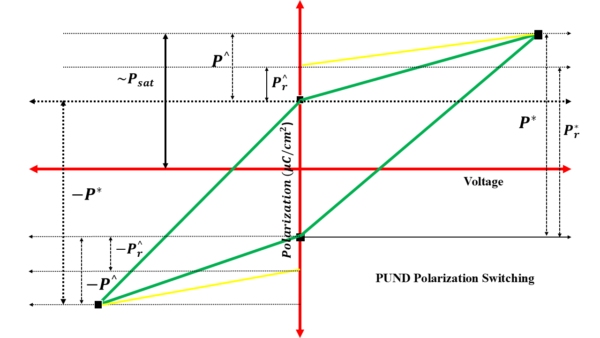
Introduction: Why PUND and Why Now?
In the previous tutorial, we established that conventional ferroelectric measurement — standard P-E hysteresis loop the standard P-E hysteresis loop — can misrepresent the true ferroelectric behaviour of a material. Artefacts arising from leakage currents, dielectric displacement, and parasitic capacitance can produce loop shapes that mimic ferroelectricity even in non-ferroelectric materials. This is a serious scientific problem, particularly in emerging thin film and polymer ferroelectrics where leakage currents are often non-negligible.
This is precisely where PUND — Positive-Up Negative-Down — enters as the definitive solution. PUND is a pulse-based measurement technique that separates the true ferroelectric switching response from all non-switching contributions in the time domain. Rather than relying on loop shape alone, PUND directly subtracts the non-switching current from the total measured current, leaving only the intrinsic domain-switching polarization.
If you are just beginning in ferroelectric research, PUND might appear complex at first encounter. This beginner's manual will walk you through the complete theory, setup, and step-by-step procedure in a clear and accessible manner. Whether you are a student performing your first characterisation experiment, a research scholar validating new materials, or simply curious about advanced material characterisation techniques, this guide is designed to make you confident and hands-on with PUND.
PUND has become increasingly critical with the rapid rise of new-generation ferroelectric materials. Hafnium zirconium oxide (HZO) — now at the centre of next-generation non-volatile memory and FeFET devices — requires PUND to separate its genuine ferroelectric switching from competing non-polar phase contributions. Similarly, 2D sliding ferroelectrics (hBN, MoS₂, graphene heterostructures) and organic polymer ferroelectrics (PVDF-based) all depend on PUND for reliable polarisation quantification. The technique's importance has only grown with the field.
Key Advantages of PUND Over Conventional P-E Measurement
The advantages of PUND analysis over conventional ferroelectric measurements — such as simple P-E hysteresis loops — are significant and well-established in the literature. Let us examine each advantage carefully:
- Eliminates leakage current contributions: Ohmic leakage is a non-switching phenomenon — it appears equally in both the switching (P) pulse and the non-switching (U) pulse. Subtraction removes it completely.
- Removes dielectric displacement effects: The linear dielectric displacement current (ε₀εᵣ dE/dt) is identical in both P and U pulses, so it cancels perfectly in the PUND subtraction.
- Accounts for parasitic capacitance: Any capacitive contribution from the measurement circuit, contact resistance, or interfacial layers is common to both pulses and is eliminated.
- High accuracy in thin films and leaky ferroelectrics: PUND is the only reliable method for characterising materials where the leakage contribution is comparable to or larger than the switching contribution — such as ultrathin HZO films, PVDF-based polymers, and 2D ferroelectrics.
Step-by-Step Guide to PUND Analysis
The following section outlines the complete, systematic procedure for performing PUND analysis. Follow each step carefully to obtain accurate and reproducible results.
Before beginning any measurement, ensure you have all necessary equipment assembled and calibrated.
- Ferroelectric sample with deposited electrodes (e.g., Pt/PZT/Pt, BNT/BiFeO₃/SRO, or PVDF-based polymer films)
- Pulse measurement system: a dedicated precision ferroelectric analyser such as Radiant Technologies Precision Premier , aixACCT TF Analyzer 3000, or Keithley 4200A-SCS with pulse measurement module
- Alternatively: a pulse generator combined with a current integrator (charge amplifier)
- Good electrical contact at all interfaces — no floating or broken connections
- Calibration verified for both voltage and current/charge accuracy
- Shielded probe station or Faraday cage to minimise electromagnetic interference
The quality of your sample directly determines the reliability of your PUND data. The following guidelines apply:
- Use a well-sintered ferroelectric thin film or bulk ceramic with uniform thickness and smooth surface
- For ferroelectric polymer samples (e.g., PVDF, P(VDF-HFP)): sintering is not applicable — these samples are prepared by annealing at specific temperatures determined by the polymer phase diagram
- Electrodes must be carefully deposited — commonly Pt, Au, or Ag — on both top and bottom surfaces to ensure reliable, uniform electrical contact
- Proper electroding is essential: it establishes a stable and uniform electrical interface between the measurement system and the ferroelectric sample, ensuring accurate pulse application and reliable detection of the polarisation response
- Measure sample dimensions (thickness, electrode area) precisely — these values are required to calculate polarisation in units of C/m² or µC/cm²
The accuracy of your polarisation calculation depends critically on the precision of your electrode area measurement. For thin film samples, use optical microscopy or profilometry to determine the electrode area accurately. A 10% error in area translates directly to a 10% error in all polarisation values.
Connect the sample to the ferroelectric tester and configure the pulse parameters carefully:
- Voltage amplitude: Must be chosen based on the breakdown strength of your sample
- Thin films: typically ±5–10 V
- Ceramic bulk samples: typically ±20–30 kV
- Polymer samples: typically ~600–900 kV/cm (convert to voltage using sample thickness)
- Pulse width: Should be long enough for complete domain switching — typically 1 µs to 100 ms depending on the material's switching speed
- Delay between pulses: Typically 1 ms to 10 ms — allows the sample to relax and reach polarisation equilibrium before the next pulse. Too short a delay can cause charge trapping artefacts
- Ensure proper grounding and shielding to minimise noise in the measured current transients
| Material Type | Voltage Range | Electric Field | Pulse Width |
|---|---|---|---|
| PZT thin films | ±3–10 V | ~0.5–2 MV/cm | 1–100 µs |
| HZO thin films | ±1–4 V | ~1–4 MV/cm | 100 ns–10 µs |
| BNT ceramics | ±50–200 V | ~20–80 kV/cm | 1–100 ms |
| PVDF polymer | ±100–3000 V | ~300–900 kV/cm | 10–100 ms |
| 2D ferroelectrics | ±1–5 V | ~0.5–5 MV/cm | 1 ns–1 µs |
PUND is a sequence of five square pulses applied to the sample in a specific order. The sequence begins with a preset pulse, followed by two positive pulses (P and U) and two negative pulses (N and D). Understanding what each pulse measures is the conceptual core of the technique.
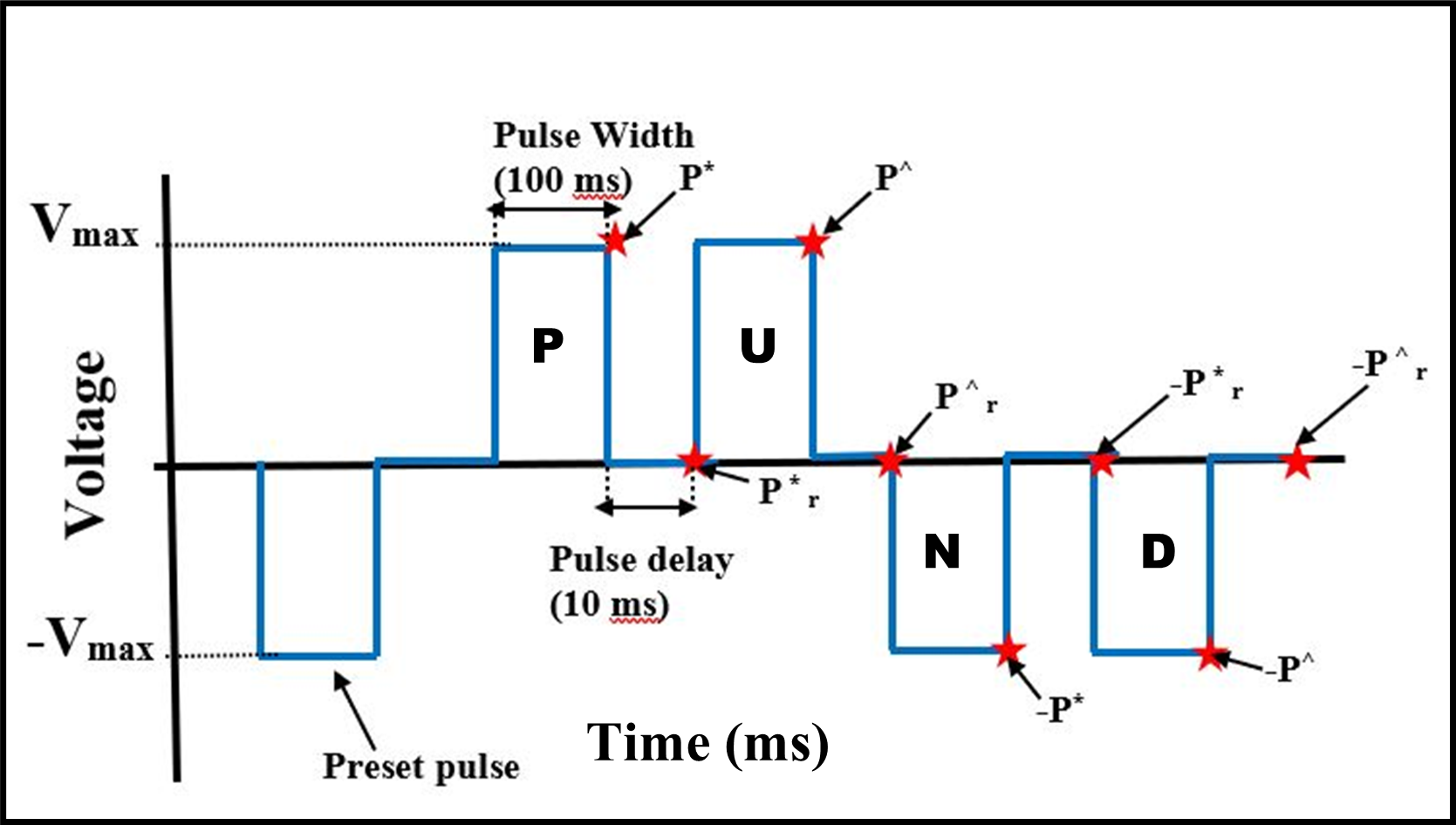
The four measurement pulses — P, U, N, and D — each serve a distinct and irreplaceable purpose:
Applies +Vmax. Measures total polarisation from −Vmax to +Vmax: includes switching polarisation + leakage + dielectric displacement + parasitic capacitance. This is the P* measurement.
Second identical +Vmax pulse. Domains are already aligned — no switching occurs. Measures only non-switching contributions: leakage, interfacial charges, dielectric displacement, parasitic capacitance. This is the P̂ measurement.
Applies −Vmax. Reverses domain polarisation direction. Measures total polarisation in negative direction from +Vmax to −Vmax. This is the −P* measurement.
Second identical −Vmax pulse. Domains already aligned negative — no switching. Measures only non-switching contributions in the negative direction. This is the −P̂ measurement.
Before the four PUND pulses, a preset pulse at −Vmax is applied. This pulse initialises all ferroelectric domains into the negative polarisation state, ensuring a well-defined, reproducible starting condition. No measurement is made during the preset pulse — it only prepares the sample. Without the preset pulse, the initial domain state would be unknown, and the P-pulse switching current would be ambiguous.
About the Square Waveform
Each of the five PUND pulses is applied as a square waveform — a type of periodic signal that alternates abruptly between two fixed voltage levels—typically a high (positive) and a low (negative or zero)—with a constant duration at each level. It is characterized by its sharp transitions, equal time spent in high and low states (for 50% duty cycle), and flat tops and bottoms. Square waveforms are generated using function generators or digital pulse circuits, and they are widely used in electronic testing, digital clocks, and ferroelectric material analysis (like PUND).
Graphically, a square wave appears as a series of horizontal lines at the high and low voltage levels (fig. 2), connected by vertical jumps at regular intervals—forming a pattern that looks like a sequence of squares or steps. The x-axis represents time, while the y-axis shows the voltage amplitude. A square waveform is a type of non-sinusoidal periodic waveform that alternates between two fixed amplitude levels—high and low—with an equal duration spent at each level (in the case of a 50% duty cycle). It is a special case of a rectangular wave and is often used in digital electronics, timing circuits, and signal processing. The waveform alternates between two voltage levels at a fixed frequency. In a digital circuit, this translates to switching between logic 0 and logic 1.The square waveform is the preferred choice in PUND for a very important physical reason: it provides a constant electric field during the entire pulse duration. This means the polarisation has the full pulse width to complete switching, leading to more complete domain reversal and more accurate measurement of saturation polarisation. In contrast, sinusoidal or triangular waveforms have a continuously varying field, so the electric field spends only a brief moment at the peak value — underestimating the true switching polarisation.
- Square wave (PUND): Field is constant at Vmax for the entire pulse width → complete polarisation switching → more accurate P* and Pr* values
- Triangular wave (P-E loop): Field only reaches Vmax for an instant → incomplete switching → underestimated remnant polarisation, artefact-prone loop shapes
- This is why PUND values of dPr are typically higher and more reproducible than Pr measured from conventional P-E loops
The complete PUND sequence produces eight distinct measured parameters, each carrying specific physical information about the ferroelectric and non-ferroelectric contributions to the total measured polarisation.
Case Study: PUND Measurement of P(VDF-HFP) Polymer Thin Film
To make all of the above concrete, let us walk through a complete PUND measurement example using a PVDF-HFP (polyvinylidene fluoride-co-hexafluoropropylene) thin film — a ferroelectric polymer system annealed at 85°C.
- Voltage amplitude: 2700 V
- Applied electric field: 900 kV/cm
- Pulse width: 100 ms
- Delay between pulses: 10 ms
- Electrode area: 90 mm²
- Sample thickness: 30 µm
- Integrator range: nC to µC
During the PUND sequence, measure the polarisation (charge) response at each pulse peak and at zero volts following each pulse. The table below shows the complete dataset for our PVDF-HFP example:
| Pulse Label | Applied Voltage | Parameter | Physical Meaning | Value (mC/m²) |
|---|---|---|---|---|
| Preset | −Vmax | — | Initialise domain state (no measurement) | — |
| P (peak) | +Vmax | P* | Switching + non-switching (remnant + non-remnant) | 10.66 |
| P (zero V) | 0 V | Pr* | Switchable + non-switchable remnant | 4.31 |
| U (peak) | +Vmax | P̂ | Non-switching only (non-remnant) | 8.18 |
| U (zero V) | 0 V | Pr̂ | Non-switchable remnant only | 1.84 |
| N (peak) | −Vmax | −P* | Switching + non-switching in negative direction | −10.86 |
| N (zero V) | 0 V | −Pr* | Switchable + non-switchable remnant (negative) | −4.68 |
| D (peak) | −Vmax | −P̂ | Non-switching only (negative) | −8.08 |
| D (zero V) | 0 V | −Pr̂ | Non-switchable remnant (negative) | −1.82 |
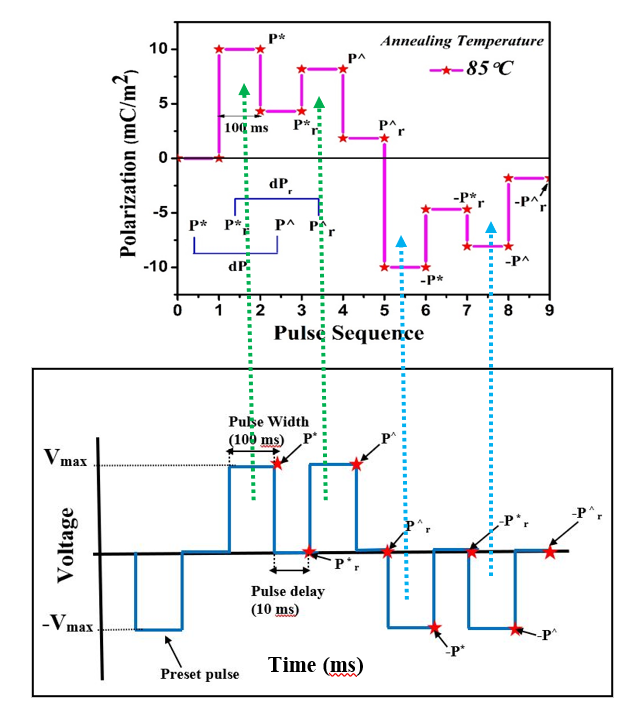
To visualise PUND results, place the pulse sequence number on the x-axis and the corresponding measured polarisation value on the y-axis. Plot using Origin, Python (matplotlib), or any reliable graphing software. The resulting graph clearly shows the stepping between switching and non-switching polarisation levels at each pulse transition.
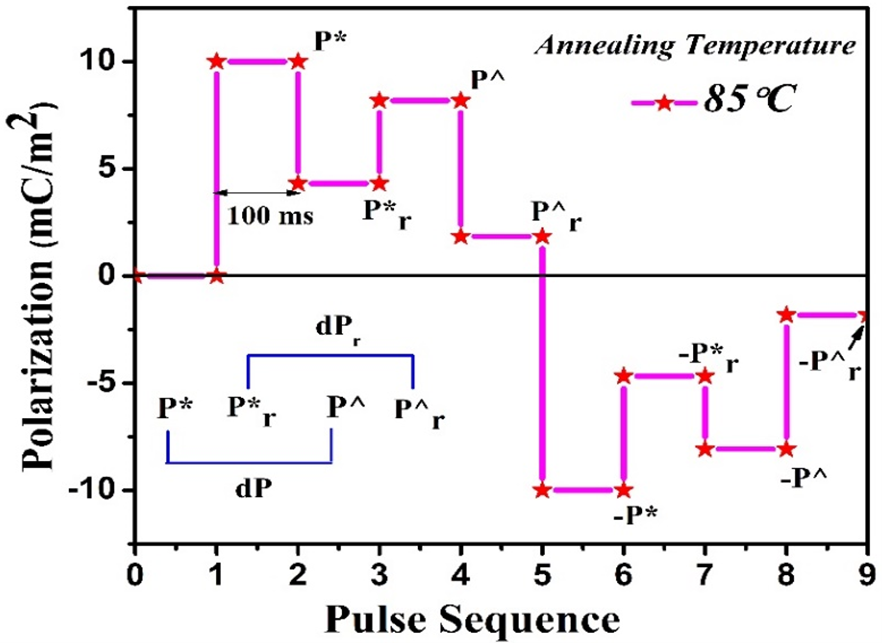
The true switchable (remnant) polarisation is extracted by subtracting the non-switching contribution from the total measured switching polarisation. Two key equations govern this:
dP  = P* − P̂           (Equation 1: switchable polarisation at peak field)
dPr = Pr* − Pr̂          (Equation 2: switchable remnant polarisation at zero field)
Where:
- P* = switchable polarisation + non-switchable polarisation (total at peak)
- P̂ = non-switchable polarisation only (non-remnant)
- Pr* = switchable remnant + non-switchable remnant
- Pr̂ = non-switchable remnant polarisation only
Theoretically, the values of dP and dPr should lie in the same range since both represent the genuine switchable polarisation. However, experimentally they often differ slightly. This difference arises because dP includes non-remnant switching contributions (polarisation that switches but does not persist at zero field), while dPr captures only the true remnant (persistent) switchable polarisation. The dPr value is generally more relevant for memory and actuator applications.
Applying these equations to our PVDF-HFP case study data:
dP  = P* − P̂  = 10.66 − 8.18 = 2.48 mC/m²
dPr = Pr* − Pr̂ = 4.31 − 1.84 = 2.47 mC/m²
| Anneal Temp. | P* (mC/m²) | Pr* | P̂ (mC/m²) | Pr̂ | dP = P*−P̂ | dPr = Pr*−Pr̂ | Switching % |
|---|---|---|---|---|---|---|---|
| 85°C | 10.66 | 4.31 | 8.18 | 1.84 | 2.48 | 2.47 | ~23% |
Step 8b: Interpretation of Results
Once dP and dPr are calculated, interpretation is guided by the following rules:
- Large dP and dPr: Confirms genuine ferroelectric switching — true domain reversal is occurring
- Small or near-zero dP: Suggests leakage-dominated or non-ferroelectric behaviour — P* ≈ P̂ means the material is not truly switching
- dP ≈ dPr: Healthy ferroelectric — the switchable polarisation is predominantly remnant (persists at zero field)
- dP ≫ dPr: Significant non-remnant switching — domains switch during the pulse but relax back towards zero; common in weak or fatigued ferroelectrics
In a PUND test, the polarisation from non-switching pulses (Pr̂ and −Pr̂) does not return to zero after the field is removed. This is physically significant: these residual values arise from leakage currents, capacitive effects, or interfacial charges — none of which are reversible intrinsic dipole effects. They represent the non-ferroelectric baseline of your measurement system and sample. A large Pr̂ relative to Pr* is a red flag indicating significant non-ferroelectric contamination of your measurement.
- Use a short delay between pulses to avoid charge trapping effects — but not so short that the sample cannot relax
- Repeat the PUND cycle several times (typically 5–10) to assess fatigue, degradation, or measurement drift
- Test under different temperatures to understand thermal activation of switching
- Test under different pulse widths to verify that polarisation values have saturated (no further increase with longer pulses)
- Always report dPr (not raw P* or Pr*) as the genuine switchable remnant polarisation in publications
Why PUND Is Scientifically Superior to P-E Loop Measurement
PUND's scientific superiority lies in its fundamental approach: it operates in the time domain, exploiting the fact that ferroelectric domain switching and non-ferroelectric responses have intrinsically different temporal characteristics.
When a ferroelectric domain switches direction under an applied pulse, it generates a sharp, transient current concentrated at the moment of domain wall motion — the polarisation reversal current. In contrast, dielectric displacement currents are proportional to dE/dt (zero during the flat top of a square pulse) and leakage currents are slow, continuous, and present throughout the entire pulse duration.
By applying an identical second pulse (U after P, D after N), PUND captures the non-switching response in isolation. Subtracting this from the first pulse response eliminates all non-domain-related currents with precision. This is fundamentally impossible in a conventional P-E loop measurement, which integrates all current contributions together without separation.
| Feature | P-E Hysteresis Loop | PUND Technique |
|---|---|---|
| Waveform type | Sinusoidal or triangular | Square pulses |
| Leakage separation | No — included in loop | Yes — fully subtracted |
| Dielectric displacement | No — contributes to loop width | Yes — cancelled by subtraction |
| Parasitic capacitance | Not eliminated | Eliminated in subtraction |
| Accuracy in leaky films | Poor — loop inflated by artefacts | Excellent — true dPr extracted |
| Required for publication | Standard overview | Mandatory for ferroelectric verification |
| Equipment complexity | Lower | Higher (pulse precision required) |
Latest Applications of PUND in Emerging Materials (2024–2026)
PUND has undergone significant development and broadening of application scope in the past two years. Understanding these emerging applications positions you at the frontier of ferroelectric research.
1. Hafnium Zirconium Oxide (HZO) — The Silicon-Compatible Ferroelectric
HZO (Hf₀.₅Zr₀.₅O₂) has emerged as arguably the most important ferroelectric material for semiconductor memory applications due to its CMOS compatibility and scalability to sub-10 nm thicknesses. PUND is now the mandatory validation technique for HZO ferroelectricity, as the material contains competing crystal phases (monoclinic, tetragonal, orthorhombic) and only the non-centrosymmetric orthorhombic phase (Pca2₁) is genuinely ferroelectric.
HZO superlattice structures have been shown to maintain high remnant polarisation values even after non-ferroelectric contributions are excluded by PUND, demonstrating excellent intrinsic ferroelectric performance. Recent studies using PUND on TiN/HZO/TiN capacitors have shown that increasing deposition temperature from 200°C to 300°C increases the 2Pr value by 25%, from 30.2 to 37.8 µC/cm², as measured by PUND pulse schemes at 1 kHz.
2. Nano-PUND and STEM-EBIC Combined Imaging
A powerful new approach called Nano-PUND improves the technique's dynamic range by injecting a current calibrated to cancel linear charging currents due to stray capacitance, addressing a key limitation of conventional PUND in nanoscale devices. When combined with scanning transmission electron microscope (STEM) electron beam-induced current (EBIC) imaging, Nano-PUND can map which specific domains are switching and at what coercive field — providing spatial resolution that conventional transport PUND cannot achieve alone.
3. 2D and Van der Waals Ferroelectrics
PUND-measured polarisation-electric field hysteresis loops have been demonstrated in five-layer hexagonal boron nitride (hBN) devices, confirming ferroelectricity in 2D van der Waals systems where conventional P-E loops would be dominated by leakage artefacts. This represents one of the most challenging applications of PUND — measuring intrinsic ferroelectricity in atomically thin films where the switchable polarisation signal is orders of magnitude smaller than in conventional ferroelectrics.
- HZO and doped HfO₂: FeRAM, FeFET, ferroelectric tunnel junctions (FTJ) — CMOS-compatible memory
- 2D sliding ferroelectrics: hBN, MoS₂, bilayer graphene heterostructures — atomically thin switches
- Organic ferroelectrics: PVDF, P(VDF-TrFE), P(VDF-HFP) — flexible electronics and energy harvesting
- BiFeO₃-based multiferroics: Separation of magnetic and ferroelectric switching contributions
- Lead-free ceramics: BNT, KNN, and BZT systems — where leakage is often significant near phase boundaries
Common Mistakes and Troubleshooting
Even experienced researchers encounter problems with PUND measurements. Here are the most frequent issues and their solutions:
| Problem Observed | Likely Cause | Solution |
|---|---|---|
| P* ≈ P̂ (very small dP) | Material is not ferroelectric, or voltage is below coercive field | Increase voltage amplitude; verify sample with PFM first |
| Very large Pr̂ relative to Pr* | High leakage current or strong interfacial charging | Reduce pulse width; check electrode quality; reduce temperature |
| Noisy or irreproducible data | Poor electrical contact or electromagnetic interference | Check probe contacts; use Faraday cage; improve shielding |
| P* varies between cycles | Imprint or fatigue; charge trapping | Increase delay between cycles; perform conditioning cycles first |
| Asymmetric P* and −P* | Internal bias field (built-in potential) | Calculate internal bias as Eint = (Ec+ + Ec−)/2; report separately |
| Sample breakdown during measurement | Voltage amplitude too high | Start from 50% of expected coercive voltage; increase gradually |
Conclusion
PUND analysis stands out as a powerful and scientifically rigorous technique for unambiguously distinguishing genuine ferroelectric switching from experimental artefacts. By carefully following the standardised eight-step procedure outlined in this manual, researchers can confidently assess and validate true ferroelectric behaviour in a wide range of materials — from classic PZT and BNT ceramics to emerging HZO thin films and 2D van der Waals ferroelectrics.
The technique's strength lies not merely in its ability to produce a number (dPr), but in the physical clarity of what that number represents: the polarisation that switches under an applied field, persists at zero field, and is genuinely due to ferroelectric domain reversal — nothing more and nothing less. In an era where the definition of ferroelectricity itself is under rigorous scrutiny in emerging material systems, PUND provides the quantitative foundation that the field demands.
Practice Multiple Choice Questions
- (a) To measure the initial polarisation state of the sample
- (b) To initialise all ferroelectric domains into a known (negative) polarisation state ✔
- (c) To calibrate the voltage amplitude of the measurement system
- (d) To remove charge trapped in the electrodes
- (a) Total switching polarisation in the positive direction
- (b) Non-switching contributions only: leakage, dielectric displacement, parasitic capacitance ✔
- (c) The remanent polarisation after domain switching
- (d) The coercive field of the ferroelectric sample
- (a) dPr = P* + P̂
- (b) dPr = Pr* − Pr̂ ✔
- (c) dPr = P* / Pr*
- (d) dPr = P̂ − Pr̂
- (a) Square waves are easier to generate electronically
- (b) Sinusoidal waves cause sample breakdown at high frequencies
- (c) Square waves provide constant electric field during the entire pulse, allowing complete polarisation switching ✔
- (d) Square waves eliminate the need for a preset pulse
- (a) Excellent ferroelectric switching with minimal leakage
- (b) The material is not genuinely ferroelectric, or the applied voltage is below the coercive field ✔
- (c) The preset pulse was applied incorrectly
- (d) The measurement delay between pulses was too long
- (a) Classical PZT bulk ceramics with low leakage
- (b) Hafnium zirconium oxide (HZO) thin films for FeRAM and FeFET ✔
- (c) Single-crystal BaTiO₃ at room temperature
- (d) Standard SrTiO₃ dielectric layers
- (a) Very strong genuine ferroelectric switching
- (b) Significant leakage current or interfacial charge contribution contaminating the measurement ✔
- (c) High coercive field in the material
- (d) The sample has been fully poled
- (a) 4
- (b) 5 ✔ — preset + P + U + N + D
- (c) 6
- (d) 8
Key Takeaways
- PUND DEFINITION: Positive-Up Negative-Down — a 5-pulse square-wave sequence that separates genuine ferroelectric switching from leakage, dielectric, and capacitive artefacts.
- PRESET PULSE: Applied first at −Vmax to initialise all domains into a known state. No measurement is made from this pulse.
- P AND U PULSES: Both positive at +Vmax. P = switching + non-switching (P*). U = non-switching only (P̂). Subtraction gives true dP.
- N AND D PULSES: Both negative at −Vmax. N = switching + non-switching (−P*). D = non-switching only (−P̂). Confirms symmetry of ferroelectric response.
- EIGHT PARAMETERS: P*, Pr*, P̂, Pr̂, −P*, −Pr*, −P̂, −Pr̂ — fully describing the ferroelectric and non-ferroelectric polarisation in both directions.
- KEY EQUATIONS: dP = P* − P̂ (switchable polarisation). dPr = Pr* − Pr̂ (switchable remnant polarisation). These are the gold-standard values to report.
- SQUARE WAVEFORM: Preferred because it maintains constant E-field during the pulse, ensuring complete domain switching and accurate P* values.
- SUPERIORITY OVER P-E LOOP: PUND eliminates leakage current, dielectric displacement, and parasitic capacitance contributions — none of which are separated by conventional P-E loops.
- EMERGING APPLICATIONS: Now essential for HZO thin films (FeRAM/FeFET), 2D van der Waals ferroelectrics (hBN, MoS₂), and polymer ferroelectrics (PVDF-based systems).
- TROUBLESHOOTING: Large Pr̂ signals high leakage. P* ≈ P̂ signals non-ferroelectric behaviour. Asymmetric results indicate internal bias fields.
Glossary
- P*
- Switching + non-switching polarisation; contains both remnant and non-remnant components. Measured at peak of the first positive (P) pulse.
- Pr*
- Switchable remnant + non-switchable remnant polarisation. Measured at zero volts after the P pulse.
- P̂ (P-hat)
- Non-switching polarisation containing only non-remnant components (leakage, dielectric displacement, capacitive effects). Measured at peak of the U pulse.
- Pr̂ (Pr-hat)
- Non-switchable remnant polarisation. Measured at zero volts after the U pulse.
- dP
- True switchable polarisation = P* − P̂. Represents genuine ferroelectric domain reversal contribution at the peak applied field.
- dPr
- True switchable remnant polarisation = Pr* − Pr̂. The gold-standard metric for ferroelectric characterisation in publication-quality research.
- −P*, −Pr*, −P̂, −Pr̂
- Mirror parameters in the negative field direction, measured from the N and D pulses respectively.
- Preset pulse
- The initial −Vmax pulse applied before the PUND sequence to initialise all domains into the negative state. No measurement is made.
- Coercive field (Ec)
- The electric field magnitude at which the ferroelectric polarisation passes through zero during switching. Determines the minimum Vmax needed for complete switching.
- Internal bias field (Eint)
- An asymmetry in the coercive field between positive and negative directions, indicating built-in electric fields from imprint, defect asymmetry, or interface charges.
References
- Ferrodevices, Main Vision Manual IV: Tutorials. Vision software user manual. [Online]. Available: ferrodevices.com (accessed Nov. 2025).
- R. Verma and S. K. Rout, "Influence of annealing temperature on the existence of polar domain in uniaxially stretched polyvinylidene-co-hexafluoropropylene for energy harvesting applications," J. Appl. Phys., vol. 128, no. 23, Art. no. 234104, Dec. 2020, doi: 10.1063/5.0022463.
- R. Verma and S. K. Rout, "Frequency-dependent ferro–antiferro phase transition and internal bias field influenced piezoelectric response of donor and acceptor doped bismuth sodium titanate ceramics," J. Appl. Phys., vol. 126, no. 9, Art. no. 094103, Sep. 2019, doi: 10.1063/1.5111505.
- R. Verma and S. K. Rout, "The Mystery of Dimensional Effects in Ferroelectricity," in Recent Advances in Multifunctional Perovskite Materials, P. Sharma and A. Kumar, Eds. London, U.K.: IntechOpen, 2022, doi: 10.5772/intechopen.104435.
- H. L. Chan et al., "Nano-PUND and STEM EBIC Imaging for Ferroelectric Polarization Mapping," Microscopy and Microanalysis, vol. 30, Supplement 1, July 2024, doi: 10.1093/mam/ozae044.074.
- Nature Communications (2025): "Enhancing ferroelectric stability: wide-range adaptive control in epitaxial HfO₂/ZrO₂ superlattices," doi: 10.1038/s41467-025-61758-2.
- ACS Applied Materials & Interfaces (2025): "Temperature-Dependent {111}-Texture Transfer to Hf₀.₅Zr₀.₅O₂ Films and Its Impact on Ferroelectricity," doi: 10.1021/acsami.4c17978.

26.5 g · waterproof to 10 m
If the rest of this list is about tracking what you did, WHOOP is the one that tells you whether your body is actually ready to do it again. It has no screen and no notifications — you wear it through the gym, the commute and the shower, and the answer is waiting in the app when you wake up.
Two full weeks per charge — and the wireless PowerPack clips on so you never have to take the band off.

2 thoughts on “How to Perform PUND Measurements — A Beginner’s Lab Manual”
Hello Ma’am. I have been trying P-E loop measurement on my sample (thin films), but the loops i have obtained (majorly the loop is broken) shows exceptionally high polarization values (2000-2500 microC/cm2). I have done PUND measurement the remnant polarization I have obtained is around 3-4 microC/cm2. I am trying to optimize the sample to get a proper loop with reasonable polarization values. But so far I am not able to obtain a proper data. Any suggestion from you will be highly appreciable.
I am using Radiant technologies, i have prepared samples with spin coating with thickness of 40-50 nm on ITO substrate, I am using Gallium indium eutectic as my bottom and top electrodes.
Hello Payal,
Thank you for your detailed and thoughtful question. This is a very common—and important—issue in thin-film ferroelectric measurements, and you are absolutely right to cross-validate P–E loop data with PUND analysis.
Based on your description, the exceptionally high polarization values obtained from the P–E loops (~2000–2500 µC/cm²) are not physically realistic for ferroelectric thin films. Such values strongly indicate that the measured loop is dominated by non-switching contributions, including leakage current, capacitive charging, and electrode-related effects. In contrast, the remnant polarization obtained from your PUND measurement (~3–4 µC/cm²) is far more reasonable and should be considered a much closer representation of the intrinsic ferroelectric response of your film.
A few important points to consider while optimizing your measurements:
1. In very thin films (≈40–50 nm), distorted or broken P–E loops are commonly observed due to a combination of high leakage current, imperfect electrode interfaces, and non-uniform electric fields.
2. The use of liquid gallium–indium eutectic as both top and bottom electrodes can further complicate the measurement. It has various limitations at the nm scale. Liquid electrodes often introduce unstable contact areas, additional series resistance, and parasitic capacitance. These effects can severely distort P–E loops, even though PUND measurements may still appear relatively cleaner.
3. For ferroelectric films in the 40–50 nm thickness range, solid electrodes are strongly recommended if your goal is to extract meaningful polarization values. Liquid Ga–In can be useful as a preliminary or temporary contact, but it should not be relied upon for final conclusions. However, proceed carefully, just remember that ITO is not a perfect metal, so interface effects must be interpreted carefully, not ignored.
4. At this stage, the PUND result should be treated as the more reliable indicator of ferroelectric switching. A low PUND polarization combined with an inflated P–E loop almost always signifies that the loop is leakage-dominated rather than polarization-dominated.
5. Before attempting further loop optimization, focus on reducing leakage. This may involve lowering the applied electric field, optimizing the measurement frequency, or improving film quality through suitable annealing (if compatible with your material system).
• During optimization, it is crucial to apply the electric field gradually rather than sweeping directly to a high field. Increasing the field step-by-step—from a low value toward saturation or breakdown—helps clearly identify the onset of switching, leakage, or dielectric failure, and avoids artificial loop distortion caused by sudden high-field stressing.
• Measurements should also be performed at a sufficiently low frequency appropriate for your material system. If the frequency is too high, leakage and capacitive currents can dominate the response, especially in ultrathin films, leading to exaggerated polarization values. Joint optimization of frequency and field amplitude is therefore essential.
• Finally, it is important to remember that for many thin-film ferroelectrics—particularly at nm-scale thicknesses—a perfectly “textbook-like” P–E loop is not always achievable. In such cases, PUND analysis becomes essential and is often preferred in research publications for reporting reliable remnant polarization values.
You are approaching this problem in exactly the right way by comparing P–E and PUND results. I encourage you to continue focusing on leakage suppression and interface optimization, and to rely more strongly on PUND data for intrinsic polarization assessment.
I hope this clarifies your observations. Please feel free to share further results if you would like to discuss them.
Best regards,
Dr. Rolly Verma
Advance Materials Lab